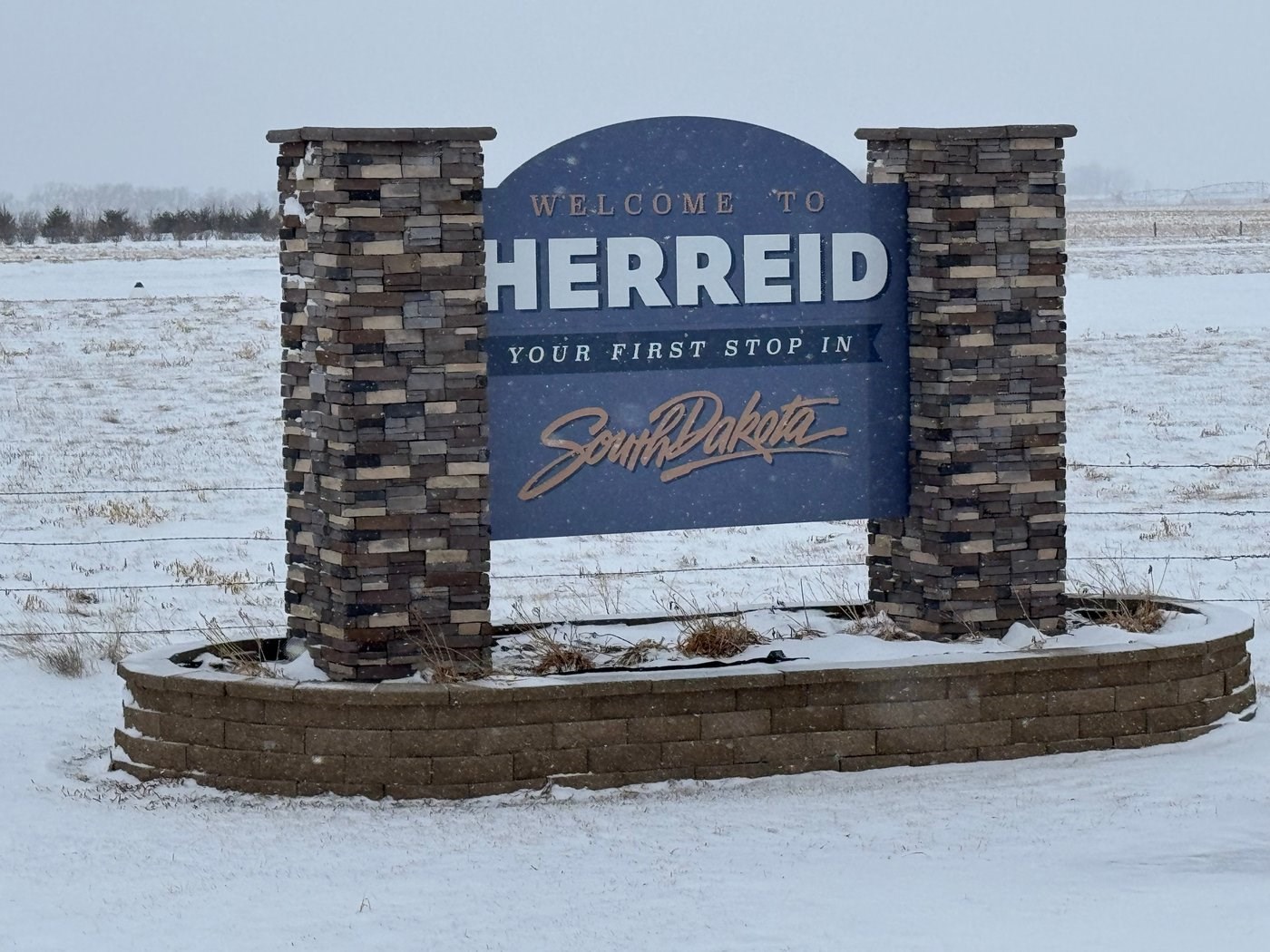
A sign welcomes people to Herreid, S.D., on Feb. 3, 2026. (Bart Pfankuch/South Dakota News Watch via AP)
March 23, 2026 - 12:56 PM
Dick Werner drives his pickup through the streets of this northern South Dakota town and can hardly go a block before stopping to point out new houses or apartments that have popped up in the past few years.
To be sure, the journey doesn’t last long because the agricultural outpost of Herreid – located 7 miles south of the North Dakota border – only has about 400 residents and just a few streets that splinter off U.S. Highway 83, the main drag through town.
And yet, Werner’s excitement is palpable as he shares the stories of how he and other local leaders have spurred a rebirth of the ranching and outdoor recreation town’s population and economy by adding new housing, new municipal amenities and new businesses.
Werner, 68, is a retired banking executive who served in the state Legislature and on the Beadle County Commission before taking on a volunteer role as president of Herreid Area Housing Development (HAHD.)
He grew up in Herried but spent adulthood elsewhere, returning to his hometown in 2016 to find the local grocery store shuttered and the school population at 109, just above the threshold where state law requires dissolution of the school and assimilation into a larger nearby district.
“If you lose your school and your grocery store, your town is in trouble,” Werner said.
Herreid’s population peaked in 1960 at 767 people and has been on the decline since, falling to 416 in 2020, according to the U.S. Census. School enrollment followed suit as the population grew older and fewer families with children made Herreid their home.
Since returning, Werner has played a key role in finding the money and providing the expertise to begin rebuilding the housing stock in Herreid, a critical first step in attracting families and workers who form the backbone of the future for any small town in South Dakota.
“We were really hurting for homes because without places to live, there’s no way people can move here to work or raise a family,” he said.
Response: Grants and local donors drive growth
As with many small, remote South Dakota communities, Herreid is not a target for privately funded housing projects, largely because profit margins for developers are too narrow and it is difficult for them to get materials and skilled workers.
Instead, Herreid has turned to a unique funding model to find money for new homes and apartments.
Over the past decade, Werner has obtained $2.2 million in grants to help pay for land, materials and construction for development of new housing, for rehabilitation of existing homes and businesses, and for municipal projects including a pool, playground and sports complex.
The list of funders is varied and includes among others the South Dakota Housing Authority, U.S. Department of Agriculture Rural Development, the Land, Water and Conservation Fund, Grow South Dakota, the South Dakota Community Foundation, Wellmark Foundation, WEB Water, CoBank, MDU Resources, Campbell County Bank, Federal Home Loan Banks, and Homes Are Possible Inc. in Aberdeen.
Meanwhile, the HAHD created another pool of about $180,000 in available funds by soliciting loans from 30 local residents who were committed to supporting future growth. The group also raised more than $250,000 from fundraising events, including $200,000 from a Queen of Diamonds raffle program held in a local tavern.
“You just have to know where to get the money,” Werner said. “You’ve got to have connections and partnerships, but it’s important to know that there are resources across the state to help your community.”
Evidence: New homes, apartments in Herreid
Successful projects have followed the funding.
HAHD has developed five speculative homes that were sold before completion and brought 25 new residents to town. It has helped new residents pay for single-family and twin homes through the state Governor’s House program, in which houses are built by prison inmates.
HAHD has acquired 16 apartment units that are fully occupied. Its next proposed project is construction of a new three-unit apartment building for which Werner just landed $700,000 in grants. The organization has also helped pay for improvements to 18 existing homes.
The HAHD is now trying to sell and support development of single-family homes on eight lots just north of downtown that are already served by sewer and water lines. The group is selling the full-size lots for only $7,000 and can provide assistance to buyers to keep their construction and mortgage costs low, Werner said.
“We want to get people into homes, to own them and have pride of ownership,” Werner said.
Insights: Economic growth follows housing
If housing is the platform that enables growth in a community, economic development is the resulting engine that can propel forward prosperity for individuals and families.
Through a team effort among town leaders, engaged local residents, the HAHD and the Herreid Economic Development Corp., the town has seen positive growth on several fronts in recent years.
Melinda Neeley, president of the development corporation, said expansion of housing in Herreid has set the stage for arrival of new businesses and residents that have stabilized the local economy.
Even with only 400 people, Herreid now boasts a thriving grocery store, medical clinic, pharmacy, bank, day care, livestock yard, diesel repair shop, and hardware and feed store.
Tax money, grants and local donations were used to help pay for a $200,000 sports complex, a $145,000 upgrade of a downtown playground, and a $1.1 million municipal pool upgrade as well a $20,000 addition of local pickleball courts.
The local K-12 public school just completed a $4 million addition and renovation project.
“I feel like we’re on an upward trajectory,” Neeley told News Watch. “It takes the help of people from all of these different groups to not just maintain what we have but to grow the services we have here.”
Moreover, the slow but steady rebuilding of the local economy has attracted or strengthened employers that are providing good jobs — including the Pig Improvement Co., Agtegra Cooperative, and a host of area ranchers and farmers as well as agricultural supply and trucking companies, Neeley said.
The volunteer economic development group owns several land lots in town that it has made available for development at low cost, Neeley said. The group also owns a few buildings downtown that it is able to rent at reasonable rates, lowering the entry and ongoing costs of businesses that want to make a go of it.
Additionally, the group has taken steps to create succession plans for business owners who plan to retire or leave town, Neeley said. The organization tries to provide affordable rent and other assistance to increase viability of new businesses or for businesses with new ownership.
“If they had to purchase the building, the cost would be much greater,” she said. “The loss of a single business could make a huge impact on our sales tax collection and the housing progress we’ve made.”
Limitations: Positive signs but work to do
Kayla and Preston Huber moved to Herreid seven years ago, and even though Kayla is a nurse, she jumped headlong into entrepreneurship by opening a grocery store called Fresh Start Market.
When she arrived, Herreid did not have a grocery store, and food options were limited within a drivable distance.
She and her husband downsized into a double-wide trailer house that they renovated because housing options were almost non-existent when they arrived.
“We got lucky when we moved back because there weren’t many options (for housing),” she said.
Huber said she has had great success and attributes some of that to efforts to generate new housing in town. “As a business owner, it’s definitely great to see,” she said.
And yet, she sees more opportunity for community growth if more housing can be developed.
“More people want to get out of cities and big-city life, and this is a great place to raise a family,” she said. “We’ve had some younger couples move back, and I know a few more that would move back if there were more places to live.”
Werner predicts that Herreid’s population will show a jump in the 2030 census, which would be the first increase in 70 years. Werner has also done calculations that he said show enrollment in the Herreid school will rise to about 150 in the next four years.
Some of the population growth has come from about 40 Hispanic residents who are in South Dakota on three-year federal work visas, some of whom have purchased homes in Herreid. The town has also attracted several Hutterite families who have moved to town in recent years, Werner said.
“If you’re in small, rural communities in South Dakota, and you’re not willing to accept diversity, you’re not going to grow because the Norwegians, Swedes, Germans and Polish are done coming here,” he said.
Werner said there’s no “special sauce” to generating growth in rural areas but that it does require an individual or a group to step up and get things started. But he cautions that it takes perseverance to keep the momentum and an ability to ignore the doubters.
“Housing development is a marathon, not a sprint, and you’ve got to have people who are committed,” he said. “There’s been all these naysayers out there on all these projects, but once they see the results, the naysayers all go away.”
During the drive around Herreid in February, Werner said that all the time and effort he has put into promoting housing and economic growth in his hometown have been well worth it.
“Probably the toughest thing you can do is to develop a property,” he said. “I’ve run banks, groups of banks and managed dozens of employees, and this is the toughest thing I’ve ever done. But it’s also the most rewarding.”
___
This story was originally published by South Dakota News Watch and distributed through a partnership with The Associated Press.
News from © The Associated Press, 2026