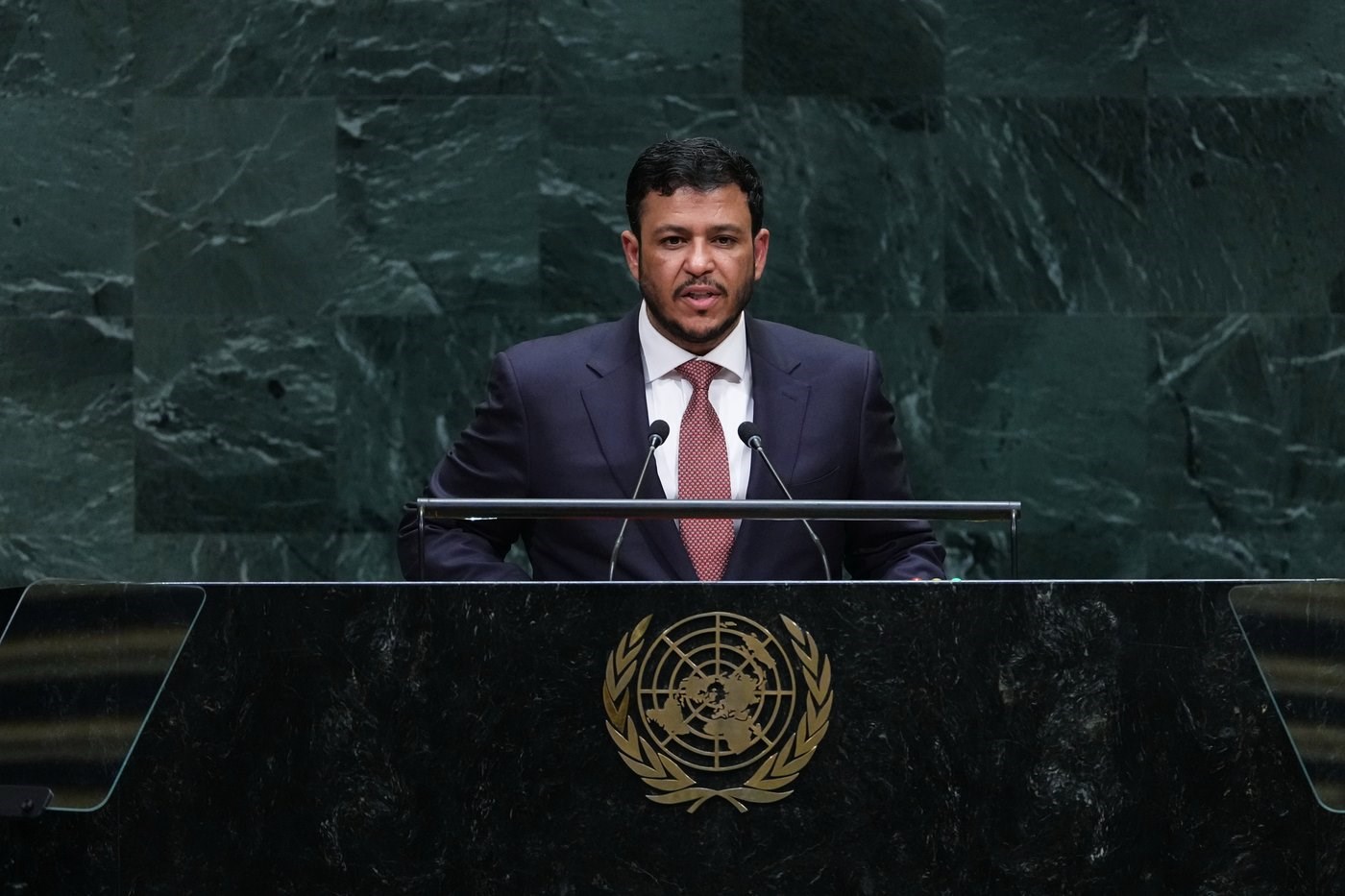
Yemen Vice President Abdullah Abdulkader Al Alimi-Bawzer addresses the 81st session of the United Nations General Assembly at U.N. headquarters Thursday, Sept. 24, 2026. (AP Photo/Frank Franklin II)
Republished September 24, 2026 - 10:23 PM
Original Publication Date September 24, 2026 - 5:46 AM
UNITED NATIONS (AP) — Yemen's internationally recognized government pressed world leaders anew Thursday for help defeating the Iran-backed Houthi rebels, saying that their new perch along one of the world's busiest waterways presents an international economic risk.
The Houthis — who have controlled Yemen's capital, Sanaa, and much of the country's north for over a decade — stormed down Yemen's coast this month and seized the crucial port city of Mokha and key Red Sea islands. That gives them better surveillance of ships passing through the Bab el-Mandeb Strait, at the sea's southern end. About 12% of the world’s trade usually passes through the waterway.
The rebels have declared a blockade on Saudi shipping. While asserting there's no other threat to commercial shipping on the Red Sea, they have warned other nations not to get involved.
But the vice president of the internationally recognized government council urged world leaders at the U.N. General Assembly not to trust the Houthis' assurances — and to see a bigger picture in the strife around the strait.
“The Houthi militias' use of the safety of navigation as a tool for blackmail threatens not only Yemen. It is taking hostage the entire global economy,” said the vice president, Abdullah Abdulkader al Alimi-Bawzer.
Yemeni VP says weapons, technology should be kept from rebels' hands
Arguing that protecting the strait “is the responsibility of every economy that depends on secure supply chains, energy security and freedom of navigation,” he urged the international community to keep weapons and technology from getting into the rebels' hands.
For years, the U.N. Security Council has imposed an arms embargo on the Houthis and an asset freeze and travel ban on their leaders and top officials.
Iran denies arming the Houthis, but smuggled Iranian weapons and parts have been seized from numerous shipments bound for Yemen, and a report by U.N. experts in 2024 documented extensive military ties between the Houthis, Iran and its other allies. Al Alimi-Bawzer contended Thursday that the rebels wouldn't have been able to maintain their position for a dozen years without Iranian weapons, expertise and military technologies.
The Houthis claimed Thursday to have fired dozens of ballistic missiles and drones at Saudi Arabia’s southwestern Jazan province. A Saudi military spokesperson, Maj. Gen. Turki al-Malki, said the kingdom intercepted six ballistic missiles targeting its Red Sea port of Yanbu and the southwestern city of Taif, blaming the Houthis.
His statement followed alerts by Saudi civil defense authorities, who later noted the danger had passed.
Fighting risks full-scale return to civil war
In Yemen, the latest fighting risks a full-scale return to the civil war that killed more than 150,000 people and forced millions from their homes. Already, nearly 130,000 people have been newly displaced and hundreds killed, and a humanitarian crisis is deepening in the Arab world’s poorest country.
The fighting near the crucial Red Sea shipping corridor and the Houthis' pursuit of a blockade of Saudi Arabia, the world’s top oil exporter, also have worried global markets. The Bab el-Mandeb Strait has become all the more crucial since Iran has asserted control over the even busier Strait of Hormuz, off its coast, since the U.S. and Israel attacked the Islamic Republic in February.
After the Houthis overran Sanaa and northern parts of Yemen in 2014, Saudi Arabia formed a military coalition to intervene on behalf of the Yemeni government. But the fighting wore on, and the Houthis endured.
A truce took hold in 2022. But after the Israel-Hamas war began the next year, the Houthis began attacking Red Sea shipping. The attacks continued until a U.S. bombing campaign in 2025.
Yemeni official thanks Saudis and US
On Thursday, Al Alimi-Bawzer thanked the Saudis and hailed the U.S. for having shown a “decisive approach.”
The Saudis have recently again sought military support from allies, but the U.S. hasn't renewed military involvement. U.S. Secretary of State Marco Rubio has said repeatedly that the U.S. will fulfill its defense commitments to Saudi Arabia but has not specified how.
Saudi Foreign Minister Prince Faisal bin Farhan told reporters at the U.N. on Thursday that his country was “continuing to work with our partners in the U.S. to address the issue of this conflict.”
Despite the Houthis’ latest advances, he suggested his country wasn’t worried about a Houthi takeover in Yemen's south. The Yemeni government, he said, “is very capable of defending the territory it controls."
___
Anna reported from Jerusalem and Khaled from Cairo. Associated Press writer Farnoush Amiri contributed from the United Nations.
News from © The Associated Press, 2026