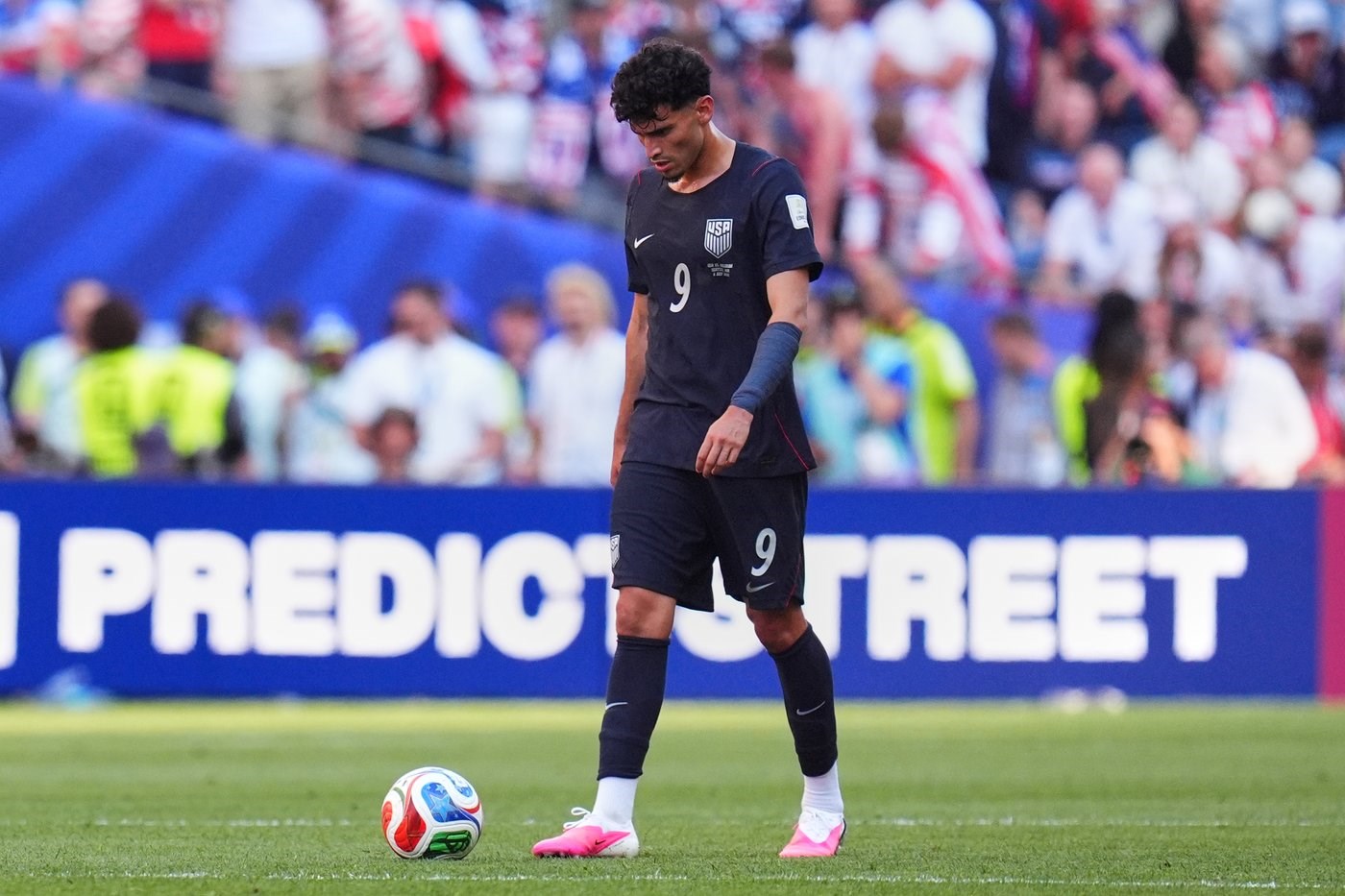
United States' Ricardo Pepi (9) reacts after Belgium scored a goal during the World Cup round of 16 soccer match in Seattle, Monday, July 6, 2026. (AP Photo/Manu Fernandez)
July 18, 2026 - 5:00 AM
In Argentina, one of the greatest honors for a local soccer club might be to produce a player who moves to an even bigger club, then maybe becomes part of the country’s storied national team. In the United States, if a player like that walked into a local soccer program, it would surprise nobody if that program tried to eke every penny out of the player's parents before showing him or her off to the world.
Therein lies one of the crucial differences between a nation of 46 million that plays Spain on Sunday for a fourth World Cup title and another with more than seven times the population that has never sniffed that kind of success.
America’s early departure from the 2026 World Cup raised a question that arises every four years: What would it take to produce a global men's soccer superpower in the United States?
This time around, many of the answers appear to lie in retooling the so-called “pay-for-play” system that permeates youth sports in America. The majority of youth organizations in the U.S. stay in business by developing players for a fee, then keeping them in the program for as long as their family is willing to pay.
Upending this dynamic in soccer won’t happen in four, eight or 12 years. Figuring out how to get better results from it could happen sooner.
“Our strategy should not be to copy and paste what works in another country,” said JT Baston, the CEO of the U.S. Soccer Federation. “It's, how do we, in partnership with the pro clubs, design the right youth pathways here. It looks like the hub-and-spoke model where you're leveraging the best of the professional clubs, leveraging the best of the rest of the ecosystem here and the national team program.”
Soccer is part of a growingly expensive youth sports culture in America
In America, some families shell out up to five figures a year, including team dues, equipment and travel expenses, to place their children in a system with no fewer than seven national oversight bodies and 54 state federations dedicated to youth soccer.
The expenses aren't unique to soccer. Project Play estimated a typical U.S. family paid $1,016 in 2024 to bankroll a child’s primary sport — a 46% increase over five years earlier. For so-called “elite” sports, costs can rise above $12,000 a year.
Players who can’t afford to buy into the so-called “pay-for-play” system sometimes never get on a soccer field.
That’s another ingrained fact of life in the United States, where between 4 million and 6 million kids play soccer but the sport, at its highest level, remains buried behind football and basketball across large swaths of U.S. sports fans’ conscience.
“I’d make the argument that if Erling Haaland was a kid in America, he’d be playing in the NFL right now,” longtime U.S. goalkeeper Kasey Keller said of the Norwegian soccer star who captured the world’s imagination during his team’s run to the quarterfinals.
America's MLS tries to retool the pipeline and replicate the world's club system
If there is any “official” pipeline, it belongs to Major League Soccer, which in 2020 took over the country’s main developmental program after the USSF shut it down due to COVID-related financial strains.
MLS Next this fall will cover around 53,000 players, only a fraction of whom have their training — including physical therapy, travel and equipment — fully subsidized.
The top level of that program, the homegrown division, includes more than 17,000 players: around 3,000 from the academies of the league’s 30 teams (including three in Canada), who play for free, plus players from elite youth clubs outside MLS. The remainder are in the next level down, called the academy division.
MLS Next has established a grant program in which grassroots clubs are paid for developing players who go on to play in America’s top league.
That fledgling system pales in comparison to what exists in Argentina and many countries across Europe and South America.
Soccer in many countries operates in what Rory O'Neill, a Pennsylvania grassroots coach, calls an “open ecosystem.” In that system, thousands of pro and semi-pro clubs across hundreds of leagues, big and small across the globe, are relegated and promoted yearly based on their performance. That relegation system creates a steady need to uncover talent wherever clubs can find it.
Players who come up through the club system can earn a spot on that club’s top team and make that team better. They can also be sold to clubs in bigger leagues, which provides a revenue stream that keeps the system running.
“If you’re not in that ecosystem, you might have a hard time understanding, ‘Well, how could what happens at the professional level have any impact on my son or daughter’s 12-year-old soccer team?’” O’Neill said. “But it has a huge impact. It’s just a very different bar to cross" than in America.
It is also far from nirvana. In addition to the emotional toll taken by the cutthroat nature of constant talent evaluation, Argentina's top clubs have long been accused of exploitation and sex abuse of minors inside their programs.
For one family, ‘Thousands and thousands and thousands of dollars’
Dan Chisesi is a retired salesman in Colorado Springs, Colorado, whose son and daughter, now in their 30s, played through their childhood.
Neither, he said, had huge ambitions of playing beyond high school. Both, he said, have loads of good memories from traveling across the country playing soccer as kids.
He never tallied up the expenses, he said, “but it was thousands and thousands and thousands of dollars.”
He said he often wonders what was missed by spending every weekend, every holiday, every season, “dividing and conquering” with his wife on all the car rides, the banquets, the practices, the plane trips to out-of-town tournaments and other logistics involved in having two kids so deeply enmeshed in a single sport.
Yes, he’d do it all over again. And though he doesn’t care if he ever stands on a field for another youth soccer game again, he’s a soccer fan — wrapped up in the World Cup and a little bummed about America’s inability to play into the final rounds.
“I believe youth sports have become somewhat elitist,” Chisesi said. “I think we’re missing out on a lot of talent because people just can’t afford to do these travel competitive teams. There are some kids out there who aren’t being seen. I don’t know how you fix it.”
A former leader in the sport says there are too many chefs in the kitchen
One person with ideas is Skip Gilbert, a longtime sports executive who last year left U.S. Youth Soccer after five years as its CEO.
Earlier this year — almost expecting this question would bubble up against this summer — Gilbert dusted off and updated his three-year-old essay called “The Future of Youth Soccer. A Call for Structural Change.”
He calls soccer in America, with its five dozen-plus oversight bodies, the most “fractioned” of all youth sports — one that “forces more focus on the cannibalism of players by teams in competing sanctioning bodies over a concerted effort to create the most dynamic player development pipeline in the world.”
His solution is to combine the many organizations under one umbrella (U.S. Soccer), which would, he says, create a strong database that would single out America's top talent all in one place.
His critics say it’s a plan designed to consolidate data and power among the same entities already running soccer. Gilbert thinks it’s a way to break a cycle in which programs compete for players by telling their parents: “We’re going to get your kid a D-I scholarship when they’re 8 years old.”
“And parents, God love all of us, we’re more than happy to write checks if we think it’s going to help our kids,” Gilbert said. “The downside is, there isn’t another pathway. You have to go into that pay-or-play model.”
US leaders try to lean into a unique system and make it better
Brad Sims, the CEO of the NYC Football Club in MLS, tells the story of Seymour Reid, a Jamaican kid in New York who was not playing organized soccer five years ago. A scout on the team saw him in a pickup game, asked what club he was playing for and Reid’s response was: “I don’t play for a club.”
He does now. The 18-year-old signed a contract with NYCFC and was a finalist for the first MLS Pathway Player of the Year award in 2025. Though it’s a success story, Sims wonders how many kids like that are playing around the country “who don’t have the connections or don’t have the finances to play.”
“But this is a bigger problem that’s not on MLS clubs or maybe even the MLS league to try to solve independently,” Sims said. “I think U.S. Soccer obviously wants to figure that out as much as anybody.”
Michael Bradley, a former American national team captain who is now coach of NYCFC’s rival in MLS, the New York Red Bulls, agreed the U.S. has to chart its own way to get in the game with Argentina, Spain and the rest.
“We have our own soccer culture,” he said. “The way the game looks in this country, the way it feels, what we are as a soccer nation, is going to be different than other places, and that’s OK. We don’t need to pretend to be something that we’re not.”
___
https://apnews.com/hub/fifa-world-cup
News from © The Associated Press, 2026