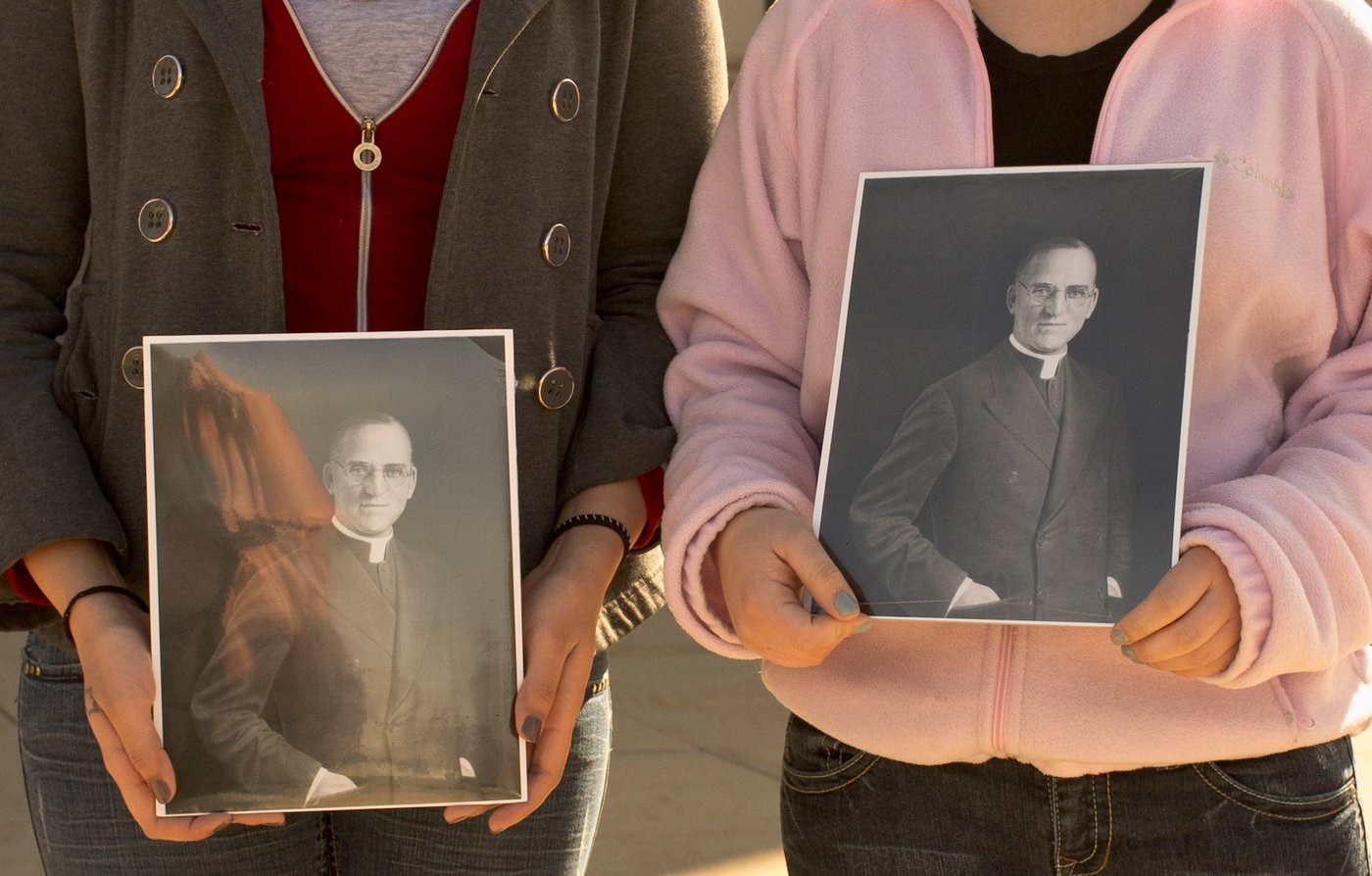
FILE - Boys Town students hold portraits of Boys Town founder Father Edward Flanagan outside St. Cecilia Cathedral in Omaha, Neb., Feb. 27, 2012. (AP Photo/Nati Harnik, File)
March 23, 2026 - 11:55 AM
Pope Leo XIV put the Rev. Edward Joseph Flanagan a step closer to possible sainthood Monday as he proclaimed the “heroic virtues” of the founder of Boys Town, a Nebraska home for at-risk youths that gained national renown and inspired an Oscar-winning biopic performance.
With Leo's proclamation, the priest commonly known as “Father Flanagan” is now officially declared “venerable.” Later steps on a possible path of sainthood would include beatification and ultimately canonization.
Omaha Archbishop Michael McGovern said he is “overjoyed” with the news.
“We continue to pray that he will one day be beatified and ultimately declared a saint,” the archbishop said in a statement. “In the meantime, may we work to affirm the dignity of every person created in God’s image by serving the poor, the abandoned and the vulnerable, especially at-risk youth.”
Flanagan was born in Ballymoe, Ireland, in 1886 and immigrated to the U.S. in 1904. He was ordained a priest in 1912 and began work in the Diocese of Omaha in 1913.
He provided shelter for homeless men, whose stories convinced him that many adult troubles are rooted in broken homes and parental neglect, according to his biography on the website of the Father Flanagan League, a society dedicated to promoting his cause for sainthood.
Flanagan began mentoring boys in the juvenile justice system and established his first home for boys in 1917 in downtown Omaha. In 1921, he bought a farm on the western outskirts of Omaha and began building what became the campus known as Boys Town, still located there in a village of the same name.
By the 1930s, hundreds of boys lived at the site, which included a school and dormitories where boys elected their own mayor, council and commissioners, according to the organization’s website.
Flanagan traveled to postwar Japan to help develop a child welfare program. In 1946, he visited his native Ireland and criticized its system of putting children in industrial schools and reformatories, decrying them as exploitative.
Flanagan died of a heart attack in 1948 at age 61 while visiting Germany. His tomb at Dowd Memorial Chapel in Boys Town displays one of his most famous quotations: “There are no bad boys. There is only bad environment, bad example, bad thinking.”
His work was depicted in the 1938 movie, “Boys Town,” starring Spencer Tracy as a heroic Flanagan and Mickey Rooney as one of the boys in his care. The movie yielded Oscar wins for Tracy (best actor) and for writing (original story).
The Boys Town organization has opened various locations around the country and began admitting girls to its residential programs in 1979.
The Boys Town organization applauded the Vatican announcement in a Facebook post Monday.
Flanagan “believed that children had the right to be valued, to have the basic necessities of life and to be protected,” it said. “His lifesaving work continues across the country today.”
Flanagan is the second U.S. cleric with Midwestern connections to be moved closer to sainthood this year under the pontificate of the Chicago-born Pope Leo. In February, the Vatican approved the beatification ceremony of Archbishop Fulton Sheen in his native Illinois after years of delays.
The Vatican’s Dicastery for the Causes of Saints reviewed a lengthy dossier on Flanagan's life, writings and works. Leo on Monday signed the decree attesting that Flanagan lived a life of heroic virtue. Such a decree doesn’t mean he was free of sin or mistakes, but it means he had a reputation of holiness by living all the Christian virtues in a heroic manner.
The next step toward possible sainthood is beatification. For Flanagan to be beatified, the postulator — the person responsible for advancing the cause — has to find someone who was miraculously healed by praying for Flanagan’s intercession. The process involves vetting by theological and medical experts. If convinced, the dicastery sends the case to the pope, who signs a decree saying the candidate can be beatified.
A second miracle is needed to declare the candidate a saint. Martyrs — people killed for their faith — can be beatified without a miracle. A miracle is needed, however, for martyrs to be canonized.
A pope can also bypass the miracle requirements in declaring a saint, as Pope Francis did on occasion during his 12-year papacy. Francis canonized St. Junipero Serra during a 2015 Washington, D.C., visit even though the Vatican hadn’t confirmed a second miracle attributed to his intercession.
___
Associated Press religion coverage receives support through the AP’s collaboration with The Conversation US, with funding from Lilly Endowment Inc. The AP is solely responsible for this content.
News from © The Associated Press, 2026