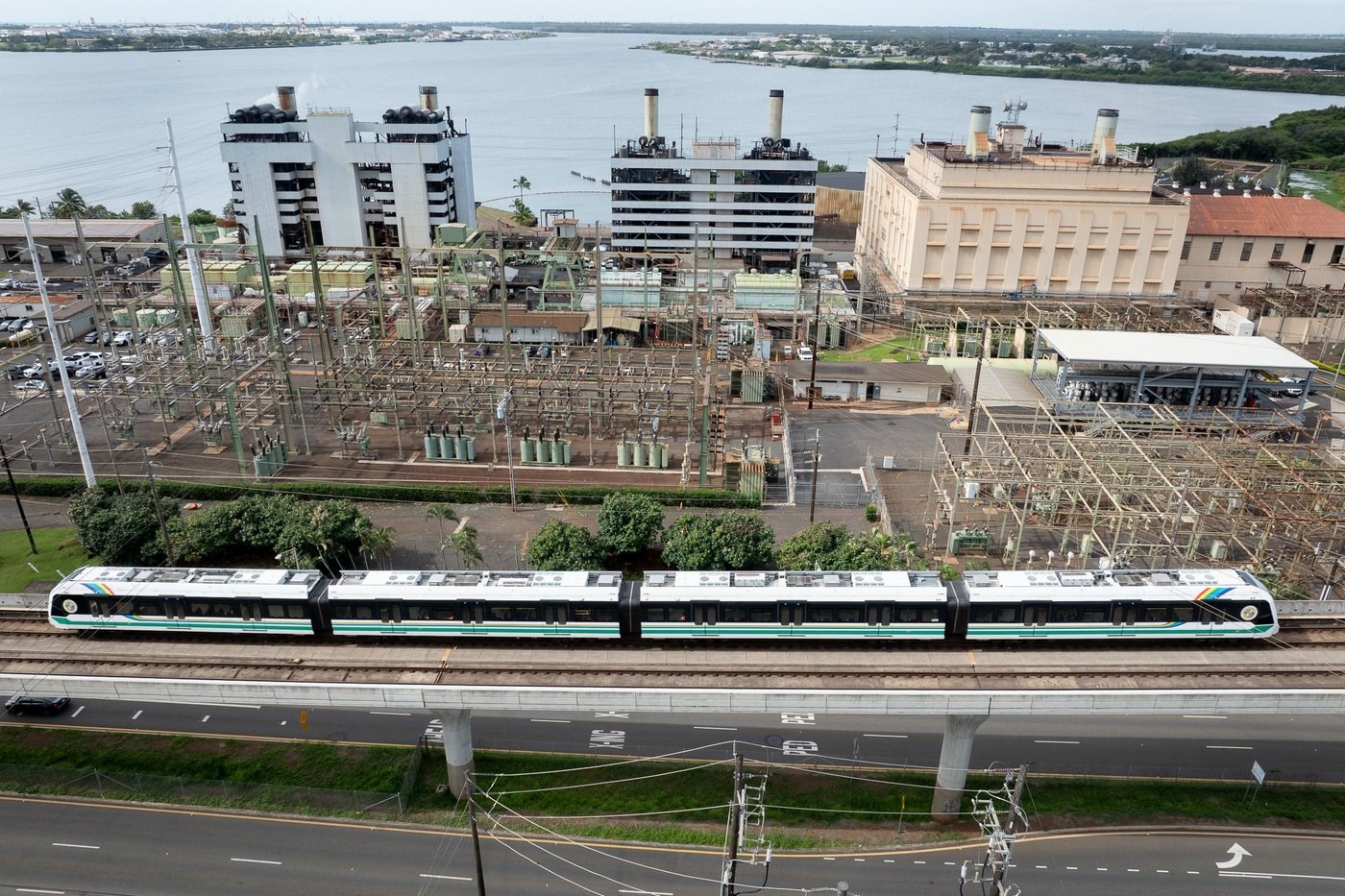
Needs copyright confirmation - A Skyline train passes in front of the Waiau Power Plant on Thursday, April 2, 2026, in Pearl City, Hawaii. (Craig Fujii/Honolulu Civil Beat via AP)
Republished April 14, 2026 - 2:24 PM
Original Publication Date April 14, 2026 - 12:11 PM
Last month, it looked like the only thing standing in the way of Hawaiian Electric Co., Inc.’s proposed $1.15 billion upgrade to its Waiau power plant was the amount the utility would be allowed to charge customers to build it.
Then came a highly unusual public comment, filed last week by a shadowy group, with an alarming and seemingly overlooked fact: The Waiau power plant sits in a newly designated flood zone.
That wasn’t the case when HECO announced plans for the Pearl City project in December 2023. But in July 2024, FEMA announced new preliminary maps putting the site in a 100-year flood zone. The new zones go into effect in two months.
It’s a detail that could have significant impacts on the utility company’s ability to obtain building permits and federal funding, raising potential risks for HECO customers, who ultimately will bear the cost of building the facility.
The public comment from an entity called Concerned Ratepayers of O?ahu includes a memo it sent to federal officials who are considering a loan that HECO needs to finance the project. The memo asks the U.S. Department of Energy whether HECO disclosed the pending flood zone designation in its loan application and whether the department has begun a review process required by law to fund projects in flood zones.
HECO’s vice president of government and community relations and corporate communications, Jim Kelly, said the plant has operated on a slope above Pearl Harbor since 1938 without flooding. The new flood maps show only the footprint of potential flooding, he said, not the depth.
Kelly also questioned the motives of the document’s essentially anonymous author.
“To anonymously express concerns about the project after its approval by the PUC raises questions about the real motivations of those behind the letter, whether they’re truly ‘concerned ratepayers’ or something else entirely,” he said.
It’s not clear why the flood zone issue didn’t arise sooner in the years-long approval process or why a third-party independent observer, Bates White Economic Consulting, didn’t raise concerns about it.
HECO Knew About Zoning Changes
When HECO first proposed the project in 2023, it was not located in a flood zone. FEMA announced new preliminary 100-year flood zone maps in July 2024 that included the Waiau site.
HECO didn’t object to the new flood zone designations during FEMA’s 90-day public comment period in 2025.
HECO knew about the designation at the time, Kelly said, but “the preliminary 100-year flood maps weren’t seen as affecting our project planning since the new equipment would be built upon existing infrastructure several stories above the ground.”
HECO also didn’t alert the state Public Utilities Commission that the project site had been preliminarily designated as a flood zone when the utility filed an updated project application in October because, at that time, Kelly said, FEMA’s designation was only preliminary.
The maps were finalized two months later, in December, and go into effect in June.
Property owners such as HECO still can appeal FEMA’s decision, Melvin Ragudo, a geographer with FEMA’s Region 9, said during a virtual open house to discuss the flood map changes on O?ahu.
However, city officials said the new designations could pose problems for the utility.
Scott Humber, Honolulu Mayor Rick Blangiardi’s communications director, confirmed in a written statement that sections of the Waiau project will transition to a newly designated, 100-year “flood zone A,” which means there’s a 1% chance of annual flooding.
“The change in flood zone means that changes to powerplant structures and equipment may require meeting stricter Federal and City flood resilience standards, depending on the scope of the upgrades,” Humber wrote.
The project would include six new generators to replace aging equipment, some of which dates back to the 1940s. The PUC approved the project but said HECO could tap ratepayers for only $847 million, plus inflation adjustments — far short of the $1.15 billion HECO wants to pass on to customers.
The PUC order would put HECO on the hook for just over $300 million of the project’s cost. The utility company has asked the PUC to reconsider its order and let the utility charge ratepayers the full $1.15 billion.
Now, as the proceeding moves toward what seemed like its end, the PUC will likely open a new line of questions for HECO about the flood zone issue, said Henry Curtis, executive director and vice president of consumer affairs with Life of the Land, a nonprofit that advocates for sustainable agriculture, renewable energy and progressive economic policies.
Curtis, who frequently appears before the commission as an intervenor, said the Concerned Ratepayers of O?ahu’s public comment was highly unusual. There’s no entity named Concerned Ratepayers of O?ahu registered with the Hawai?i Department of Consumer Affairs. A national search of the OpenCorporates database also found no such entity. Queries using Google and its advanced Gemini Pro AI tool found no reference to such an organization on the internet or in public records.
Still, Curtis said, the substance of the public comment, which is presented as a detailed 71-page business or legal memo, makes it hard for the PUC to dismiss.
HECO’s own guidelines for new power projects said the projects couldn’t be located in “A” flood zones — the type of flood zone in which HECO would locate its project, thanks to FEMA’s new maps.
“It raises too many substantive issues for the PUC simply to ignore it,” Curtis said of the public comment. “I think HECO may be screwed on this one.”
Flood Zone Designation May Put Federal Loan At Risk
Federal funding is key to the project moving forward.
HECO’s parent company, Hawaiian Electric Industries, still must pay Maui wildfire victims $1.99 billion over four years to settle legal claims related to fires the company was found to have started in 2023 — a significant task for a company with a diminished credit score.
While HEI told federal securities regulators in February that it believes it can raise the settlement money, the company also said, “there is no assurance that future financing will be available in sufficient amounts, on a timely basis or on reasonable terms acceptable to HEI, if at all.”
On top of financing settlement payments, HECO will have to finance the Waiau project — and, if the feds won’t help, pass on higher financing costs to customers. The question is whether the federal government will help when federal law discourages federal agencies from funding projects located in the type of flood zone where Waiau now sits.
Executive Order 11988, signed by former President Jimmy Carter in 1977, orders the federal government “to avoid direct or indirect support of floodplain development wherever there is a practicable alternative.” Procedures for following the order are codified in federal regulations.
The regulations prescribe an eight-step process agencies must follow before funding projects in flood zones, including identifying and documenting alternatives to the location, notifying the public and allowing people to comment on the proposal.
HECO specifically is seeking a loan from the U.S. Office of Energy Dominance Financing, which provides loans for power projects designed to strengthen electrical grids.
While the law doesn’t strictly prohibit the financing office from issuing loans to power plants located in flood zones, the new flood zone designation would at the very least subject HECO’s loan application to additional scrutiny under federal law.
“Our understanding is that the executive order and regulations don’t prohibit construction in a flood zone for federal funding,” Kelly said. “It requires mitigation. Brownfield industrial projects using the existing footprint have less environmental impact than greenfield projects.”
The Office of Energy Dominance Financing declined to comment beyond confirming that HECO has applied for a loan. Theresa Garner, a spokeswoman for the office, did not respond to a request for comment about the flood zone issue.
Waiau Proceeding Is Rife With Controversy
The public comment adds intrigue to a PUC proceeding that’s become rife with controversy in recent weeks. In March, Hawai?i’s Chief Energy Officer Mark Glick caused an uproar by filing a public comment asking the commission to postpone approving the project. In addition to citing the project’s cost, Glick mentioned that JERA Co., Inc., a strategic partner of Gov. Josh Green’s administration, was planning an even bigger power plant for O?ahu.
Glick’s request sparked an outcry from environmental groups fiercely opposed to JERA’s plan to import natural gas to Hawai?i to replace the oil now used to fire power plants. Curtis cried foul about what he said was Glick’s attempt to upset a years-long approval process. Renewable energy companies such AES Hawai?i chimed in with support for HECO, which in turn accused Glick of openly favoring JERA.
The PUC ignored Glick’s request and approved the project, but limited the amount HECO could charge customers.
Now, with the flood zone change, the commission has something else to think about.
David Richmond, the utility commission’s government affairs officer, declined to speak about the Waiau matter. Generally, Richmond said, when the commission makes decisions, it considers only filings by parties in a proceeding as formal evidence. In this case, the parties are HECO and the state Division of Consumer Advocacy, which represents ratepayers.
Still, Richmond said, a substantive public comment, even from an anonymous source, could prompt the commission to issue information requests to HECO, which along with HECO’s responses, would be formal evidence.
Curtis said the commission will have to take a hard look at the flood plain issue as it considers HECO’s request to approve costs above what the commission has approved so far.
“This new issue about flood zones would have to be taken up as part of the proceeding,” Curtis said, “and likely increase HECO’s cost further.”
___
This story was originally published by Honolulu Civil Beat and distributed through a partnership with The Associated Press.
News from © The Associated Press, 2026