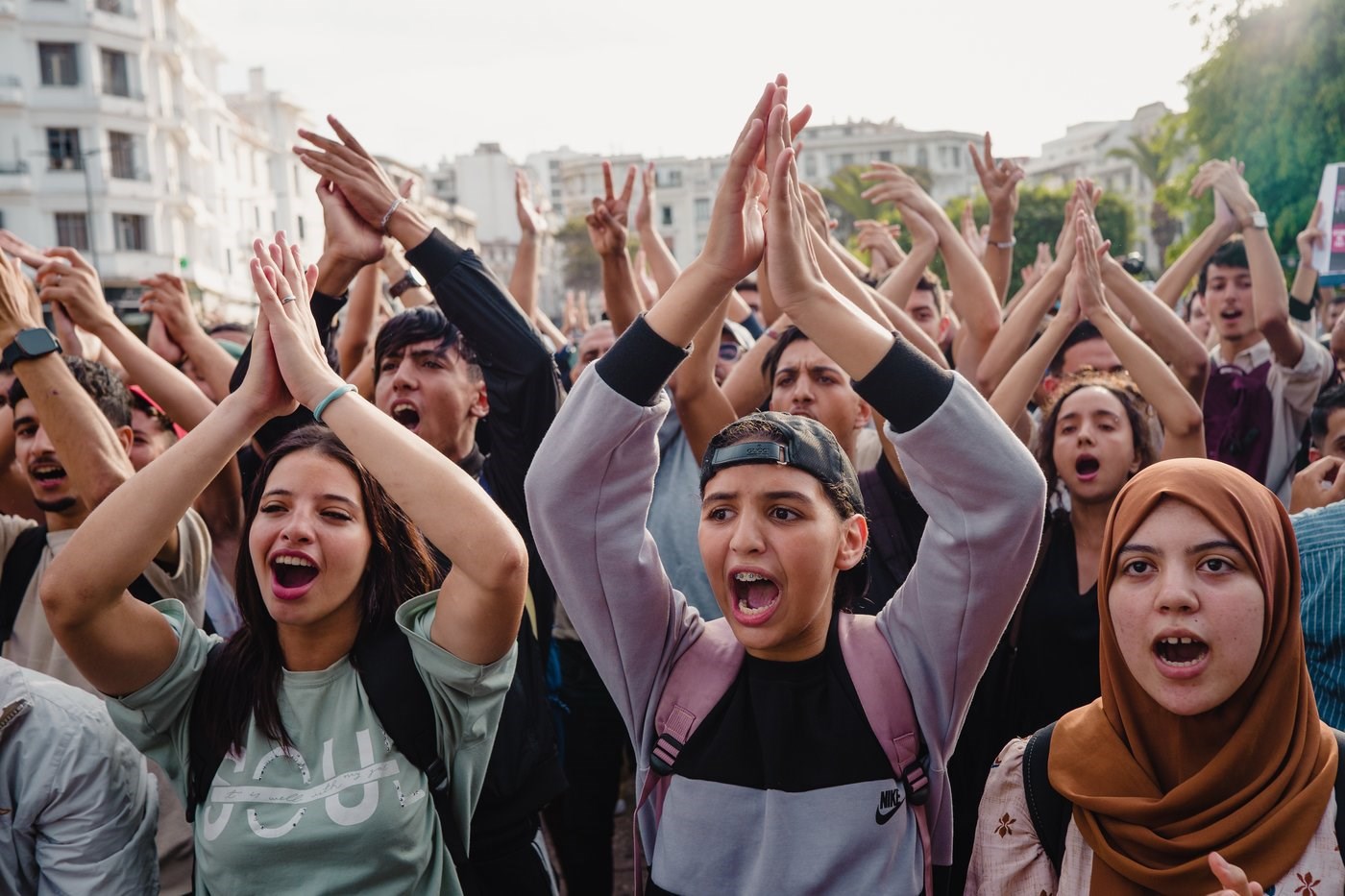
FILE - People protest against corruption and calling for healthcare and education reform, in Casablanca, Morocco, Oct. 2, 2025. (AP Photo, File)
September 20, 2026 - 8:12 PM
SIDI MOUSSA EL MAJDOUB, Morocco (AP) — A funeral in rural Morocco for an elderly woman became an unlikely campaign stop for candidates trying to motivate disenchanted young voters ahead of parliamentary elections Wednesday.
Moroccan young people’s struggles to find jobs and opportunity drove Gen Z-led protests last year and a surge of migration to Spain’s Ceuta this summer. Candidates like Yassine Moujane see youth concerns as central to the campaign for Wednesday’s vote.
“I used to plead for my clients in court, and now, the time has come to plead for Moroccans in parliament,” Moujane told The Associated Press in Sidi Moussa El Majdoub, about 80 kilometers (50 miles) from the capital, Rabat. “Young people can do politics.”
The 28-year-old attorney came to Sidi Moussa El Majdoub, the hometown of a fellow candidate on his party list, for the funeral last week. The candidates paid condolences, listened to grievances — and quietly asked for votes.
Some mourners welcomed their pledges and attention, while others remained skeptical.
Moujane is among the youngest candidates in the elections, running with the Democratic and Social Movement, a pro-establishment party. He has two small children.
The World Cup and jobs are priorities for Morocco's leaders
Moroccan voters will choose from among 7,288 candidates from 27 political parties competing for 395 seats in the House of Representatives, and the next prime minister will come from the party that wins the most seats.
The vote will be the first since the deadly youth-led protests nearly a year ago and a mass attempt to cross Morocco’s borders into the Spanish territory of Ceuta.
Young Moroccans were among the dozens of people who died trying to reach Ceuta, including a factory worker seeking a better job to pay his mother’s medical bills, a struggling soccer player and a high school student dreaming of a better future, according to AP interviews with their families and friends.
The next government will be under the global spotlight as it will oversee billions of dollars in infrastructure and development projects as Morocco prepares to co-host the 2030 FIFA World Cup.
But it will face more immediate domestic challenges: addressing inflation and unemployment, and showing young Moroccans that the country’s economic transformation can translate into higher incomes and improved public services.
Morocco has developed a large automotive and aeronautics industry and its high-speed rail network is expanding. Tanger Med port has become a major global container hub.
The World Bank expects Morocco's gross domestic product to expand by 4.2% this year, but the growth has not generated enough jobs.
Few young people are registered to vote
The gap is particularly stark for young people. Official data put Morocco’s unemployment at 13% in 2025, but the rate among people aged 15 to 24 was 37%, while unemployment among higher-education graduates stood at 19%.
“Politicians don’t care about us. They only care about their own interests,” said Yassine Hasnaoui, a 28-year-old unemployed man from Sidi Moussa El Majdoub. “They come from higher social classes than us.”
People aged 18 to 24 account for roughly 12% of the country’s population but make up just 4% of its 15.8 million registered voters. Reaching the voting age of 18 does not automatically place citizens on the electoral rolls; they must actively register to vote.
For young Moroccans interviewed by AP, the frustration is less about political ideology than about everyday concerns: finding a job, affording a decent life and getting access to functioning schools, hospitals and infrastructure. Those are the same grievances voiced by migrants in Ceuta and by the Gen Z protesters.
Hassan Challaoui, a 32-year-old boilermaker from the same village, wants a school bus for children in his rural area. He said they have to walk about 10 kilometers (6 miles) each day — in the sun, rain and cold — to reach school.
He said he has watched the same political figures remain in power for years. “People didn’t change, but we want change,” he said.
Youth say they're angry at politicians, not the monarchy
Morocco is a constitutional monarchy in which King Mohammed VI retains broad powers, including key decisions on foreign policy, national security and strategic affairs. The constitution also gives the king the power to appoint the head of government from the party that wins most seats in parliamentary elections.
“Political power remains highly centralized in the monarchy, and parties are widely perceived by youth as unresponsive,” said Steven Höfner, head of the Rabat office at the German think tank Konrad Adenauer Stiftung.
“As a result, many young people neither vote nor participate in parties, often citing lack of political knowledge, disinterest, and poor communication from political elites.”
Yet some young Moroccans said they see value in voting, in hopes it can influence decisions on issues like minimum wages, public sector hiring and family law.
When Gen Z-led protests erupted across Morocco last year, young demonstrators focused their criticism on the government and political parties seen as responsible for poor healthcare and education, rather than on the royal palace.
They called on the king to oversee reforms and viewed the monarchy as an anchor of stability. That set them apart from larger Arab Spring protests in the 2010s that called for limits on the king’s powers and a stronger parliament.
It's hard for young candidates to secure a seat
Moujane said he volunteered to defend protesters arrested during the Gen Z demonstrations.
“They had the same demands that we plan to address in our party platform: better schools, hospitals, housing and a better environment,” Moujane said. “They are valid claims.”
Securing his party’s nomination was no easy task. Unproven and unknown in political circles, Moujane said he had to make relentless phone calls to win over skeptical party leaders.
Now, running a low-budget campaign, he is attempting to break into a parliament where the average age among lawmakers is 53.
News from © The Associated Press, 2026