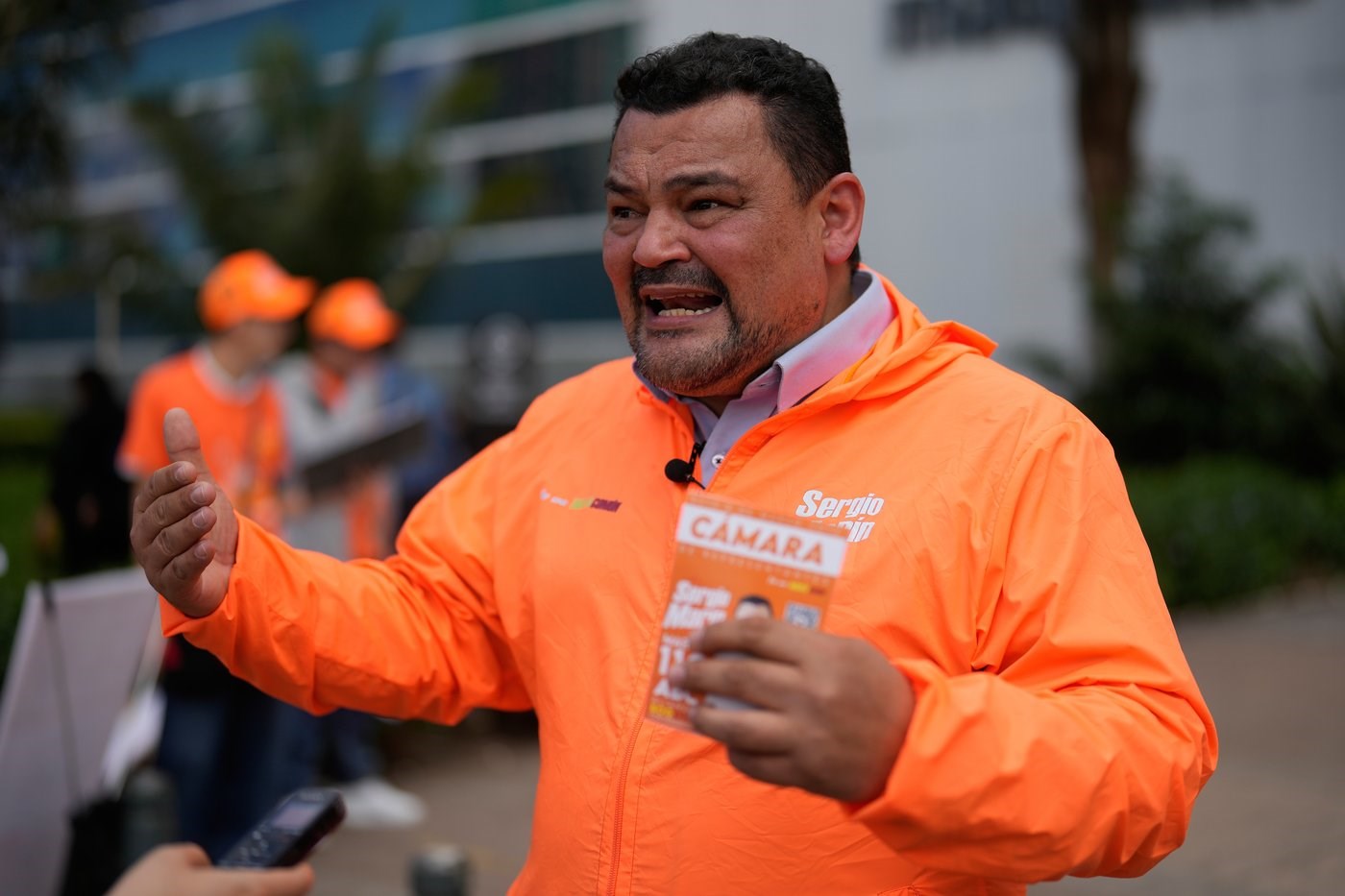
Congressman Carlos Carreño Marín, who goes by Sergio Marin, of the Comunes party, gives an interview while campaigning for reelection ahead of legislative elections in Bogota, Colombia, Thursday, Feb. 26, 2026. (AP Photo/Fernando Vergara)
March 02, 2026 - 4:20 AM
BOGOTA, Colombia (AP) — Former rebels that once controlled large swaths of rural Colombia are now fighting for their survival as a political party, as the country holds a high-stakes congressional election on Sunday.
Getting enough votes to retain their congressional seats, or even maintain their status as a political party, will be a tall order for former members of the Revolutionary Armed Forces of Colombia, or FARC, who now run the party called Comunes, or Commoners.
The party had 10 guaranteed seats in Colombia’s Congress during the last two legislatures, a concession granted to the rebels in their 2016 peace deal with the government.
But now, under the terms of the deal, those seats are gone, and Comunes must compete on equal footing with other political parties.
Few observers expect the former rebels to retain their seats in a crowded field where more than a dozen parties will compete for positions in the Senate and House of Representatives.
“They have not really gained the support of the people,” said Yan Basset, a political science professor at Bogota’s Rosario University.
The former rebels kidnapped thousands of people and bombed dozens of villages in their five-decade conflict with Colombia’s government.
The stigma of the conflict continues, Basset said, "and obviously for many Colombians it is difficult to forgive.”
Even with guaranteed seats, the Comunes party saw dismal results in previous elections.
During the 2018 congressional elections, the party obtained 89,300 votes nationwide. That went down to 50,100 in 2022.
The decline is critical because Colombian electoral laws require parties to capture at least 3% of the total vote to maintain a status that enables them to field candidates and receive public funding. In the last election, parties needed 509,000 votes to reach the crucial 3% mark.
In an effort to improve its chances in this election, Comunes has formed an alliance with Fuerza Ciudadana, a movement founded 20 years ago by left-wing activists and academics that recently won mayorships and a governorship in northern Colombia.
The former rebels also appear to be hiding their symbols to make their candidates more palatable to the average voter. Flyers, flags and stickers handed out by the party feature the logo of Fuerza Ciudadana, while the Comunes red rose is absent from most marketing materials.
Comunes also registered its coalition as Fuerza Ciudadana with electoral authorities, ensuring that the movement's orange logo, rather than its own, will appear on Sunday’s ballots.
“Politics in Colombia is very complex,” said Carlos Carreño Marín, a former FARC commander.
Marín was one of the FARC’s negotiators in the 2016 peace deal, and has represented Comunes in Congress since 2018.
Now he is attempting to hold on to his Bogota congressional seat, and acknowledges it will be challenging.
“We are in an intense struggle against parties that have been doing this for two centuries,” the 48-year-old said.
Almost 300 seats in Colombia’s congress will be up for grabs on Sunday.
The election’s outcome could be crucial for President Gustavo Petro's efforts to rewrite Colombia's constitution. Petro has accused judges and legislators of blocking his efforts to nationalize the country's health care system and reform the pension system.
___
Manuel Rueda in Bogota, Colombia, contributed.
___
Follow AP’s coverage of Latin America and the Caribbean at https://apnews.com/hub/latin-america
News from © The Associated Press, 2026