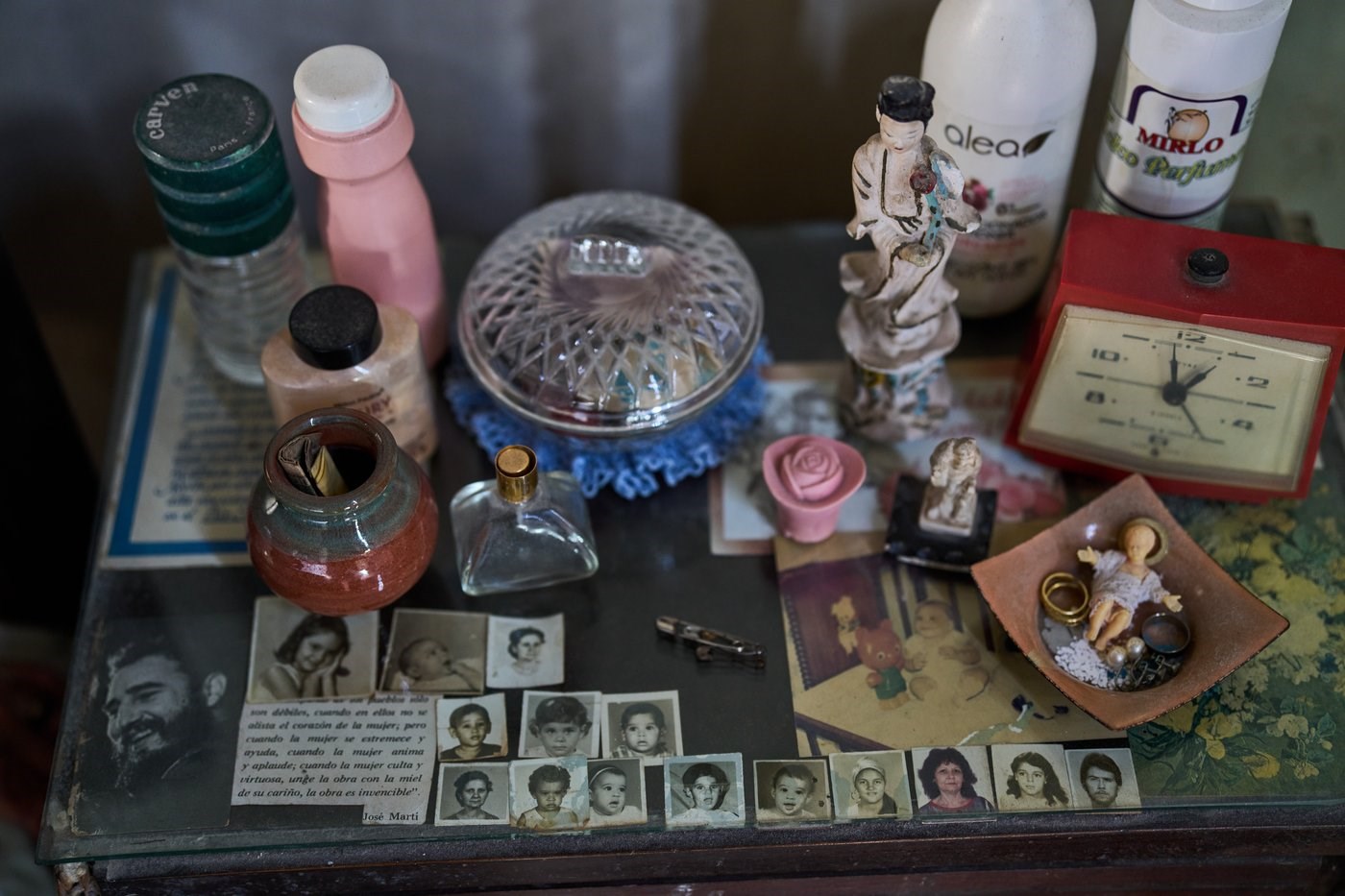
A photo of the late Cuban President Fidel Castro sits alongside photos of Mercedes Lopez Rey’s family on a bedside table at the 83-year-old’s home in Old Havana, Cuba, Wednesday, Feb. 19, 2025. (AP Photo/Ramon Espinosa)
April 26, 2026 - 9:24 PM
HAVANA (AP) — Cuba’s elderly are among those bearing the heaviest burden of the island’s deepening economic crisis, which has worsened since the start of the year after an oil embargo imposed by U.S. President Donald Trump.
Even before the latest downturn, Cuba already had one of the oldest populations in Latin America, shaped by long life expectancy and low birth rates.
By the end of 2024, nearly 26% of Cuba’s population was age 60 or older, according to the country’s National Bureau of Statistics, almost twice the regional average of 14.2% reported by the Economic Commission for Latin America and the Caribbean.
Many are former state workers living on meager pensions, facing cuts to long-subsidized goods and increasing loneliness as younger Cubans continue to emigrate. Over the past five years, Cuba’s population has fallen by nearly 1.5 million, largely because of migration.
The island's elderly were young when Fidel Castro entered Havana. Now, in old age, they are confronting a new period of scarcity that is testing how far pensions, rationed goods and personal resilience can stretch. The impact is visible in daily life: Elderly people walk the streets alone, stand in long lines for bread and rice, and increasingly depend on churches and some state institutions for basic meals.
One such place is the Church of the Holy Spirit in Old Havana, where nearly 50 elderly residents gather three times a week for a modest hot meal of ground meat, rice, red beans and crackers topped with mayonnaise. For many, the meals offer more than nourishment. They provide a small measure of routine, relief and company during long days of shortages, outages and solitude.
Among them was Mercedes Lopez Rey, a retired engineer who until her death went to the church three times a week as worsening conditions made daily life increasingly difficult. Lopez also picked up food for her friend Julia Barcelo, who had breast cancer and was unable to leave her home.
Another regular is Carmen Casado, an 84-year-old retired chemical engineer who depends on the meals because her monthly pension of 2,000 Cuban pesos is worth about $4 at the informal exchange rate used by many Cubans. She has no children, receives no remittances from relatives abroad, and lives alone on the upper floors of a deteriorating 19th-century building, one of many in Havana showing the strain of age and neglect. Despite the poverty and loneliness, she still places her faith in the government and blames the island’s hardships on the United States.
___
This is a documentary photo story curated by AP photo editors.
___
Follow AP’s coverage of Latin America and the Caribbean at https://apnews.com/hub/latin-america
News from © The Associated Press, 2026