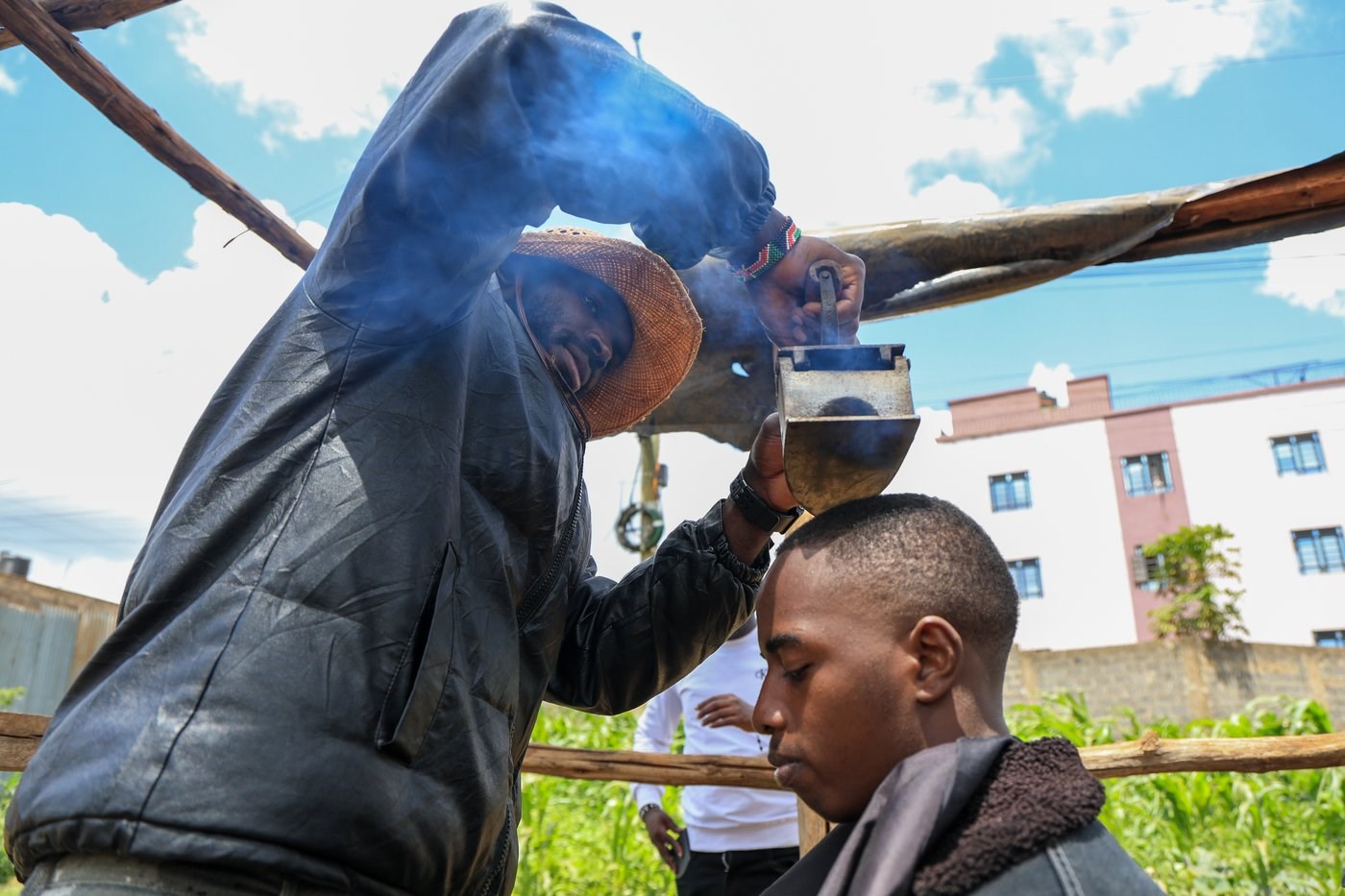
Barber and viral content creator Safari Martins, demonstrates one of his inventive shaving methods using an iron box while grooming Ian Njenga in Kiambu, Kenya, Wednesday, Nov. 26, 2025. (AP Photo/Andrew Kasuku)
December 31, 2025 - 2:34 PM
KIAMBU, Kenya (AP) — Safari Martins leads his client Ian Njenga into a sparse shack on the rural roadside in Kiambu, at the edge of metropolitan Nairobi. On the shack’s wooden walls hang a shovel, iron, agricultural shears and a wrench, but Njenga is not there to buy equipment. He's there to get a haircut.
“I just use unconventional tools,” Martins says, smiling, moments before sliding a razor-sharp shovel edge across Njenga’s head, lopping off a swath of hair in the first of a series of moves that yields a surprisingly clean haircut.
Unconventional tools are a hallmark for Martins, who is one of Kenya’s most recognizable barbers with around 1 million followers on each of his Instagram and TikTok accounts, where he is known as Chief Safro.
As he makes precision cuts across Njenga’s head, a helper stands to the side, capturing every moment from different angles on a smartphone camera.
Influencer barbers are a new trend in Kenya, where social media usage has exploded in recent years and platforms like TikTok are being used both for entertainment and as a lucrative side hustle.
Born in Rwanda and now based in Nairobi, Martins got his start barbering in high school in 2018. Using borrowed clippers, he began offering trims outside classrooms and in cramped dormitories. Five years later, he added a camera and dropped a conventional trimmer — and never turned back.
Martins went viral for zany barbering methods, but he has increasingly incorporated traditional African folk tales into voiceovers on his videos.
“I’m motivated by African culture, by African stories,” he says, adding that one of his tools, a sharpened iron box, was blessed by village elders.
The barber’s staying power has come from the haircuts themselves, which his customers say they love—and the chance to be featured on one of Kenya’s most magnetic social media accounts.
“If I compare him with other barbers his talent is next level,” says Njenga, who first visited Martins last year. “When I get shaved here I get very comfortable … while walking in the streets I get very confident.”
The draw of a unique barbering experience and five minutes of social media fame is enough for customers to push past the price. Martins charges up to 1500 Kenyan shillings, or almost $12, for one of his cuts, a hefty premium in Nairobi, where men may pay a tenth of that for a trim.
The popularity of Martins and other content creator barbers has come amid the breakneck growth of social media in Kenya. In January 2023, there were just 10.6 million social media users in the country, according to DataReportal, a market research group. By January 2025, that number had increased almost 50%, to 15.1 million.
With monetization of social media content often benchmarked to Western digital advertising rates, finding success online can also bring a relative windfall to Kenyans. Around 15% of Kenyans engaged in online content creation rely on it as their primary source of income, the Kenya Institute for Public Policy Research and Analysis, a think tank, said in a June 2025 brief.
Nevertheless, Martins complains that barbers do not not reap the same rewards as other content creators, and he is right. Some of the highest-paid creators are those who make gaming, education, or lifestyle content, according to Fundmates, a company that finances influencers, because of the wide applicability of brand deals in these niches.
“Barbers get viral on social media but I feel like they are not respected,” says Martins. “You are not paid as a content creator, even though you have the views, even if you have the engagement.”
News from © The Associated Press, 2025