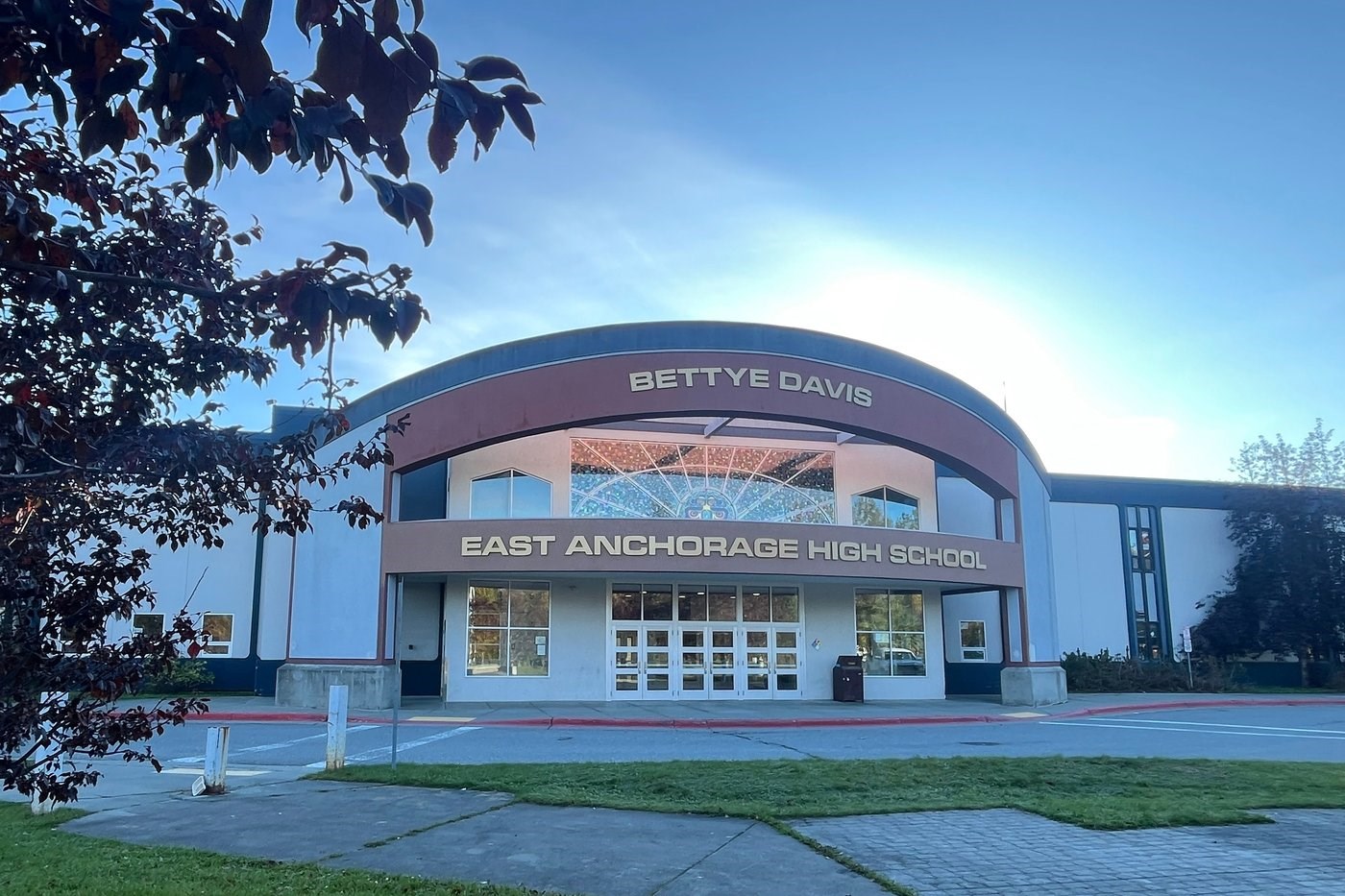
Bettye Davis East Anchorage High School is seen Wednesday, Sept. 23, 2026, in Anchorage, Alaska. (Hannah Flor/Alaska Public Media via AP)
September 23, 2026 - 12:28 PM
It was lunchtime at Anchorage’s West High.
Sophomore Mae Agnew Bemben already had her sandwich – strawberry jam with mixed nut butter – and was walking with a friend through the quiet of Westchester Lagoon.
She likes the calm, whether it’s here or at home, she said.
“I’ve always been someone who’s just done better on their own,” she said.
That’s not what she’s getting at school though, where her classes are significantly bigger than last year. Take her AP World History. With 35 teenagers, it’s packed tight. Students are constantly running into each other. The teacher is trying to answer 10 questions at once. The bathroom pass is always in use.
“It’s sort of like you can’t really breathe,” she said. “It’s hard to actually pay attention to what the teacher is trying to tell you.”
Mae’s experience isn’t unique. This year there’s an average of four more students in each classroom in the Anchorage School District. And there are a whole bunch of problems that come with those packed classrooms. District officials say they’re doing everything they can, but years of flat state funding paired with inflation has led to the elimination of hundreds of teaching positions.
Kersten Johnson-Struempler, an administrator with the district, said the only way to balance the budget is to reduce staff.
“When 87% of your budget comes from personnel and people, that really doesn’t leave you a lot of wiggle room to do other things to adjust your budget,” she said.
Cramped circle time
This year alone there are roughly 300 fewer teaching positions than last year from a combination of vacancies, layoffs, retirements and a hiring freeze.
When there are fewer teachers to go around, larger class sizes are a direct result. That has a big impact on kids. It also impacts teachers. The job is harder and the hours are longer, Johnson-Struempler said.
“That’s the emotional toll that you see in education,” she said. “When there is always more to be asked of you with limited resources, it is hard for teachers to not feel burnt out.”
Kjerstin Thomas, a kindergarten teacher at Denali Montessori in downtown Anchorage, said that is absolutely true for her.
“I would say there’s a direct correlation between the size of my class and how intense and exhausting it is,” she said.
Sometimes there’s just not enough space. This year Thomas has too many kids to fit on her rug for circle time. She’s had to shift the rules about personal space. A lot of the time, she feels like she needs a bunch more hands for things like zipping up coats.
At 25 kids this year, she’s teaching her largest class ever. That may not seem like a lot compared to upper grades, she said, but remember, her students are 5 years old.
“They’re very needy,” she said. “That’s just who they are, and I’m their person who’s helping them figure out their needs, and so I just feel more stretched thin.”
Bigger classes, more grading, less learning
Gary Snyder has been teaching at Bettye Davis East Anchorage High for nearly three decades. In his early years, he had about two dozen students. Now, his biggest class has 34 students. In the upper grades, bigger classes mean teachers spend a lot more time grading assignments outside of school, he said.
“You don’t clock out and leave if you’re a good teacher,” he said. “You cannot do your job in the hours a day you get paid for. You can’t.”
To cut down on all that grading time, Snyder said teachers assign students fewer essays and more worksheets and multiple choice.
He said it also means there’s less individual feedback and more “Yep, looks like you did it.” That results in less learning.
Snyder said another issue is that his budget for materials doesn’t go up when class sizes do. That means when it’s time to dissect fetal pigs, a lot more kids are sharing an animal than before. Snyder said he also worries about chemistry class, with all those kids packed in around bunsen burners.
Slipping through the cracks
What’s more, with so many kids in the classroom, it’s hard for Snyder to even get to know his students. That also impacts their learning, he said.
“The way you get kids to learn is you rope them in emotionally, and then you can raise the bar academically,” he said. “If the kids like you, if they enjoy your class, if they think it’s important, then you can get them to do a lot.”
It’s stressful, Snyder said. He wakes up at night worrying about his students. Some of them are absolutely slipping through the cracks. But he just doesn’t have enough time for everything.
He said one of the hardest things, especially in the last few years, is feeling like he’s part of something that’s failing.
“I want my kids to be successful,” he said. “I want to be successful. I want my classroom to be good. And when you see so many holes in the system – mostly caused by the budgets – you feel like ‘I don’t want to be part of this.’”
Snyder is retiring next year. If he were younger though, newer in the profession, he said he’d be having second thoughts about sticking with teaching.
___
This story was originally published by Alaska Public Media and distributed through a partnership with The Associated Press.
News from © The Associated Press, 2026