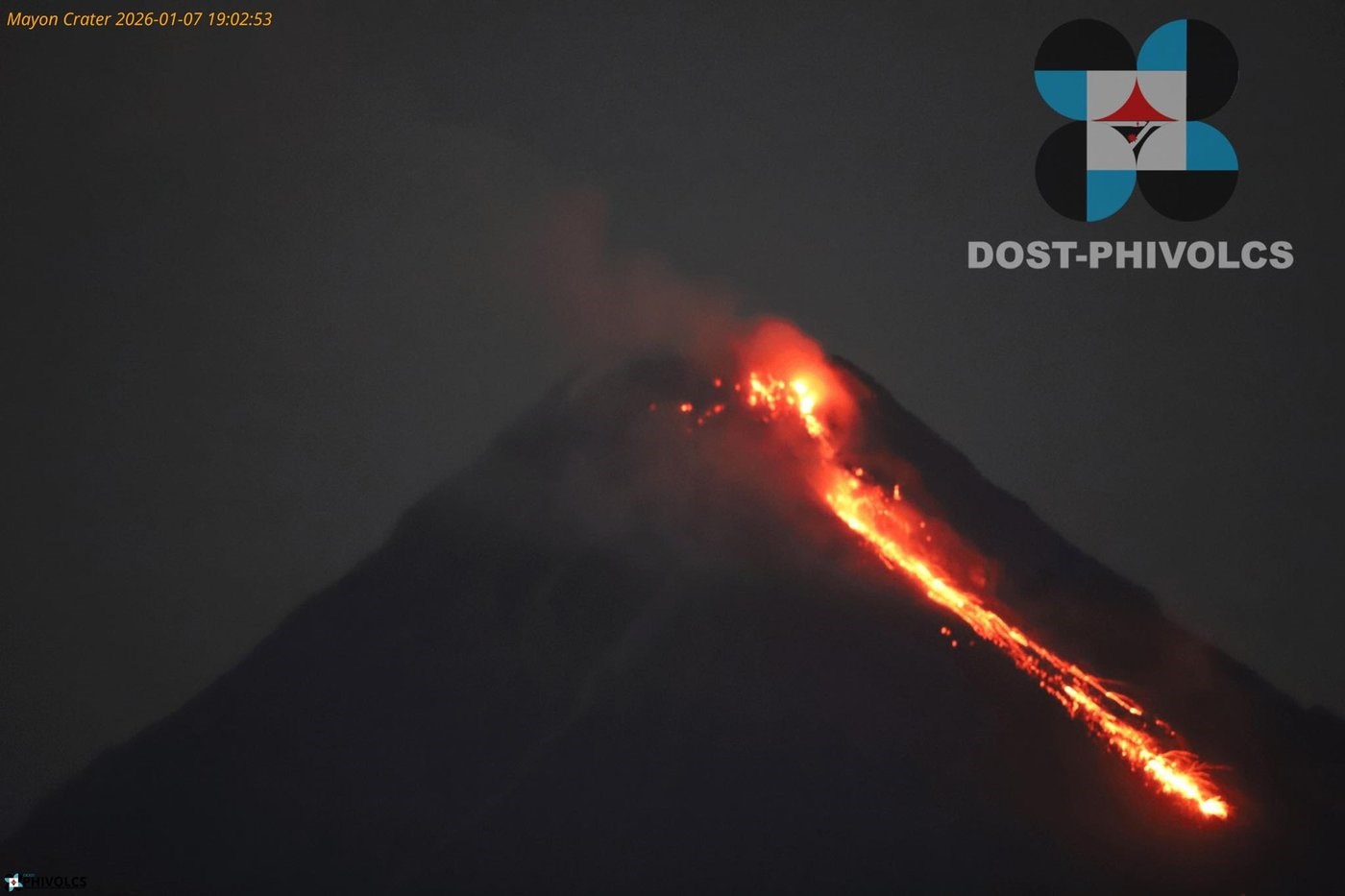
In this photo provided by the Philippine Institute of Volcanology and Seismology, lava flows from the crater of the Mayon volcano as alert level 3 remains raised in Albay province, north eastern Philippines on Wednesday Jan. 7, 2026. (Philippine Institute of Volcanology and Seismology via AP)
Republished January 07, 2026 - 10:41 AM
Original Publication Date January 07, 2026 - 5:16 AM
MANILA, Philippines (AP) — A series of mild eruptions at the most active volcano in the Philippines has prompted the evacuation of nearly 3,000 villagers from a danger zone on its foothills, officials said Wednesday.
Authorities raised the 5-step alert around Mayon Volcano in the northeastern province of Albay to level 3 on Tuesday after detecting intermittent rockfalls, some as big as cars, from its peak crater in recent days along with deadly pyroclastic flows — a fast-moving avalanche of super-hot rock fragments, ash and gas.
Alert level 5 would indicate that a major explosive eruption, often with violent ejections of ash and debris and widespread ashfall, is underway.
“This is already an eruption, a quiet one, with lava accumulating up the peak and swelling the dome, which cracked in some parts and resulted in rockfalls, some as big as cars,” Teresito Bacolcol, the country's chief volcanologist, told The Associated Press.
He said it is too early to tell if Mayon’s restiveness would worsen and lead to a major and violent eruption given the absence of other key signs of unrest, like a spike in volcanic earthquakes and high levels of sulfur dioxide emissions.
Troops, police and disaster-mitigation personnel helped evacuate more than 2,800 villagers from 729 households inside a 6-kilometer (3.7-mile) radius from the volcano’s crater that officials have long designated a permanent danger zone, demarcated by concrete warning signs, Albay provincial officials said.
Another 600 villagers living outside the permanent danger zone have evacuated voluntarily to government-run emergency shelters to be safely away from the volcano, Claudio Yucot, regional director of the Office of Civil Defense, said.
Entry to the permanent danger zone in the volcano’s foothills is prohibited, but thousands of villagers have flouted the restrictions and made it their home or maintained farms on and off for generations. Lucrative businesses, such as sand and gravel quarrying and sightseeing tours, have also thrived openly despite the ban and the mountain’s frequent eruptions — now 54 times since records began in 1616.
The 2,462-meter (8,007-foot) volcano is one of the Philippines’ top tourism draws because of its near-perfect cone shape. But it’s also the most active of the country’s 24 restive volcanoes.
A terrifying symbol of Mayon’s deadly fury is the belfry of a 16th-century Franciscan stone church which protrudes from the ground in Albay. It’s all that’s left of a baroque church that was buried by volcanic mudflow along with the town of Cagsawa in an 1814 eruption which killed about 1,200 people, including many who sought refuge in the church, about 13 kilometers (8 miles) from the volcano.
The thousands of people who live within Mayon’s danger zone reflect the plight of many impoverished Filipinos who are forced to live in dangerous places across the archipelago — near active volcanoes like Mayon, on landslide-prone mountainsides, along vulnerable coastlines, atop earthquake fault lines, and in low-lying villages often engulfed by flash floods.
Each year, about 20 typhoons and storms batter the Philippines, which lies along the Pacific “Ring of Fire,” an arc of fault lines along the Pacific Ocean basin often hit by volcanic eruptions and earthquakes.
News from © The Associated Press, 2026