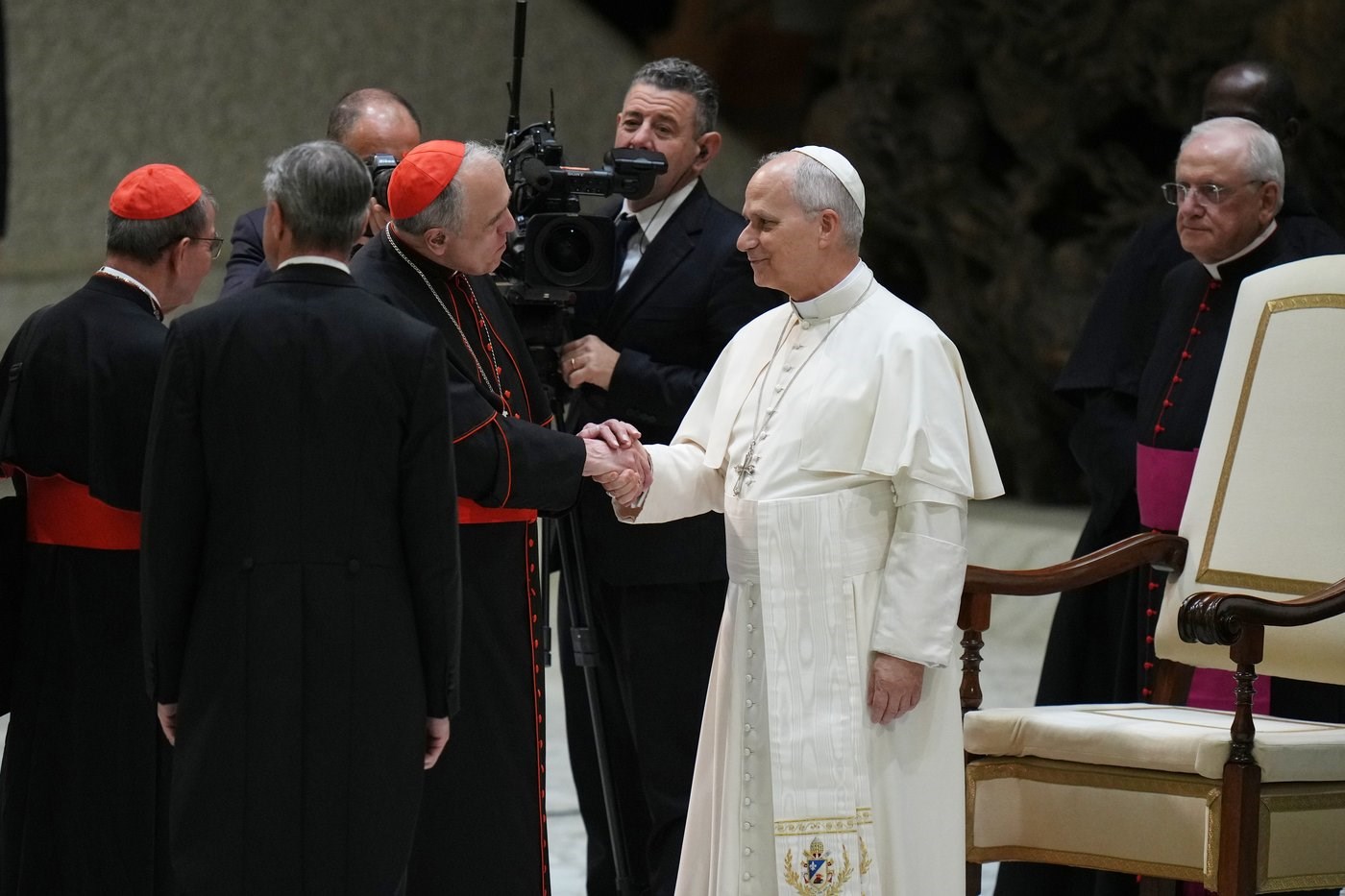
Pope Leo XIV meets Cardinals and Bishops at the end of his weekly general audience in the Paul VI Hall at the Vatican, Wednesday, Jan. 7, 2026. (AP Photo/Alessandra Tarantino)
Republished January 07, 2026 - 6:43 AM
Original Publication Date January 07, 2026 - 3:46 AM
VATICAN CITY (AP) — Pope Leo XIV on Wednesday opened a new phase of his pontificate by gathering the world’s cardinals to Rome and asking them to advise him on key priorities for the next two years. They responded by indicating continuity with Pope Francis' key aims of making the church more missionary and responsive to the needs of ordinary faithful.
Some 170 red-capped cardinals, or around two-thirds of the total College of Cardinals, trickled into the Vatican’s audience hall for the opening session of the two-day meeting, known as a consistory, the first of Leo's papacy.
In his opening remarks, Leo asked them to share what they considered to be the priorities that should guide him and the Holy See for the next year or two. He originally offered four agenda items but then asked the cardinals to pick just two. Significantly, the cardinals chose not to focus on questions about the liturgy and the divisive question about the old Latin Mass.
“This day and a half together will point the way for our path ahead,” Leo said.
Earlier in the day Leo had given the strongest signal yet about the direction of his still-young pontificate, calling for the full implementation of the reforms of Vatican II, the 1960s meetings that modernized and revolutionized the Catholic Church and remain a source of debate today.
Leo told his weekly general audience that for the foreseeable future, he would devote his weekly catechism lessons to a rereading of key Vatican II documents.
“Therefore, while we hear the call not to let its prophecy fade, and to continue to seek ways and means to implement its insights, it will be important to get to know it again closely, and to do so not through hearsay or interpretations that have been given, but by rereading its documents and reflecting on their content,” he said.
Citing all the popes from Vatican II forward who spoke about its importance, Leo said: “Indeed, it is the magisterium that still constitutes the guiding star of the church’s journey today.”
Among other things, Vatican II allowed for use of the vernacular rather than Latin for Mass. It called for greater participation of lay faithful in the life of the church and revolutionized Catholic relations with Jews and people of other faiths. At the time and in the decades since, though, its reforms crystalized the divisions between traditionalist, conservative Catholics and the more progressive wing of the church that are still alive today.
Leo turns to the College of Cardinals
for support
Leo’s first few months as pope were dominated by fulfilling the intense 2025 Holy Year obligations of celebrating special Jubilee audiences and Masses and wrapping up the outstanding matters of Francis’ pontificate.
He called the consistory of cardinals to begin the day after he closed out the Jubilee, suggesting that he saw its conclusion as the opportunity to unofficially launch his pontificate and look ahead to his own agenda.
It was a significant gesture, since Francis had relied not on consistories or the College of Cardinals as a whole to help him govern, but rather a small, hand-picked group of nine cardinals who met every few months at the Vatican.
Cardinals complained that they had been sidelined during Francis' 12-year pontificate, and Leo obliged by bringing them together.
A Francis-style agenda
Originally, the official agenda included four topics: a discussion of two of Francis’ key reform documents: his inaugural statement on the missionary nature of the church issued at the start of his pontificate, and the 2022 document that reformed the Vatican bureaucracy. Also on the original agenda was Francis' call for the church to be more “synodal,” or responsive to the needs of rank-and-file Catholics, and a discussion of the liturgy.
At the start of the meeting Wednesday, Leo asked the cardinals to choose two of the four to focus on. The majority decided to focus on the issues of the missionary and synodal church rather than the liturgy or Vatican reform, Vatican spokesman Matteo Bruni said.
The liturgy question had been expected to refer to divisions within the church over the celebration of the old Latin Mass. The ancient liturgy became a source of division in the church in some parts of the world after Francis greatly restricted it. While the majority of cardinals chose not to make it one of the two main themes of discussion for Thursday, individual cardinals are free to speak about it, Bruni said.
___
Associated Press religion coverage receives support through the AP’s collaboration with The Conversation US, with funding from Lilly Endowment Inc. The AP is solely responsible for this content.
News from © The Associated Press, 2026