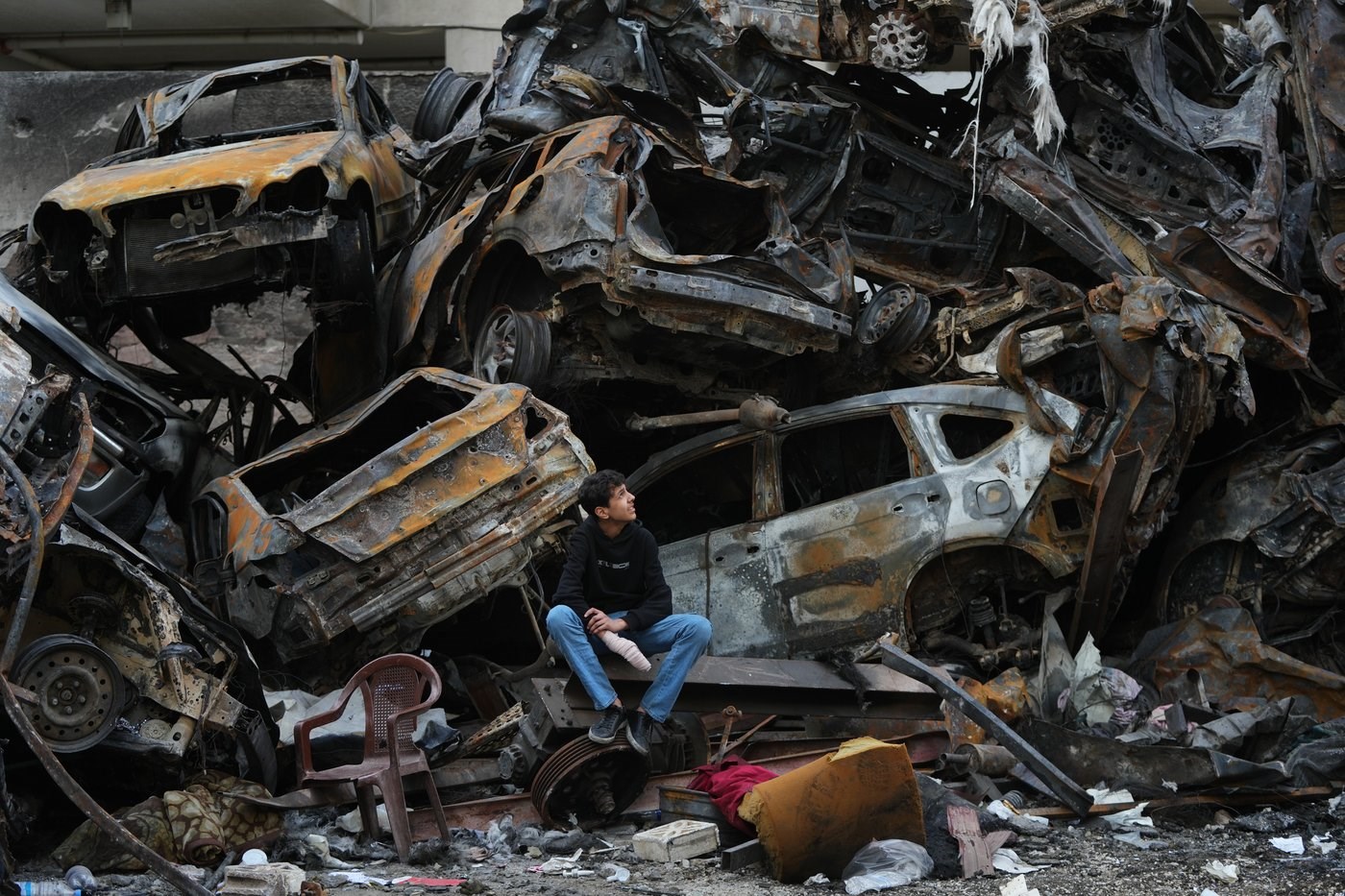
A man sits next to charred cars and wreckage where a building was destroyed by an Israeli airstrike the previous Wednesday, in central Beirut, Lebanon, Tuesday, April 14, 2026. (AP Photo/Hassan Ammar)
Republished April 14, 2026 - 2:31 PM
Original Publication Date April 13, 2026 - 11:46 PM
The U.S. military claimed Tuesday that it has successfully begun to enforce a blockade of Iranian ports, as the standoff between the U.S. and Iran deepens. Tehran threatened to strike targets across the region, a day after Trump warned on social media that any Iranian warships nearing the blockade would be destroyed in a “quick and brutal” strike.
With Pakistan racing to bring the sides together for more talks, U.S. President Donald Trump said Tuesday that a second round “could be happening over the next two days.” The first round ended without an agreement on Iran’s nuclear ambitions, which the White House says is a sticking point.
Neither side has indicated what will happen after the ceasefire expires on April 22.
Lebanon and Israel opened their first direct diplomatic talks in decades on Tuesday in Washington, as fierce fighting between the Israeli military and Hezbollah militants rocks southern Lebanon. U.S. Secretary of State Marco Rubio took part, joining the Israeli and Lebanese ambassadors to the U.S. Hezbollah opposes the direct talks and won’t abide by any agreements made as a result, a high-ranking member of its political council told the AP.
Here is the latest:
Treasury says US will not renew Iranian oil sanctions waiver
The Treasury Department says “the short-term authorization permitting the sale of Iranian oil already stranded at sea is set to expire in a few days and will not be renewed,” in a post on X.
The administration allowed for the delivery and sale of Iranian crude oil already in transport before March 20, and would last through April 19.
Additionally, the administration allowed a waiver on Russian oil at sea to expire on Saturday.
Israeli strike in Gaza kills 6 more Palestinians, health officials say
The Israeli drone strike on a group of people in Gaza City brought the total number of Palestinians killed Tuesday to 11, according to health officials at Shifa hospital.
The Israeli military said it had struck Hamas militants in the area.
Separate Israeli strikes earlier Tuesday killed two children, including a 3-year-old, and three adults, an official at the hospital said.
Deadly airstrikes are a near-daily threat in Gaza, where more than 750 Palestinians have been killed by Israel despite a ceasefire with Hamas since October, according to figures from the Hamas-run Gaza Health Ministry.
Lebanon praises first talks with Israel in decades as ‘constructive,’ calls for ceasefire
Lebanon’s top envoy to the U.S. says the first high-level diplomatic engagement between her country and Israel was “constructive,” but urged an end to the ongoing conflict between Israel and Iran-backed Hezbollah militants that has displaced thousands of Lebanese.
After participating in Tuesday’s talks with Rubio and Israel’s ambassador to the U.S., Nada Hamadeh Moawad said she had “underscored the need to preserve our territorial integrity and state sovereignty” during the two-hour discussion.
“I called for a ceasefire and the return of displaced persons to their homes,” she said in brief comments released by the Lebanese embassy in Washington.
US could sanction Chinese and Arab banks for doing business with Iran
The U.S. Department of the Treasury sent a letter, viewed by The Associated Press, to financial institutions in China, Hong Kong, the United Arab Emirates, and Oman, warning about the risks of doing business with Iran. The Treasury Department threatened secondary sanctions against the nations’ banks and accused those countries of allowing Iranian illicit activities to flow through their financial institutions.
The letter states that Iran processed at least $9 billion through U.S. correspondent accounts in 2024 using a series of front companies, most notably in Hong Kong and the UAE.
The Treasury Department’s account on the social platform X posted on Tuesday that financial institutions “should be on notice that the department is leveraging the full range of available tools and authorities and is prepared to deploy secondary sanctions against foreign financial institutions that continue to support Iran’s activities.”
Ships near Strait of Hormuz alter signaled destinations on first full day of US blockade
A Malawi-flagged oil tanker entering the Strait of Hormuz revised the destination it was broadcasting over its tracking system on Tuesday, according to maritime data. The Rich Starry was the only ship that shipping data firms and maritime analytics trackers reported as entering the blockaded waterway.
On Monday morning, it listed Sohar, Oman, a port just south of the strait, as its destination. By evening, it was broadcasting no destination, according to MarineTraffic, a maritime analytics provider.
The Rich Starry was among several tankers to change their reported destinations. So-called “shadow fleet” ships like the vessel sometimes fly flags of landlocked countries and alter signals or transmit false positions, including to evade sanctions on Iran. Other ships also adjusted their signals to avoid listing Iranian ports, according to shipping publication Lloyd’s List.
U.S. Central Command said no ships transited the strait on Tuesday and did not respond to questions about the shadow fleet vessels.
US says first Israel-Lebanon talks ‘productive,’ will continue with aim of launching formal negotiations
The State Department says the first high-level meeting between Israel and Lebanon in decades was “productive” and will continue with the aim of launching direct negotiations.
In a statement released after the two-hour session in Washington between Rubio and the ambassadors of Israel and Lebanon to the United States, the department said, “All sides agreed to launch direct negotiations at a mutually agreed time and venue.”
Israel has been fighting Lebanon’s Iran-backed Hezbollah movement and demands that the group, which opposed the talks and was not represented, be disarmed.
It’s time for Lebanon and Israel to work together, UN chief says
Guterres said Tuesday’s first Israeli-Lebanese meeting in decades will be very important if the talks create a change in their actions.
“The truth is that Hezbollah and Israel have always helped each other to destabilize the government of Lebanon,” the secretary-general told U.N. reporters Tuesday while the ambassadors of Lebanon and Israel were meeting in Washington with Rubio.
Whenever Israel occupies part of Lebanon, Hezbollah uses it as a pretext to say it can’t disarm and must keep up the resistance, Guterres said, and Israel uses Hezbollah rocket attacks into its territory as a pretext for massive operations against Lebanon.
Lebanon’s government is committed to having the monopoly on the use of force, which implies the disarmament of Hezbollah, Guterres said. “So, it’s time for Israel and Lebanon to be working together instead of Lebanon being the victim” of the negative actions of Hezbollah and Israel.
There needs to be a ‘complete’ separation between Lebanon and Iran, Israeli envoy says
Leiter, who was the only diplomat to come out and speak after the talks, described the meeting among the U.S., Israel and Lebanon in an extremely positive tone despite Rubio earlier describing the gathering as part of a longer “process.”
The ambassador highlighted several areas of consensus while making it clear that Israel needs to see Lebanon “completely” separate itself from Tehran and its proxy Hezbollah.
“The Lebanese government made it very clear that they will no longer be occupied by Hezbollah and Iran has been weakened; Hezbollah is dramatically weakened,” Leiter said. “This is an opportunity.”
Second round of talks has not been scheduled, official says
A U.S. official, who was not authorized to speak publicly and spoke on condition of anonymity, said Tuesday that future talks with Iran are under discussion, but no talks have been scheduled at this time.
Israeli ambassador says Israel and Lebanon are ‘on the same side of the equation’ after DC talks
In a statement to reporters Tuesday after the historic talks, Israeli Ambassador to the U.S. Yechiel Leiter praised his Lebanese counterparts for their cooperation in the meeting in Washington despite pressure from Hezbollah not to.
“We discovered today that we’re on the same side of the equation. That’s the most positive thing we could have come away with,” Leiter said. “We are both united in liberating Lebanon from an occupation power dominated by Iran called Hezbollah.”
Israel and the Western-backed Lebanese army have both been unable to forcibly disarm Hezbollah.
The talks between envoys from longtime adversaries began at 11 a.m. EDT and lasted for two hours.
399 US troops have been wounded in the Iran war
The formal injury count, provided by Capt. Tim Hawkins, spokesman for U.S. Central Command, says three service members have been seriously wounded.
Central Command said two weeks ago in a previous update that 348 troops were wounded, six of them seriously. However, the military command does not provide any further details about the wounded, so it’s unclear whether anyone’s status improves or worsens.
Hawkins says of the total wounded to date, 354 service members have returned to duty.
Since the Iran war began, 13 U.S. service members have been killed in combat.
UN chief says it is 'highly probable’ that US-Iran talks will restart
Guterres said this was the indication he had after a phone call on Tuesday with Pakistan’s deputy prime minister, who is also the country’s foreign minister.
The U.N. secretary-general expressed “enormous admiration” for Pakistan’s initiative to bring peace to the Middle East.
“I consider it essential that these negotiations go on,” Guterres told U.N. reporters, explaining that it would be “unrealistic” for long-lasting and complex problems between the U.S. and Iran to be resolved in a first negotiating session.
“We need negotiations to go on, and we need a ceasefire to persist as negotiations go on,” he said.
UN chief says international law is ‘being trampled’ — especially in the Middle East
Secretary-General Antonio Guterres warned Tuesday that violations of international law are fueling instability and mistrust. Speaking to reporters at the U.N. headquarters, he urged renewed U.S.-Iran talks and respect for freedom of navigation in the Strait of Hormuz.
The secretary-general said he will travel to The Hague, Netherlands, later this week to mark the 80th anniversary of the International Court of Justice, the U.N.’s highest tribunal, and send “a message that in a world moving toward greater fragmentation and sharper power competition, international law is indispensable.”
US State Department issues $10 million reward for Iraqi militia leader
The bounty was placed on Ahmad al-Hamidawi, secretary general of the Iran-backed militia Kataib Hezbollah. In a post on X, in which it published al-Hamidawi’s photograph, the State Department’s Rewards for Justice program wrote that the group was “responsible for attacks on U.S. diplomatic facilities in Iraq, the kidnapping of U.S. citizens, and the killing of innocent Iraqi civilians.”
Last month, Kataib Hezbollah kidnapped an American journalist, Shelly Kittleson, in Baghdad, but released her several days later on condition that she leave the country. Officials with the group at the time told The Associated Press that in exchange, the Iraqi government would release several members of the militia who had been previously detained.
Kataib Hezbollah is allied with Lebanon’s Hezbollah but they are two entirely different groups with different leaders.
Trump says talks with Iran could resume this week
In a phone call with The New York Post, Trump said a second round of talks with Iran “could be happening over next two days.”
Trump initially told the newspaper they would likely be held somewhere in Europe but later updated that they could be held again in Pakistan’s capital.
An initial round of talks ended without an agreement on Iran’s nuclear ambitions, which the White House says is a central sticking point.
US military claims blockade success
The U.S. military claims that it has successfully begun to enforce a blockade of Iranian ports, though at least one ship with apparent ties to Tehran has transited the Strait of Hormuz.
U.S. Central Command, which oversees the Middle East, said that “during the first 24 hours, no ships made it past the U.S. blockade and 6 merchant vessels complied with direction from U.S. forces to turn around to re-enter an Iranian port on the Gulf of Oman.”
While some tankers approaching the strait on Monday did turn around shortly after the blockade took effect, the tanker Rich Starry reversed course again and transited the waterway early Tuesday.
Rubio says Israel-Lebanon talks are a process but doesn’t expect an immediate agreement
Secretary of State Marco Rubio says that historic Israel-Lebanon peace talks the U.S. is mediating are a “process, not an event,” downplaying expectations for any immediate or significant agreement.
Meeting at the State Department with the ambassadors of Israel and Lebanon to the United States, along with the U.S. ambassador to Lebanon, Rubio said the Trump administration is “very happy” to be facilitating the discussions.
“This is a historic opportunity,” he said. “We understand we’re working against decades of history and complexities” that will not be quickly resolved.
Israeli fire kills 5 Palestinians in Gaza, hospital officials say
Among the killed are a 3-year-old and a 15-year-old in the two separate strikes in northern Gaza and Gaza City on Tuesday, according to a health official at Shifa hospital, where the casualties arrived.
The Israeli military said it was looking into it.
The first strike on a police vehicle in Gaza City killed four, including the 3-year-old who was standing nearby, and another in the Jabaliya refugee camp in northern Gaza killed the 15-year-old, the hospital and the families said.
“What was this little kid’s fault? He was walking in the street,” said Samia al-Malahi, the grandmother of the 3-year-old.
The Gaza Strip has seen near-daily Israeli fire and strikes since a fragile ceasefire was reached in October, and more than 750 Palestinians have been killed since then, according to figures from the Hamas-run Gaza Health Ministry.
Turkey presses with diplomatic push for Iran-US talks
Turkish Foreign Minister Hakan Fidan has held separate telephone calls with his Iranian and Pakistani counterparts on Tuesday to discuss the negotiation process, a Turkish official said.
The conversation with Pakistani Foreign Minister Ishaq Dar centered “on the steps to be taken in the days ahead,” the official said.
The official, speaking on the condition of anonymity as required by protocol, did not provide further details.
— By Suzan Fraser
Death toll in Israel-Hezbollah war in Lebanon rises above 2,100
Israeli strikes have killed a total of 2,124 people during the six-week war, Lebanon’s health ministry said. Among them are 254 women, 168 children and 88 health workers. Another 6,921 have been wounded.
Israel has halted its strikes in Beirut since last Wednesday, when a massive barrage on the capital drew international outcry, but strikes and ground fighting have continued in the country’s south.
The war in Lebanon started on March 2, when the Iran-backed Lebanese militant group Hezbollah fired missiles across the border, two days after the U.S. and Israel launched their war on Iran.
UN chief praises Pakistan’s role in US-Iran talks
Pakistan’s Foreign Minister Ishaq Dar received a call Tuesday from U.N. Secretary-General António Guterres, who appreciated Pakistan’s “constructive role” in bringing the United States and Iran to the negotiating table to advance regional peace.
In a statement, the Ministry of Foreign Affairs said Dar reaffirmed Pakistan’s commitment to promoting dialogue and diplomacy to ensure peace and stability in the region.
Hezbollah appears to step up its fire on northern Israel as talks in Washington begin
The incoming fire triggered nonstop drone and rocket alert sirens in Israeli communities near the Lebanese border on Tuesday.
Ahead of the negotiations between Israel and Lebanon in Washington, the first direct talks between the two countries in decades, the Israeli military issued a warning to northern residents to be prepared for a possible increase of fire from Lebanon.
Hezbollah, which is opposed to the direct talks, claimed 26 attacks on northern Israel and on Israeli ground troops in southern Lebanon on Tuesday. It said it won’t stop its attacks until Israel halts its strikes on Lebanon.
China’s Xi warns against ‘the law of the jungle’
As the leaders of China and Spain pledged Tuesday to work to safeguard multilateralism at a time of conflicts including the war in Iran, President Xi Jinping reiterated a phrase he used earlier in the day when meeting the crown prince of Abu Dhabi — he said countries should “oppose the world’s retrogression to the law of the jungle.”
Xi said they should “jointly safeguard genuine multilateralism,” strengthen communication and cooperate closely, during a reception for Spanish Prime Minister Pedro Sánchez at the Great Hall of the People.
Sánchez agreed and said China and Spain “can contribute to finding solutions to the various trade tensions that exist, to the geopolitical difficulties and complexities of today’s world, to the wars, to the environmental and social challenges that afflict the world.”
? Read more:
Modi and Trump stress the need to keep the Strait of Hormuz open
Indian Prime Minister Narendra Modi and Trump spoke about the need to keep the Strait of Hormuz open during a call, Modi said on the social platform X.
Modi said the two leaders “discussed the situation” in the Middle East and “stressed the importance of keeping the Strait of ?Hormuz open and secure.”
The call between Modi and Trump lasted nearly 40 minutes, Indian media reported.
What Lebanon, Israel and Hezbollah said ahead of talks in Washington
1. Lebanon: Wants a truce as a prerequisite to negotiations, similar to what Pakistan brokered between the U.S. and Iran. “Israel’s destruction of Lebanese territories is not the solution, nor will it yield any results,” said Lebanese President Joseph Aoun Monday, who came to power vowing to disarm non-state groups including Hezbollah. “Diplomatic solutions have consistently proven to be the most effective means of resolving armed conflicts globally.”
2. Israel: Has ruled out a ceasefire and said the goal is Hezbollah’s disarmament and a potential peace agreement between Lebanon and Israel. Foreign Minister Gideon Saar Tuesday denied having disputes with Lebanon, and said “the problem is Hezbollah.”
3. Hezbollah and its supporters: Called the talks a free concession to Israel unless there is first an end to the war and a pullout of Israeli troops from Lebanon. Secretary-General Naim Kassem said Hezbollah wants a return to the 2024 agreement, with indirect talks mediated by the U.S., France and the United Nations peacekeeping mission.
1. Lebanon: Wants a truce as a prerequisite to negotiations, similar to what Pakistan brokered between the U.S. and Iran. “Israel’s destruction of Lebanese territories is not the solution, nor will it yield any results,” said Lebanese President Joseph Aoun Monday, who came to power vowing to disarm non-state groups including Hezbollah. “Diplomatic solutions have consistently proven to be the most effective means of resolving armed conflicts globally.”
2. Israel: Has ruled out a ceasefire and said the goal is Hezbollah’s disarmament and a potential peace agreement between Lebanon and Israel. Foreign Minister Gideon Saar Tuesday denied having disputes with Lebanon, and said “the problem is Hezbollah.”
3. Hezbollah and its supporters: Called the talks a free concession to Israel unless there is first an end to the war and a pullout of Israeli troops from Lebanon. Secretary-General Naim Kassem said Hezbollah wants a return to the 2024 agreement, with indirect talks mediated by the U.S., France and the United Nations peacekeeping mission.
Lebanon and Israel to hold first direct diplomatic talks in decades in Washington
The first direct diplomatic talks between Lebanon and Israel since 1993 are set to begin in Washington as fierce fighting continues between Israel and the Hezbollah militant group.
U.S. Secretary of State Marco Rubio will take part, along with Israeli Ambassador to the U.S. Yechiel Leiter and Lebanese Ambassador to the U.S. Nada Hamadeh Moawad.
Hezbollah is opposed to the direct talks, and will not be represented. Wafiq Safa, a high-ranking member of the militant group’s political council, told The Associated Press that it will not abide by any agreements made in the talks.
At least 2,089 people have been killed in Israeli strikes in Lebanon, the Health Ministry said, among them 252 women, 166 children and 88 medical workers, while 6,762 others were wounded. More than 1 million people are displaced.
? Read more
News from © The Associated Press, 2026