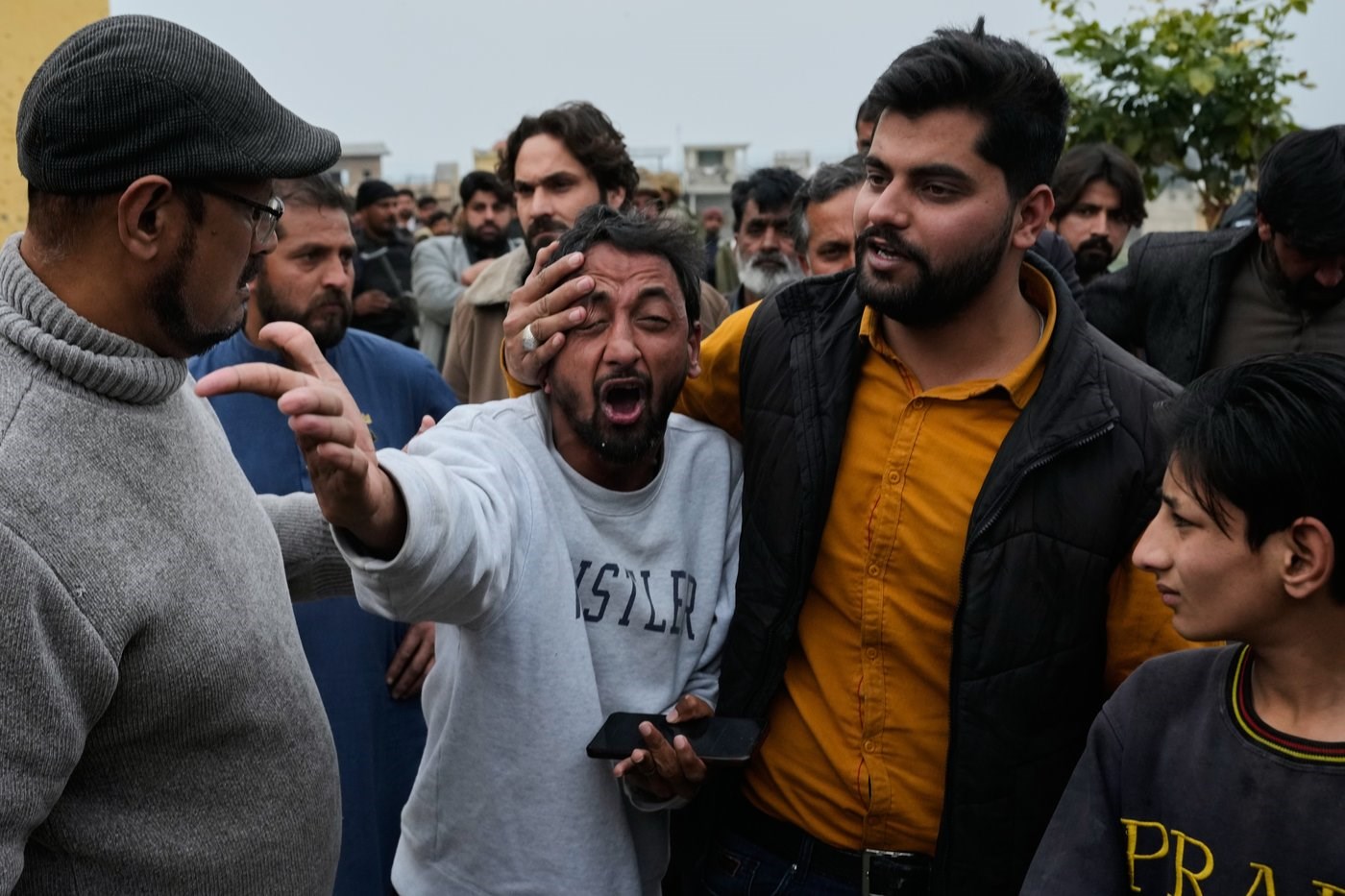
People comfort a man, center, mourning over the death of his relative, close to the site of a bomb explosion at a Shiite mosque, in Islamabad, Pakistan, Friday, Feb. 6, 2026. (AP Photo/Anjum Naveed)
February 05, 2026 - 10:02 PM
ISLAMABAD (AP) — A massive bombing ripped through a Shiite mosque on the outskirts of Pakistan 's capital during Friday prayers, killing 31 people and wounding at least 169 others, according to officials. Police said they were investigating whether the attack was carried out by a suicide bomber.
There were fears the death toll from the bombing at the sprawling Islamabad mosque of Khadija Al-Kubra could climb even higher as some of the wounded were reported to be in critical condition. Television footage and social media images showed police and residents transporting the injured to nearby hospitals.
Rescuers and wounded described a harrowing scene, with bodies and wounded lying on the carpeted floor of the mosque.
Hussain Shah said he was praying in the mosque courtyard when a sudden, loud explosion occurred. “I immediately thought that some big attack has happened,” he said.
He then went into the mosque to utter chaos — many of the wounded were screaming and crying out for help. Shah said he counted around 30 bodies inside the mosque, while the number of wounded appeared to be significantly higher.
No one immediately claimed responsibility for the explosion, but suspicion is likely to fall on militants such as the Pakistani Taliban or the Islamic State group, which has been blamed for previous attacks on Shiite worshippers, a minority in the country. Militants often target security forces and civilians across Pakistan.
Though attacks are not so frequent in Islamabad, Pakistan has seen a surge in militant violence in recent months, largely blamed on Baloch separatist groups and the Pakistani Taliban, known as Tehrik-e-Taliban Pakistan, or TTP, which is a separate group, but allied with Afghanistan’s Taliban. A regional affiliate of the Islamic State group has also been active in the country.
Shortly after the explosion was first reported with a lower number of casualties, Islamabad Deputy Commissioner Irfan Memon gave the latest, much higher casualty tolls.
President Asif Ali Zardari and Prime Minister Shehbaz Sharif condemned the attack in separate statements and extended condolences to the families of those killed. They instructed that all possible medical assistance be provided for those wounded.
“Targeting innocent civilians is a crime against humanity,” Zardari said. “The nation stands with the affected families in this difficult time.”
Sharif said he has ordered a full investigation. “Those who are responsible must be identified and punished,” he said.
Pakistan’s Interior Minister Mohsin Naqvi also condemned the attack, and asked authorities to ensure the provision of best medical care to the wounded.
Friday’s attack occurred as Uzbekistan President Shavkat Mirziyoyev, who is on an official two-day visit, was attending an event with Sharif. The event in Islamabad was several miles away from the site of the explosion.
A top Shiite leader, Raja Nasir, expressed deep sorrow over the attack at Khadija Al-Kubra.
“Such a terrorist act in the federal capital is not only a serious failure in protecting human lives but also raises significant questions about the performance of the authorities and law enforcement agencies,” he said and asked for people to give blood as the hospitals in Islamabad were in urgent need for blood supplies for the wounded.
The last deadliest attack in Islamabad was in 2008, when a suicide bombing targeted the Marriott Hotel in the capital, killing 63 people and wounding over 250 others. In November, a suicide bomber had struck outside a court in Islamabad, killing 12 people.
The latest attack comes nearly a week after the outlawed Baloch Liberation Army carried out multiple attacks in insurgency-hit southwestern Balochistan province, killing about 50 people.
Security forces responding to those attacks also killed more than 200 “terrorists,” according to the military.
___
Associated Press writers Babar Dogar in Lahore and Asim Tanveer in Multan, Pakistan, contributed to this story.
News from © The Associated Press, 2026