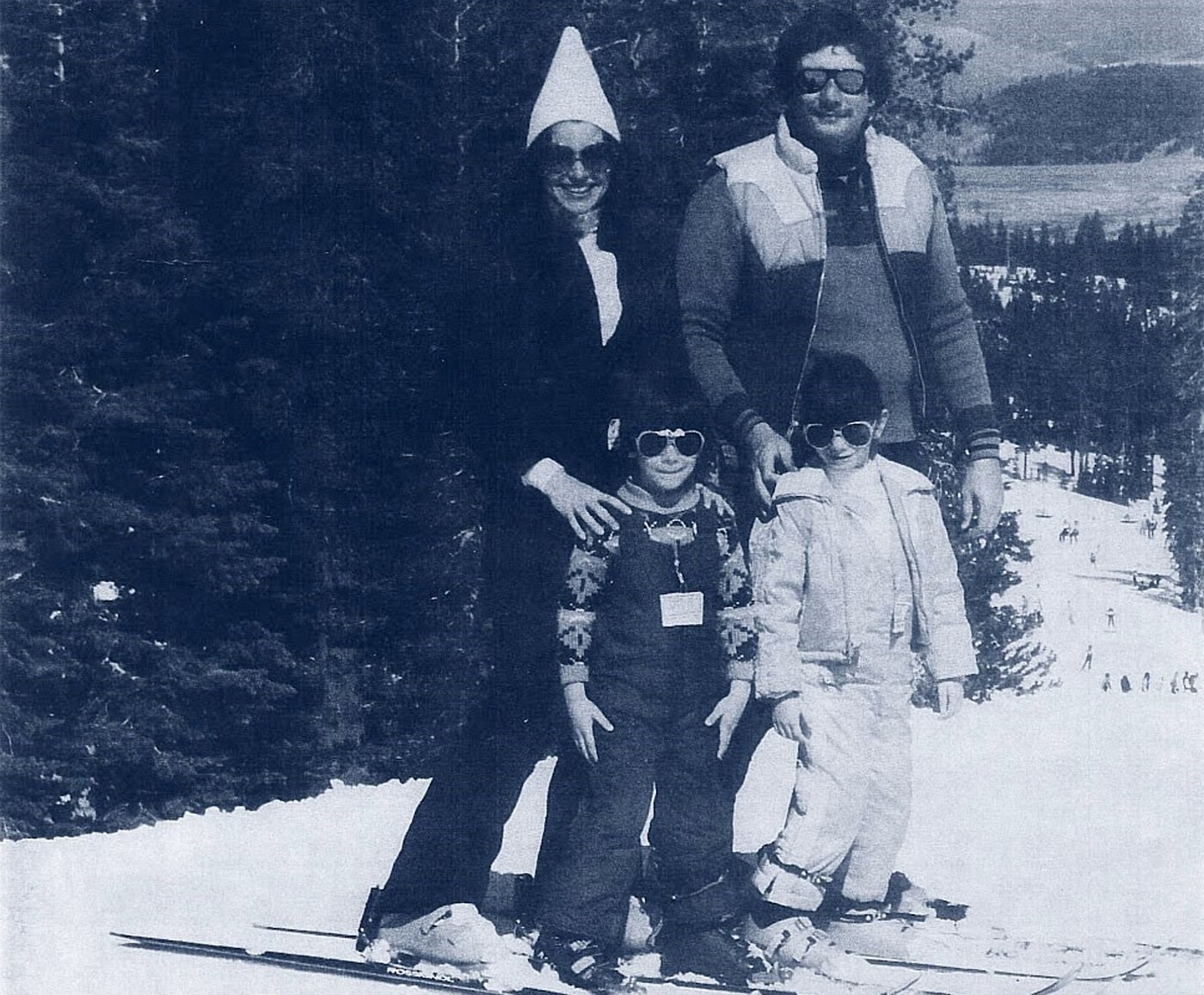
This undated photo provided by the Kovacich family shows, from top left, Janet, Paul, bottom left, Kristi and John Kovacich. (Kovacich Family via AP)
March 24, 2026 - 9:06 PM
LOS ANGELES (AP) — Paul Kovacich, a K-9 commander serving life for his wife's 1982 murder, has a mixed message for the California parole board ahead of his first chance of freedom: He doesn't want an early release — and he didn't kill his beloved German shepherd.
Far from admitting guilt, the 76-year-old argues that newly discovered FBI misconduct should reverse his 2009 conviction in a cold case that haunted the Northern California foothills. His defense team contends that long-suppressed evidence debunks decades-old claims that Kovacich stomped Fuzz, his badge-wearing K-9, to death weeks before his wife disappeared. Her body has never been found.
The dog's demise became a focal point for the FBI years after Janet Kovacich vanished, as agents exhumed and analyzed Fuzz's remains in a bid to prove her husband harbored violent tendencies. Paul Kovacich contends that was a red herring that misled jurors into convicting him, and he's using his first parole hearing Thursday as an opening salvo to clear his name.
“I would love to have the courts release me — not parole,” Kovacich told The Associated Press in an interview this month from the California Institution for Men. “I have something to prove — that I’m innocent.”
Emails from FBI agent's personal account figure prominently
Kovacich's bid hinges on never-before-seen emails between a forensic anthropologist and a veteran FBI agent who used his personal Hotmail account to describe Kovacich as “our bad guy” and, before testing, walk the expert through the “need to demonstrate to the jury that he has a violent side.”
The use of a private account excluded those emails from FBI servers and what's known as Brady material — potentially beneficial evidence turned over to the defense before trial.
“This is a very important aspect to our case,” the now-retired agent, Christopher Hopkins, wrote in 2005 about pinpointing Fuzz's cause of death. Only months earlier, local police had asked the FBI to reopen the case.
The FBI declined to comment. But current and former agents told AP the messages violate bureau policy, which prohibits the use of personal email for government business unless specifically exempted for undercover activities.
Hopkins, who long worked as a forensic examiner for the FBI, told AP there was “no exculpatory information in those emails.”
“I’m guessing my FBI email had significant restrictions at that time or I sent these emails when I did not have access to my FBI email,” Hopkins wrote in a LinkedIn message. “I don’t need to defend my actions to you.”
David Tellman, who prosecuted Kovacich, said the private emails were “concerning” and could prompt authorities to “investigate the integrity of this conviction.” But he argued the emails wouldn’t have changed the outcome of a four-month trial that featured 77 witnesses, several of whom described Kovacich's fraught marriage and muted reaction to his wife's disappearance.
“We are not aware of any new facts that have undermined the evidence on these compelling issues," Tellman, Placer County's chief deputy district attorney, told AP.
Prosecutors are opposing parole for Kovacich, saying he failed to complete required domestic violence and anger control classes behind bars.
Search for missing wife comes up empty
In Auburn, outside Sacramento, the disappearance of Janet Kovacich has been described as “the case police couldn't forget" — steeped in mystery and implicating one of law enforcement's own.
On the morning she was last seen in 1982, Janet Kovacich argued with her husband and said she planned to leave him with their two young children. The night before, she told a friend she was afraid of her husband.
Paul Kovacich, who worked for the Placer County Sheriff's Office from 1974 to 1992, told authorities he ran errands that morning before stopping by the county jail. He said he returned home to find his wife — and her purse — missing.
Detectives didn't buy the alibi — defense attorneys say they also failed to investigate it — but lacked any basis to charge Kovacich. Investigators thought it was unlikely Janet Kovacich would willingly leave her children, citing handwritten entries in her journal showing how close they had been.
Auburn police and a dozen other agencies spent thousands of hours searching for the missing woman. Authorities offered a $10,000 reward. Law enforcement combed the canyons of the American River and nearby caves. National Guard planes deployed infrared heat-seeking equipment.
The FBI dug up a yard using ground-penetrating radar and a tool that emits sonar pulses. And nearly a quarter-century after the woman disappeared, an FBI agent rappelled down a mine shaft armed with an underwater camera and what the bureau described as a “human scent vacuum.”
“Years before the victim’s disappearance," Hopkins explained in FBI records obtained by AP, her husband "told two individuals that he could commit the perfect murder by dumping the murdered victim’s body down a mine shaft.”
A big break came in 1995, months after a judge declared Janet Kovacich legally dead, when hikers found a partial skull at the bottom of a dry lake bed. The skull was missing its lower jaw and teeth but had a hole behind the right ear that authorities attributed to a bullet.
A prosecutor later described that discovery — and the DNA testing that linked the skull to Janet Kovacich in 2007 — as a “pure series of miracles.”
The investigation turns to the death of Fuzz
With a dearth of physical evidence pointing to Paul Kovacich, authorities set their sights on other skeletal remains: the K-9 known as Fuzz. Kovacich long maintained the dog had been poisoned in 1982, but the FBI and others close to Janet Kovacich were convinced the lawman kicked the dog to death while disciplining it for getting into some garbage.
“I loved that dog,” Kovacich told AP. “He was a bundle of energy and a pure beauty.”
The bureau exhumed Fuzz's remains, kept intact by a plastic trash bag, in 2005 and sent them to a bone trauma expert for analysis. That's where the agent's private emails become relevant, Kovacich's defense team contends.
The expert couldn't determine what, exactly, killed the dog in 1982 but found no signs it had been stomped to death — a finding Kovacich's defense team says Hopkins suppressed in his personal emails. The analysis also found an undigested pork rib bone in Fuzz's remains that the defense contends caused the dog's death.
“I cannot imagine a more clearly documented or egregious Brady violation,” defense attorney Kristen Reid wrote to state prosecutors. “Special Agent Hopkins not only suppressed material physical and forensic evidence that would have raised doubts about guilt, he hid proof of actual innocence — helping the real killer escape justice.”
Kovacich's defense team has urged authorities to investigate whether Janet Kovacich actually was targeted by the notorious Golden State Killer, Joseph DeAngelo, who patrolled the area around the Kovacich home before he was fired from the Auburn Police Department. DeAngelo crossed paths with Kovacich on a case involving his other K-9 German shepherd, Adolph.
A judge in 2009 sentenced Kovacich to 27 years to life in prison for first-degree murder, calling the killing “cold, calculated and selfish.”
“It’s hard being in here for something I didn’t do," Kovacich told AP. “But if we can prove all the misconduct in this case, this will have all been worth it. It's going to open a can of worms.”
News from © The Associated Press, 2026