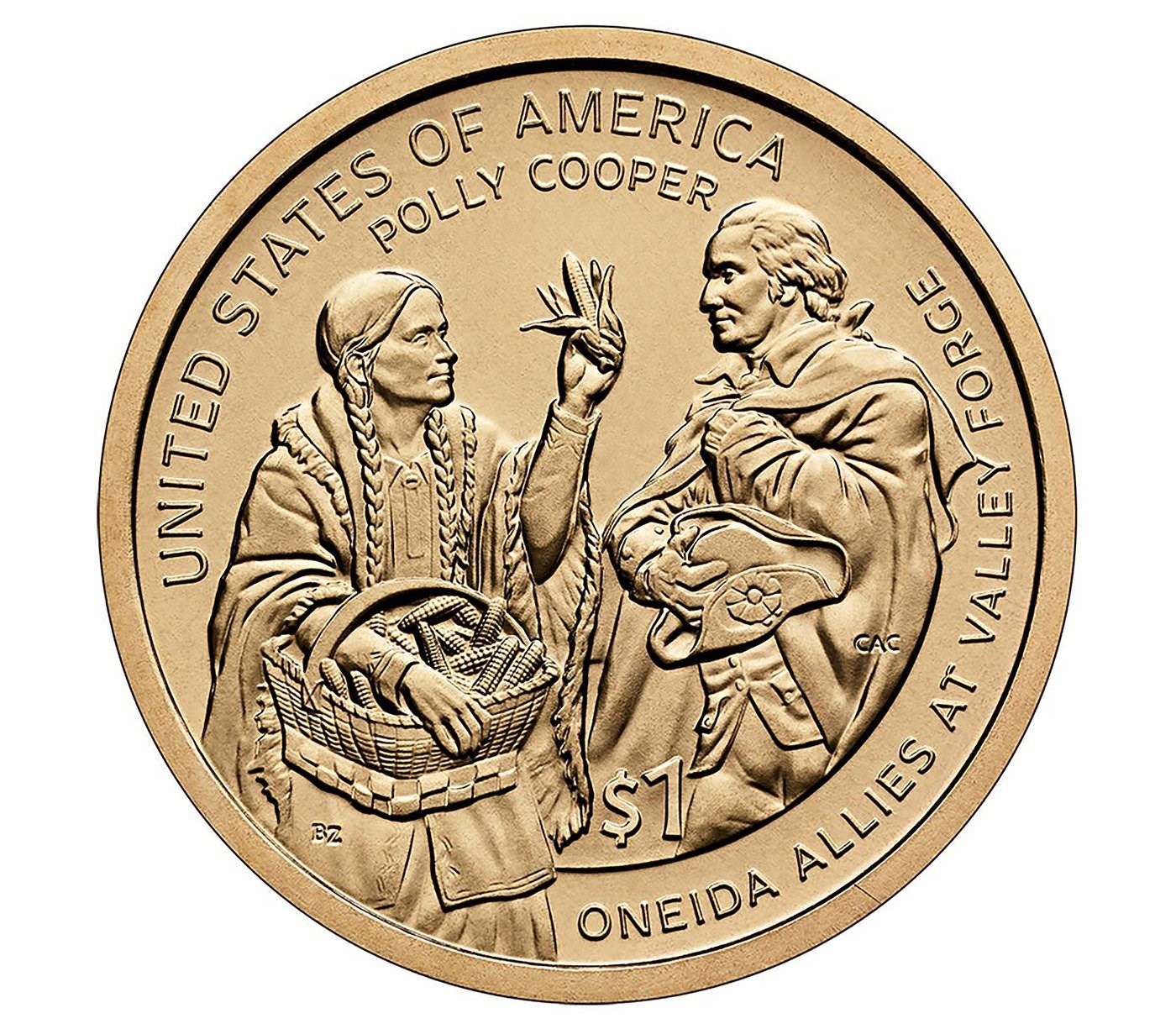
This image provided by the U.S. Mint shows a new $1 coin that depicts Oneida war heroine Polly Cooper giving corn to George Washington. (U.S. Mint via AP)
January 30, 2026 - 3:06 AM
EDGEWOOD, N.M. (AP) — The reverse side of the U.S. Mint’s 2026 Sacagawea $1 coin will feature Polly Cooper, a woman from the Oneida tribe known for helping George Washington’s Continental Army during the Revolutionary War.
The release of the coin this week coincides with celebrations of the 250th anniversary of the signing of the Declaration of Independence. It recognizes Cooper's role in a 1778 relief expedition from Oneida territory in what is now central New York to the rebel troops' winter encampment in Valley Forge, Pennsylvania, where they were facing a food and supply crisis.
“Polly Cooper symbolizes courage that is not just found on the battlefield but in compassion and willingness to help others, which is just a part of Oneida culture and hospitality,” said Ray Halbritter, a representative of the Oneida Indian Nation of New York.
Cooper and a delegation of 47 Oneida warriors carried bushels of white corn on the long, cold trek to feed the starving soldiers. According to Oneida oral tradition, Cooper intervened to prevent Washington’s hungry soldiers from eating the white corn raw, which would have made them sick. She taught them how to prepare hulled corn soup.
The coin features Cooper offering a basket of corn to Washington, a design that Halbritter said his community worked on closely with the U.S. Mint. The other side depicts Sacagawea, a young Native American woman who was a crucial guide for the Lewis and Clark expedition.
It's the latest release under the Native American $1 Coin Program, established by a 2007 act of Congress to commemorate individual Native Americans and tribes.
Past coins have featured Osage prima ballerina Maria Tallchief; Jim Thorpe of the Sac and Fox Nation who was an Olympic champion and multi-sport professional athlete; and landmark historical events like the signing of the 1778 treaty with the Delaware, the first of over 400 treaties negotiated between the United States and Native nations, although not all were ratified.
Oklahoma Republican Sen. Markwayne Mullin, a citizen of the Cherokee Nation, said the program highlights those who helped establish a country grounded in freedom and self-determination.
Meanwhile, some coin designs previously authorized in anticipation of the 250th anniversary have been scrapped by President Donald Trump's administration, including coins that would have featured suffragettes who pushed to give women the right to vote and civil rights icon Ruby Bridges.
The U.S. Department of the Treasury, which oversees the U.S. Mint, did not respond to a request for comment.
The Oneida Indian Nation of New York calls itself “America's first ally.” It broke with the Haudenosaunee Confederacy in allying with the Continental Army “at great sacrifice,” Halbritter said. The alliance made the Oneida a target for retaliation by the British and other Haudenosaunee nations. By the end of the Revolution, as much as a third of the tribe’s population had perished.
“In the long run, the Oneida don't fare any better than tribes that sided with the British,” said Dartmouth College professor Colin Calloway, an expert on Indigenous history during the revolutionary era.
Calloway said a desire to separate Native people from their land was one force that “catapulted” Americans into revolution, and that millions of acres (hectares) of Oneida territory were seized by the state of New York and private land speculators in the decades following the war. This eventually led to the displacement of many Oneida to reservations in Wisconsin and Ontario, Canada.
Like popular historical narratives around Sacagawea and the first encounters between Wampanoag people and the pilgrims, Calloway said Cooper's story could be co-opted to signify a “benign, reciprocal relationship” that never truly existed between American settlers and Indigenous people.
Still, the coin commemorates what Oneidas consider their pivotal role in the nation’s struggle for independence.
“The whole country reaps the benefit of Polly Cooper's conduct because we won the conflict and the United States was born," Halbritter said.
News from © The Associated Press, 2026