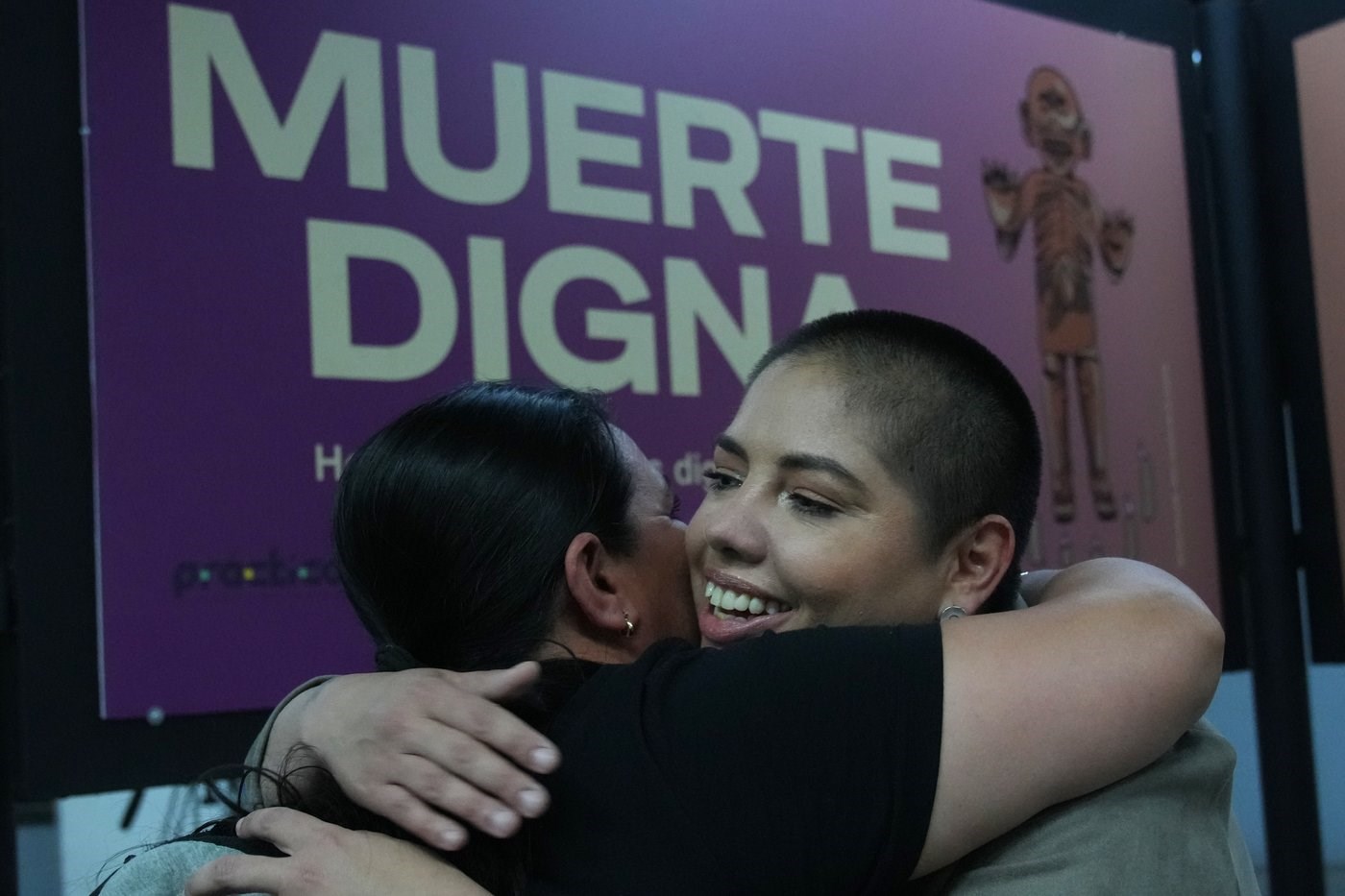
Samara Martínez, a supporter of a law to decriminalize euthanasia, hugs a friend during the "Muerte Digna," or Dignified Death, exhibition at the Ermita metro station in Mexico City, Monday, March 23, 2026. (AP Photo/Marco Ugarte)
March 26, 2026 - 5:02 AM
MEXICO CITY (AP) — Samara Martínez has written countless letters to the illness that weakens her body.
“Dear cursed one,” the Mexican activist once wrote. “I hate you because you have taken things away from me, but I love you because you have been my greatest teacher.”
At 31, Martínez is among the most prominent voices pushing to decriminalize euthanasia in Mexico. The topic has long been debated by advocacy groups, politicians and academics. However, her case has shifted that conversation into the public spotlight as lawmakers weigh possible policy changes.
Martínez developed early signs of chronic kidney failure at age 17. Despite chemotherapy, two kidney transplants, dialysis and frequent hospitalizations, her prognosis estimates she has about five years left to live.
Neither the physical toll nor the personal losses caused by the illness have broken her spirit. Martínez has told her more than half a million social media followers that her life experience has given her resilience and purpose. She often meets with politicians, hosts conferences and keeps her job as an academic in her hometown of Chihuahua, in northern Mexico.
“I would not have taken up this fight unless I had to endure what I’ve had to, so I’ve found in it my purpose,” she said.
The legal landscape
Though not explicitly addressed in the Mexican Constitution, the General Health Law defines euthanasia as “mercy killing” and bans it along with assisted suicide.
Under federal law, assisting or inducing someone to take their own life is punishable by one to five years in prison. If a person directly causes the death, the penalty can increase to 12 years.
Colombia is the only Latin American country where euthanasia is fully legal and regulated. Ecuador decriminalized it in 2024, and Uruguay approved legislation in 2025 that is expected to be implemented.
The proposal pushed by Martínez is known as the Transcendence Law.
It was presented in 2025 by lawmakers from several political groups including Morena, the party of President Claudia Sheinbaum.
The legislation proposes to remove the explicit ban and redefine euthanasia as a legal, voluntary medical procedure. It frames it as a right tied to dignity and autonomy, arguing that life should not be understood as an obligation to prolong suffering.
If approved, the proposal would allow adults to request the procedure. It includes conscientious objection for health workers, but requires public institutions to provide willing staff.
One lawmaker supporting Martínez is Patricia Mercado, a longtime advocate for women’s reproductive and labor rights.
“Samara’s emergence — her struggle, her authenticity — brings the possibility of passing legislation closer,” Mercado said. “A testimony speaks louder than a thousand data points.”
A past version of herself
Martínez often revisits her letters. Writing is cathartic, she said. And reading how her past self confronted her pain helps her recognize the strength she didn’t know she had.
“Today I read things I wrote four years ago and think: I was so wrong,” Martínez said. “But it’s nice to see how there’s more wisdom.”
She recalls a letter from 2021. Her doctor told her that her kidneys could no longer function on their own and she had two options: a transplant or relying on treatments that take over the kidneys’ role of removing waste and excess fluid from the body.
Back then Martínez saw the latter as unthinkable. “I thought I could never live connected to a machine,” she said. But she now undergoes peritoneal dialysis every night, connected for hours to a piece of medical equipment about the size of a printer that she must carry with her wherever she goes.
“An illness like this isn’t for everyone and it’s hard to embrace the pain,” Martínez said. “You can stop living and just exist, but I don’t want that.”
Before everything changed
There was a time when Martínez loved sports. She played soccer and was careful with her diet, thinking she was on track to live a healthy life.
She met her husband in 2013 at university, where she became a journalist. The couple married five years later despite Martínez’s warnings regarding her health.
“Are you sure you want to do this?” she asked him soon after being diagnosed with a broader set of health complications including lupus, an autoimmune disease. He answered that no adversity would ever take him from her side.
By the time the marriage crumbled in 2024, Martínez had lost more than love. After more than a decade of severe illness, she had also lost her dream job at a publishing house after telling her boss she would undergo a transplant and might need a week to recover. Debt piled up, forcing her to sell her home and leading her parents to take out loans. Long-time friends vanished.
Vomiting, weight gain from steroids used in her treatment and hospitalization became part of her routine. Martínez has actively avoided presenting herself as a victim and strongly rejects pity. But she said that at certain stages, anger and doubt became unavoidable.
“I consider myself agnostic, but there are moments when you look up at the sky and question God — why me?” she said. “Now I practice stoicism and live each day with gratitude.”
A debate that goes beyond the law
Critics of her stance often flood Martínez with abusive messages online. “I’ve been told that if God wants me to suffer, then I should suffer,” she said.
Opposition to euthanasia remains strong among conservative and religious groups in Mexico. Following the presentation of Martínez’s proposal, the Catholic Church echoed Pope Leo’s call to uphold the sanctity of life.
Rodrigo Iván Cortés, president of a conservative advocacy group, said they view life as something that must be protected from the womb through old age. “For us, the value of life spans every stage,” he said.
Among the few religious leaders supporting Martínez’s cause is the Rev. Héctor Reyes, who collaborates with the organization “For the Right to Die with Dignity.” The group has defended euthanasia for almost two decades.
“Transcendence has everything to do with the God I believe in,” said Reyes, who added that people should not remain trapped in the image of a judgmental and punishing God. “For me, transcendence lies in the hope that life doesn’t end with physical death.”
A farewell shaped by choice
Martínez has said she has no intention of giving up. Yet when her body gives out, she dreams of saying her farewells by the sea.
It is not cowardice that drives her, she has said, but the belief that choosing how to die is the most courageous decision of her life.
Her parents struggled the day she told them she would spend her remaining days fighting for euthanasia. “That meant beginning to grieve while I was still alive,” she said. “When my father asked me why I had to fight for this, I told him that if I didn’t do it, no one else would.”
Martínez says she’s aware that she might not live to see the outcome of her fight. But pushing for change, she says, has already been worth it.
When the end is near she wishes for a sunset far from a hospital bed. A gathering to celebrate her life, surrounded by family and friends.
“That’s what my life deserves,” she said. “A proper time to say goodbye, to laugh and cry, and leave in peace.”
___
Associated Press religion coverage receives support through the AP’s collaboration with The Conversation US, with funding from Lilly Endowment Inc. The AP is solely responsible for this content.
News from © The Associated Press, 2026