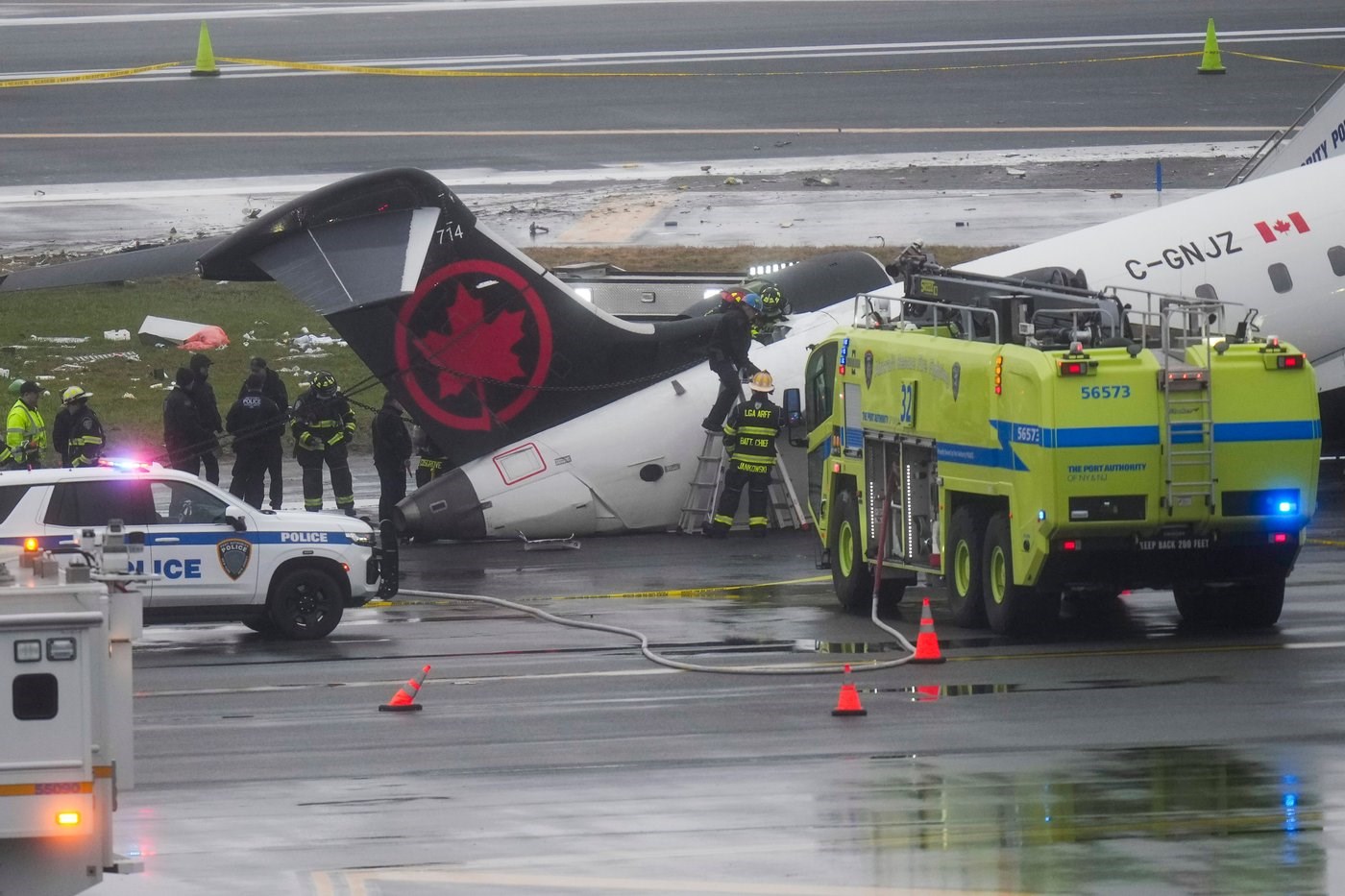
Firefighters and investigators examine the site, Monday, March 23, 2026, where an Air Canada jet came to rest after colliding with a Port Authority fire truck at LaGuardia Airport, after landing Sunday night in New York. (AP Photo/Seth Wenig)
Republished March 23, 2026 - 7:07 PM
Original Publication Date March 23, 2026 - 11:01 AM
MONTREAL — A fatal collision between an Air Canada jet and a fire truck at LaGuardia Airport late Sunday has drawn attention to the demands that a strained air navigation system places on traffic controllers, and how even strict protocols may fail to prevent a tragedy.
Audio from the tower revealed that a controller had been dealing with an earlier emergency when he cleared Air Canada Express Flight 8646 to land. Less than a minute later, he cleared a fire truck to cross the active runway.
Footage viewed by The Canadian Press shows the Bombardier CRJ-900 jet speeding along the rain-streaked strip as the truck crosses its path, turning away too late from an impact that unleashed a trail of smoke and debris as the plane skidded more than 100 metres farther, its cockpit crumpled.
The controller recognized the danger moments beforehand, instructing to tell the truck to "stop" — 12 times in 10 seconds — but receiving no reply.
"I messed up," he says in the aftermath.
"I tried to reach out. We were dealing with an emergency earlier."
The collision occurred shortly after 11:30 p.m. on Sunday as the plane — operated by Air Canada Express carrier Jazz Aviation — touched down in New York City after its journey from Montreal's Trudeau airport. The crash killed two pilots and sent 41 people to hospital, including the fire crew.
New York-based aviation lawyer Erin Applebaum called the incident "an avoidable tragedy."
"This is a controller's absolute worst nightmare," she said.
"It's important to point out that there was another emergency going on at the same time. It was just a confluence of factors."
The tower had been dealing with a United Airlines flight that aborted its takeoff after the crew reported a strange odour in the cabin and began to hunt for a spare gate, with some flight attendants feeling ill and emergency vehicles en route.
Experts say it's not uncommon — particularly late at night when takeoffs and landings are fewer — for the same air traffic controller to handle both incoming aircraft and groundcrew movement, as appeared to be the case Sunday based on tower communications. But industry observers also say it raises questions about whether more air navigation resources are needed and the risks of a staffing shortage that has plagued the industry for years.
“It’s going to bring them to the forefront,” said Phyl Durdey, CEO of Brampton, Ont.-based Flightline Training Services.
"He's under a lot of duress," he said of the flight controller.
U.S. Transportation Secretary Sean Duffy said LaGuardia has a staffing target of 37 air traffic controllers. Currently, 33 controllers are employed and seven are in training.
"As our airports go, LaGuardia is a very well-staffed airport," Duffy said Monday.
Staffing issues have come under the spotlight in recent years. Several experts pointed to a deadly mid-air crash in Washington, D.C., in January last year.
The collision between an American Airlines jet carrying 64 people and a Black Hawk army helicopter carrying three soldiers killed everyone on board both aircraft, making it the worst U.S. aviation disaster in almost a quarter century.
"Just like in the D.C. collision, the investigators are going to focus not only on the direct cause of this tragedy, but the larger root causes. What kind of position was this controller placed in as a result of staffing shortages and increased workload?" asked aviation lawyer Kevin Mahoney.
Investigators will have numerous questions to sort through, ranging from cockpit recordings and flight data to the traffic controller’s schedule.
“How long had the person been on duty ... what was the workload, what were their duties, what could they have done?” asked David McNair, a former aviation safety investigator with the Transportation Safety Board of Canada.
“They'll also look at what could the pilots have done — in my perspective as a pilot, not very much.”
Another question mark is whether the aviators or truck crew registered more than a couple of seconds in advance that they were bearing down on the runway at the same time.
“The controller was talking on the same tower frequency as the fire truck and the plane” — so the two should have been able to hear each other — said Benoit Gauthier, a retired pilot who flew with Air Canada for 37 years.
“LaGuardia’s a pretty busy place. Sometimes it could get slightly hectic.”
A preliminary report by the U.S. National Transportation Safety Board is expected within several days, followed by a more thorough investigation that could last more than a year.
A Transport Canada adviser and Transportation Safety Board investigators have been deployed to New York to assist, said Transport Minister Steven MacKinnon.
“I want to reassure everyone travelling that we have among the most modern, best systems in the world, and we need to keep working to maintain them,” he told reporters in Ottawa.
In the U.S., the past three years have seen several near misses, prompting some officials and industry players to sound the alarm.
In 2023, the U.S. Federal Aviation Administration convened industry leaders to address what it saw as a national system under strain. The agency announced plans to ratchet up hiring of air traffic controllers, deal with complaints of fatigue and install new technology to alert personnel when planes were on a possible collision course.
North of the border, Nav Canada, which provides air traffic control for the country's airports, warned last April of flight delays caused by "resource constraints" in Vancouver.
Filling the countrywide labour gap remains a challenge. The process to become an air traffic professional is among the longest in aviation, topped only by pilots and a few other specialized jobs. The role demands between 10 and 27 months of training. Parental leave or a move to a new airport mean months of retraining.
At Nav Canada, the graduation rates for air traffic controllers sat at about 40 per cent last year, according to its chief human resources officer.
This report by The Canadian Press was first published March 23, 2026.
Companies in this story: (TSX:AC, TSX:CHR)
— With files from Kelly Geraldine Malone in New York and Nick Murray in Ottawa
News from © The Canadian Press, 2026