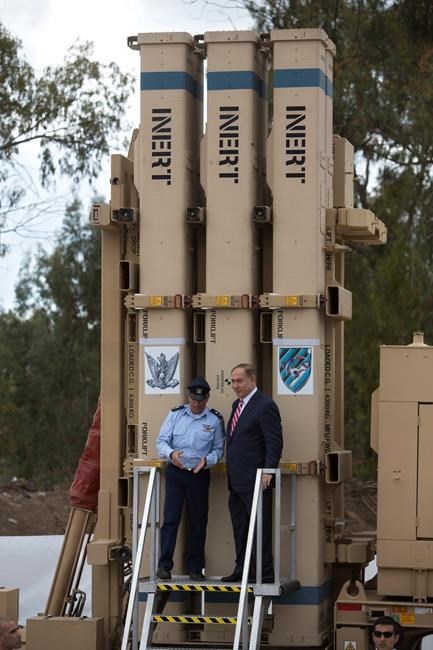
Israeli Prime Minister Benjamin Netanyahu, right stands with Israeli air force commander, Major General, Amir Eshel, next to the David's Sling Air Defense System during a ceremony at the Hatzor Air Base, Israel. Sunday, April 2, 2017. Prime Minister Benjamin Netanyahu warned Israel's enemies not to test the Jewish state at a ceremony inaugurating the joint U.S.-Israeli missile interceptor. (AP Photo/Sebastian Scheiner)
Republished April 02, 2017 - 8:11 AM
Original Publication Date April 02, 2017 - 6:40 AM
JERUSALEM - A joint U.S.-Israeli missile interceptor meant to counter the type of medium-range missiles possessed by Iranian-backed Hezbollah militants became operational Sunday, completing Israel's multi-layer defence system amid tensions on its frontiers with Syria and Gaza.
Prime Minister Benjamin Netanyahu said at the unveiling ceremony for the David's Sling system that defending the home front is of the "utmost importance." He went on to warn "whoever tries to strike us will be hit, those that threaten our existence put themselves in existential danger."
David Sling's marks the completion of Israel's multi-tier system that includes the Arrow, designed to intercept long-range ballistic missiles in the stratosphere with an eye on Iran, and Iron Dome, which defends against short-range rockets from the Gaza Strip.
David's Sling was developed by Israeli defence firm Rafael with American defence giant Raytheon.
The system became operational Sunday amid heightened tensions along Israel's northern borders with Lebanon and Syria.
In a rare clash along the Syrian border last month Israel shot down an anti-aircraft missile fired at its planes as they were carrying out an airstrike on a suspected Hezbollah weapons convoy from Syria to Hezbollah militants in Lebanon.
Israel is also on alert in the south of the country after Gaza's Hamas rulers accused it of assassinating a member of the Islamic militant group.
An annual intelligence assessment found that both Hezbollah and Hamas are probably not interested in sparking a war in 2017, but it warned of the danger of a dynamic of escalation leading to conflict.
In February, Hezbollah leader Hassan Nasrallah said Hezbollah was not seeking a resumption of hostilities. But he vowed that if war did begin, his forces would strike Israel's Dimona nuclear facilities.
News from © The Associated Press, 2017