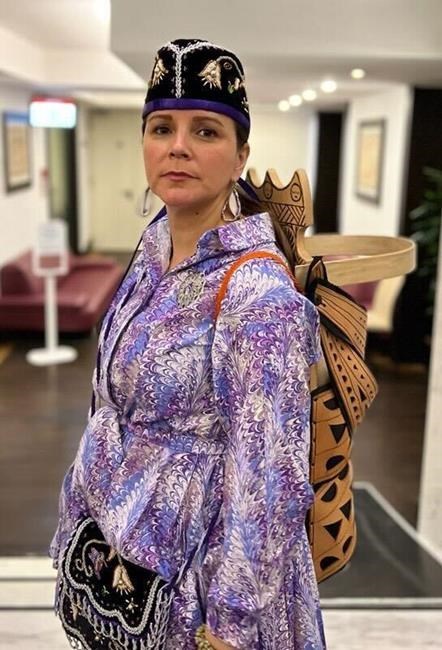
Michelle Schenandoah, in a handout photo, wears an intricate cradle board in Rome that she presented to Pope Francis to represent the First Nation delegates taking their children home. Schenandoah said the Pope will not be able to keep the board and it was to be retrieved from the Vatican on Friday. THE CANADIAN PRESS/HO-Katsisionni Fox **MANDATORY CREDIT**
April 01, 2022 - 8:06 AM
Andy Wilson’s arduous work of repatriating cultural artifacts of his people is always with his ancestors in mind.
“We’re here because of them,” said Wilson, co-founder of the Skidegate and Haida repatriation committees in British Columbia.
“When we look at the artifacts, we go, ‘Oh, our ancestors touched this. It could have been my great, great grandmother or grandfather.’”
The topic of repatriating Indigenous artifacts was among discussionsat the Vatican this week. More than 30 Indigenous delegates had meetings with the Pope about the role of the Roman Catholic Church in Canada's residential school system.
The delegates were also given access to the Anima Mundi Ethnological Museum, which includes some of the Vatican’s collection of Indigenous artifacts. The collection is known to contain masks, wampum belts, pipes and rugs.
Delegates on Tuesday saw a rare kayak made by Inuvialuit. The Inuvialuit Regional Corp. requested last year that it be returned.
Wilson said repatriation is a long process and communities must get organized if they want to be successful in claiming their cultural artifacts.
“One of the things that has to happen is the community that’s going to make a request should get a committee together to represent their nation, so they can say that they are appointed by their political groups, their chiefs and their elders,” Wilson said.
For his Haida Nation, repatriation involved artifacts and the remains of ancestors. The Haida almost lost the art of making bentwood boxes, which are used for burials. He and others used items returned from museums around the world to relearn how to make them.
Wilson said negotiations can take months and sometimes years, but the goal is to establish relationships with people running the institutions.
He also said communities must make contacts with people who know about museum protocols, so repatriated items can be sent back and stored safely.
“Another thing that has to happen is they have to have consultation with their community,” Wilson said. “We got feedback from the community about what they wanted back, where these artifacts were going to go and how they were going to be treated. There’s a lot to it.”
The Vatican has said parts of its collection were gifts to popes and the church. In 2019, the Pope committed to putting many more objects on display, including those of Indigenous people.
Gerald McMaster, a professor at OCAD University in Ontario, said there are laws in the United States requiring institutions that receive federal funding to make their collections known to Indigenous communities.
But such laws do not exist in Canada or Europe, making it more difficult for Indigenous communities to have access to their artifacts to begin the repatriation process.
McMaster, who is Plains Cree and a citizen of the Siksika Nation in southern Alberta, said many artifacts were taken during the creation of the Indian Act in 1876, when many Indigenous practices became illegal.
“That wasn’t rescinded or changed until 1951, so for years there was an accumulation of objects that couldn’t be used,” McMaster said.
“Some museums, collectors and tourists understood this, so some Indigenous people were trading, and some items were literally stolen, such as totem poles on the coast that were cut down.”
McMaster said he hopes the delegation in Rome can convince the Vatican to open its collection and archives for academics such as himself, who have long complained about the lack of access to the unknown number of objects in the church’s possession.
“I have not found any problem with accessing any other collections, whether it’s Canadian, American or European, but the Vatican is a special place,” McMaster, whose research focuses on Indigenous representations of newcomers to the Americas, said with a chuckle.
Tiffany Prete, assistant professor at the Department of Sociology at the University of Lethbridge, said truth and justice are important if the Catholic Church is serious about reconciliation.
“It’s having the Pope and the Roman Catholic Church acknowledge what has happened and the truth of how these items have actually ended up in the Vatican’s private collection," said Prete, a member of the Blood Tribe in southern Alberta.
She said there should be funding for researchers in the Vatican to be able to create an exhibit catalogue of all Indigenous items in its collection and to make it accessible to communities in Canada.
"I think every group of Indigenous people should have the ability to decide, 'Do we want everything back? Do we want to donate anything to the Vatican?'" Prete said. "It should really be left to the specific groups on what they would like to be done."
She adds that if certain nations decide to keep some artifacts in the Vatican, they should have a say on how the items are publicly displayed and presented.
"The Roman Catholic faith for over a century taught in the residential schools that Indigenous Peoples were bad and evil for being Indigenous, which is not true," Prete said.
"They helped the Canadian government rid themselves of what has famously been described in Canada as the Indian problem … so it would be nice to see them joined in ceremony with Indigenous Peoples over the repatriation of Indigenous artifacts."
This report by The Canadian Press was first published April 1, 2022.
News from © The Canadian Press, 2022