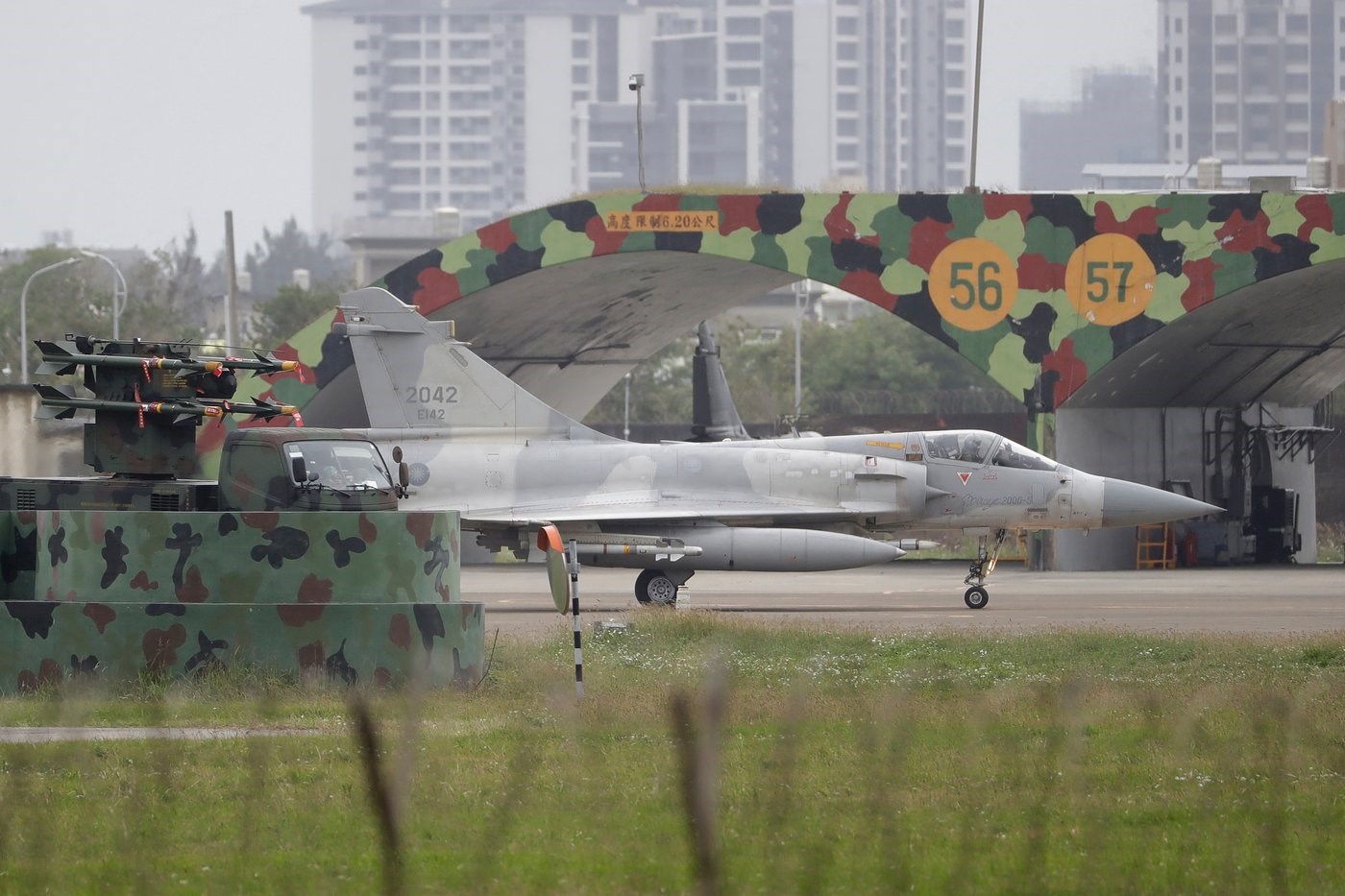
A Taiwan's Mirage 2000 fighter jet runs past an airplane fort at an airbase in Hsinchu, northern Taiwan, Tuesday, Dec. 30, 2025. (AP Photo/Chiang Ying-ying)
Republished December 29, 2025 - 11:28 PM
Original Publication Date December 29, 2025 - 9:51 PM
TAIPEI, Taiwan (AP) — China's People's Liberation Army staged a second day of large-scale military drills around Taiwan on Tuesday, unleashing a live-fire show of force as part of what it called “Justice Mission 2025" to demonstrate its ability to deter any external support for the island it claims as part of its sovereign territory.
Taiwanese officials said some of China's live rounds landed closer to the island than before.
The maneuvers increased tension around the Taiwan Strait as 2025 drew to a close, but the impact extended beyond military pressure into everyday life. Taiwan’s Civil Aviation Administration was notified that seven temporary “dangerous zones” had been set up around the strait. The schedules of Taiwan’s four international airports on Tuesday afternoon showed over 150 international and domestic flights had revised times, delays or cancellations.
Xinhua, China's official news agency, posted a commentary late Monday saying the drills sent an unequivocal message: That Beijing is always ready to prevent anything that tries to split Taiwan from China. Each escalation, it said, would be met with stronger countermeasures.
“By currying favor with the United States through obsequious loyalty gestures and promoting arms purchases, the DPP is binding the entire island of Taiwan to its catastrophic secessionist chariot, disregarding public opinion,” it wrote, referring to Taiwan’s ruling Democratic Progressive Party.
The PLA’s Eastern Theater Command sent destroyers, frigates, fighters and bombers to the waters to the north and south of the island to test its ability in sea-air coordination and blockading. Its ground forces carried out long-range, live-fire drills in the waters to the island’s north. They also organized live-fire training alongside simulated long-range joint strike with air, navy and missiles units, in the waters to Taiwan’s south, achieving what command spokesperson Li Xi called “desired effects.”
Hsieh Jih-sheng, deputy chief of the general staff for intelligence at the Taiwanese Defense Ministry, said some of the 27 rockets detected in the waters near Taiwan fell within its 24-nautical-mile (44-kilometer) line. “The landing points of rounds definitely were closer to Taiwan compared to the past,” he said. “This is a message it deliberately wants to convey.”
Aircraft, vessels and a Chinese balloon detected
Taiwan President Lai Ching-te said Tuesday his territory would act responsibly by neither escalating conflict nor provoking disputes. He condemned the drills.
Taiwan's Defense Ministry said it had detected 130 aircraft, including fighters and bombers, 14 military ships and eight other official ships around the island between 6 a.m. Monday and 6 a.m. Tuesday. Its forces kept monitoring and deployed aircraft, navy ships and coastal missile systems in response. Ninety of the Chinese aircraft crossed the median line of the strait. A Chinese military balloon was also spotted, it said.
The ministry later said it detected 71 aircraft, 13 military ships and 15 coastal guard and official vessels as of 3 p.m. Tuesday, in addition to four other warships in the western Pacific. A total of 941 flights were affected by the drills, it said.
“The military power is not necessarily the strongest, but the scale of the drills has become larger each time compared to the last,” Hsieh said. He accused Chinese forces of trying to influence public morale and undermine trust in the Taiwanese military and government.
China has vowed to seize the island, by force if necessary. Beijing sends warplanes and navy vessels toward the island on a near-daily basis.
Chinese Defense Ministry spokesperson Zhang Xiaogang said the drills served as a stern warning to “Taiwan independence” separatist forces and external forces, without naming any countries.
He criticized Lai 's administration for what it called pandering to external forces and pursuing independence, saying that was the root cause of disrupting the status quo in the strait and escalating tensions.
Last week, Beijing imposed sanctions against 20 defense-related U.S. companies and 10 executives, following a Washington announcement of large-scale arms sales to Taiwan valued at more than $10 billion.
Under U.S. law, Washington is obligated to assist Taipei with its defense, a point that has become increasingly contentious with China over the years.
Beijing slams Japan
On Monday, U.S. President Donald Trump said that while he was not informed of the military exercise in advance, neither was he particularly worried about it. He touted his “great relationship” with Chinese President Xi Jinping and suggested he didn’t think Xi was going to attack Taiwan.
The Taiwan issue also heightened China-Japan tensions. Beijing has expressed anger at a statement by Japan’s prime minister, Sanae Takaichi, saying its military could get involved if China takes action against the democratically ruled island. There remains widespread overall suspicion in China about Japan that goes back generations to when imperial Japan brutally took over parts of China in the years before World War II.
Chinese Foreign Minister Wang Yi slammed both Japan and Taiwan’s “pro-independence forces."
“Japan, which launched the war of aggression against China, not only fails to deeply reflect on the numerous crimes it committed, but its current leaders also openly challenge China’s territorial sovereignty, the historical conclusions of World War II, and the post-war international order,” he said Tuesday during an event in Beijing. China, Wang added, “must be highly vigilant against the resurgence of Japanese militarism.”
China and Taiwan have been governed separately since 1949, when the Communist Party rose to power in Beijing following a civil war. Defeated Nationalist Party forces fled to Taiwan, which later transitioned from martial law to multiparty democracy.
Stoking the tensions, China's Eastern Theater Command posted a series of online images and videos carrying provocative language throughout the exercises. It posted a video of live rounds being fired from ships and a ground-based launcher on Tuesday.
Chen Wen-chin, chairman of the Keelung District Fishermen’s Association in Taiwan, said the group started radio broadcasting every hour from Monday to inform fishermen about where China's exercises took place, urging them to avoid danger.
“The Chinese military exercises have prevented fishermen from fishing, which is their livelihood," Chen said. “The inability to fish has had a significant impact on them and caused economic losses."
___
Leung reported from Hong Kong. Associated Press journalists Taijing Wu in Taiwan and Simina Mistreanu in Beijing contributed to this report.
News from © The Associated Press, 2025