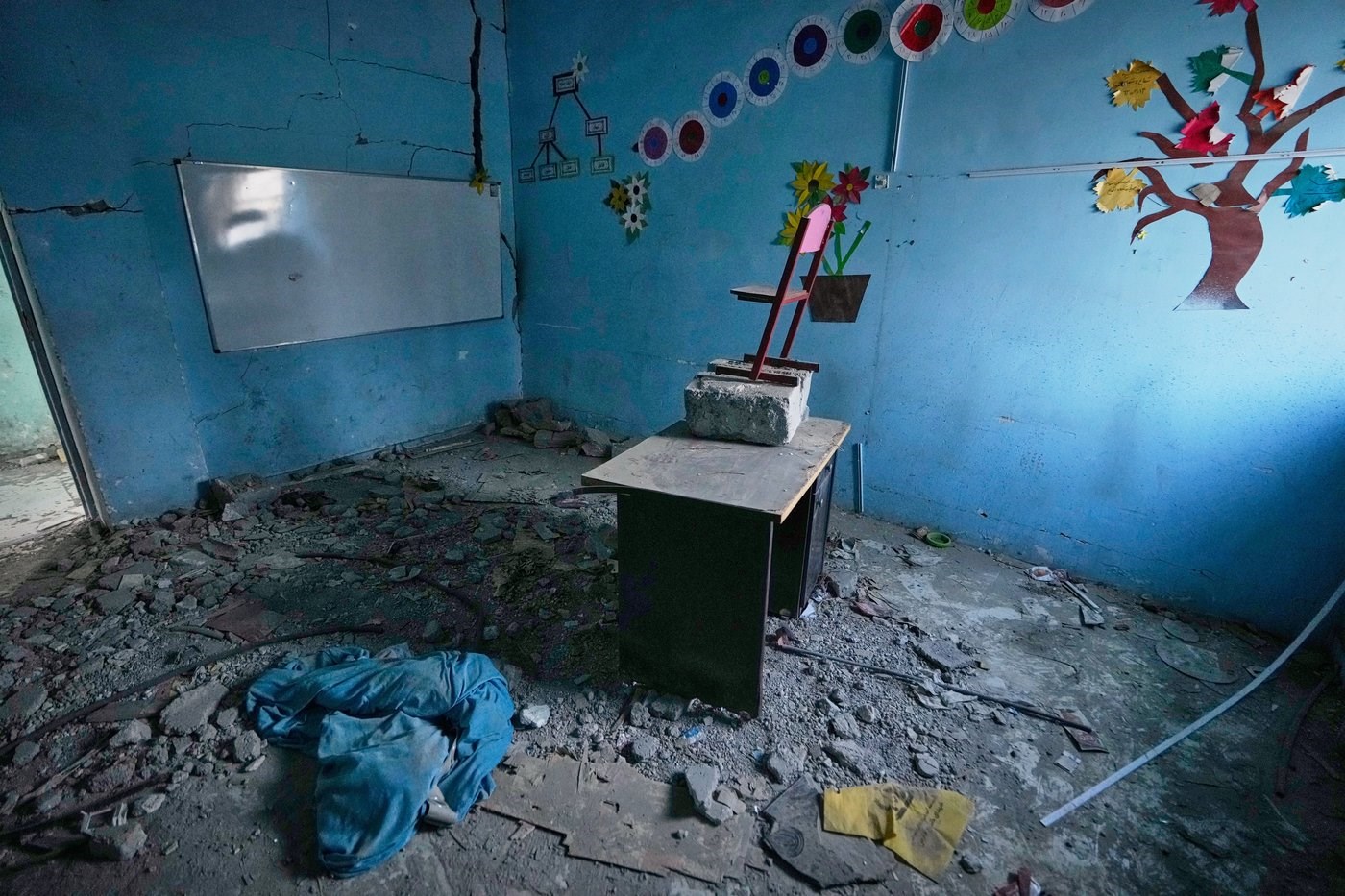
Colorful tree and flower decorations remain on the walls of a rubble-strewn classroom at Shajareh Tayyebeh school, damaged in a U.S. airstrike on Feb. 28, in Minab, southern Iran, Monday, Sept. 7, 2026. (AP Photo/Vahid Salemi)
Republished September 17, 2026 - 6:00 AM
Original Publication Date September 17, 2026 - 3:56 AM
United Nations-backed human rights experts said on Thursday there are “reasonable grounds” to believe the United States committed war crimes in two strikes in Iran on the first day of the war.
Meanwhile, the Palestinian Authority condemned the U.S. decision to deny its officials visas needed to attend the upcoming U.N. General Assembly. And countries that recently signed a defense pact with Saudi Arabia are calling for the escalation in fighting in neighboring Yemen to end.
Here’s a look at the latest news in the Middle East on Thursday. Full coverage can be found here.
UN-backed experts look at US strikes in Iran
Human rights experts commissioned by the U.N.’s top human rights body said their findings focus on a pair of U.S. strikes that killed at least 178 civilians, including women and children, on the first day of the war in Iran.
At least one U.S. missile hit the Shajareh Tayyebeh school in Minab, according to an Associated Press investigation. The Trump administration has yet to directly accept the blame or release findings of a Pentagon investigation into the school bombing.
The U.N.-backed team made the allegations of war crimes over the strike on the “clearly identifiable” school and another airstrike where missiles dispersed tungsten pellets over a “clearly identifiable sports complex and residential area” in the southern city of Lamerd.
Palestinian Authority objects to US decision on visas
The Palestinian Authority condemned the U.S. denial of visas for Palestinian President Mahmoud Abbas and other PA officials ahead of the U.N. General Assembly and called Israel’s actions “the real threat to the two-state solution and prospects for peace.”
The authority administers parts of the Israeli-occupied West Bank. It also pushed back against U.S. accusations that it has glorified extremism and strayed from the path toward peace with Israel.
Its foreign ministry said it remained committed to long-stalled negotiations but defended its efforts to gain Palestinian recognition through international bodies and courts. The U.S. opposes the strategy, saying it “internationalizes” the Israeli-Palestinian conflict and seeks to circumvent negotiations.
Israel expands plan for controversial West Bank settlement
Israel will open the bidding for an additional 2,167 units in a settlement project that would effectively cut the West Bank in two, two days before elections on Oct. 27.
The new tender, which seeks bids from developers, would bring the total number of housing units for the E1 project to 3,401. The would effectively . Critics say the planned settlement, on an open tract of land east of Jerusalem, would prevent the possibility of a Palestinian state in the territory.
The project will be “extremely difficult to reverse” under any future government, the Israeli rights group Ir Amim said in a statement.
A spokesperson for Palestinian President Mahmoud Abbas condemned the new units as a violation of international law. Israeli Prime Minister Benjamin Netanyahu’s office did not immediately respond to a request for comment. The E1 project was on hold for years due to U.S. pressure.
Protests over fuel prices lead to change in Syria
Syria will provide subsidized diesel fuel for heating and agriculture after sharp price increases sparked widespread protests this week.
The energy minister said Thursday that the government would set a tiered system of prices for diesel, with subsidized fuel being sold at 115 Syrian pounds ($0.94) per liter (35 ounces).
The government on Sunday announced price increases of 30% to 40% for gasoline and diesel, citing the U.S.-Iran war and repairs at a major oil refinery. In northeastern Syria, hundreds of oil trucks were stranded when protesters upset over prices blocked a highway.
Israel and Morocco deepen diplomatic ties
Israel and Morocco said they will open embassies and expand relations established under the U.S.-brokered Abraham Accords, which saw four Arab countries normalize ties with Israel in 2020.
Israel and Morocco announced the move in a joint statement with the United States, saying that integrating Israel into the broader Arab world “will lead to peace, stability and shared prosperity.” The Abraham Accords were a marquee foreign policy achievement of President Donald Trump’s first term.
Saudi allies call for calm in Yemen
Pakistan and Turkey, which recently signed a defense pact with Saudi Arabia, have condemned the recent attacks by Iran-backed Houthi rebels in Yemen against the kingdom.
Turkey's defense ministry described the pact as defensive in nature, focusing on collective deterrence, military cooperation and strengthening the countries’ defense capabilities. It said the signatories were working toward “institutionalizing” the alliance.
___
This piece will be updated throughout the day as new developments emerge.
News from © The Associated Press, 2026