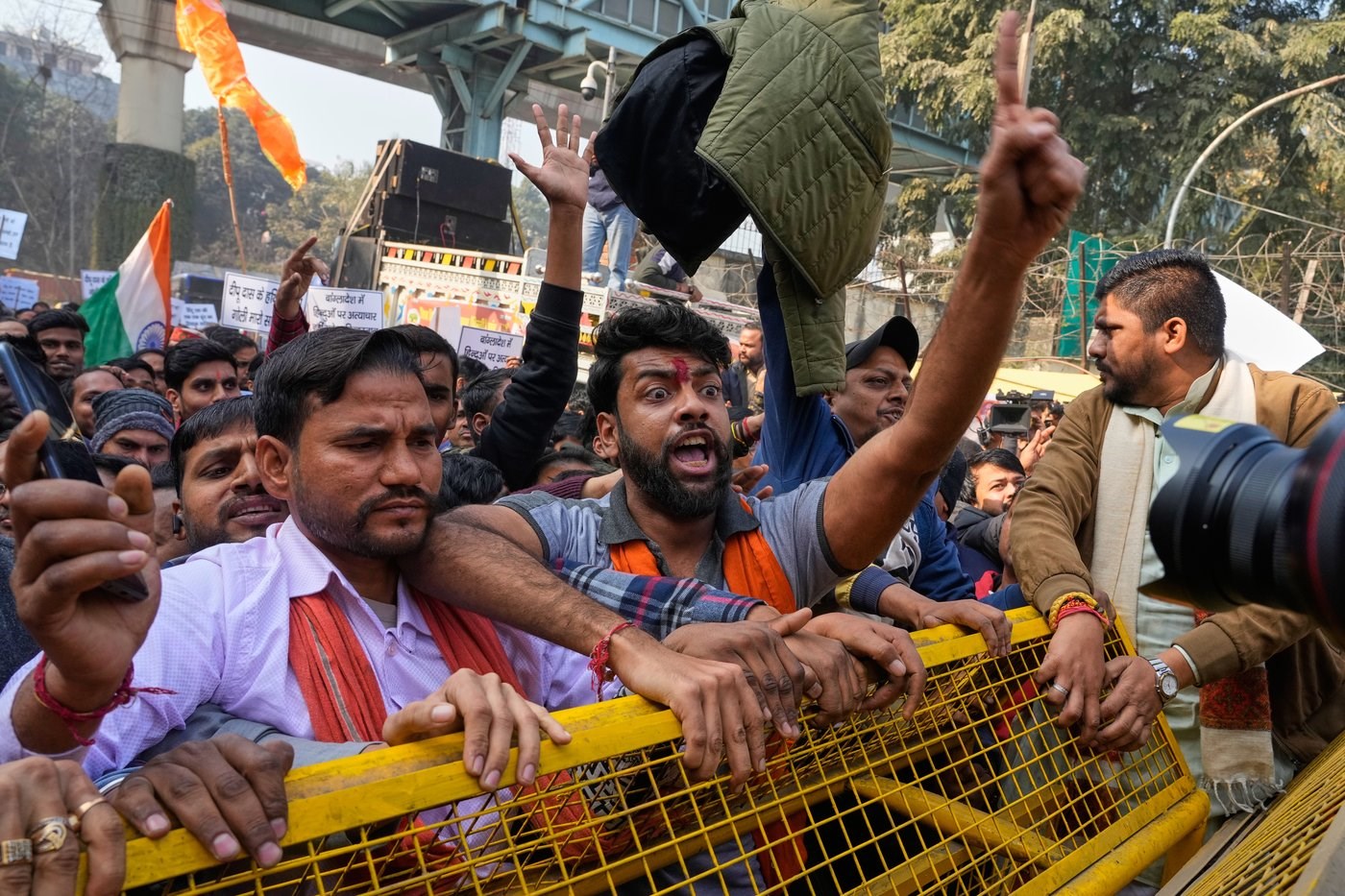
Activists of Vishwa Hindu Parishad, a prominent right-wing Hindu nationalist organization, shout slogans during a protest near Bangladesh High Commission accusing Bangladeshi groups of wrongly targeting Indians, in New Delhi, India, Tuesday, Dec.23, 2025. (AP Photo/Manish Swarup)
December 22, 2025 - 8:12 PM
NEW DELHI (AP) — A protest erupted in India’s capital Tuesday in response to the death of a Hindu man who was lynched and burned by an angry mob in neighboring Bangladesh, a new sign of strain in relations between the neighboring countries.
The protest in New Delhi, mainly led by Hindu nationalist organization Vishva Hindu Parishad, highlights the fragility in the relationship between India and Bangladesh, which often is held up as a rare example of stability in South Asia.
Bangladeshi student leader Sharif Osman Hadi died in a hospital in Singapore on Thursday after being shot on Dec. 12 in Dhaka. Police in Bangladesh said they identified suspects and the shooter likely had fled to India.
Hadi’s death triggered widespread violence in Dhaka. The offices of two national daily newspapers were torched and Indian diplomatic missions were targeted. A Hindu man also was burned alive, which sparked the protest Tuesday in India.
Hundreds of demonstrators gathered Tuesday near the Bangladesh High Commission in New Delhi, shouting slogans and accusing Bangladeshi groups of wrongly targeting minorities. They carried placards and banners with slogans including “India will not tolerate torture of Hindus in Bangladesh” and “Our silence should not be mistaken as weakness, we are lions.”
Authorities erected barricades and imposed tight security around the diplomatic enclave that included police and armored vehicles. Security personnel used batons to hold back some protesters who broke through barricades in an apparent attempt to enter the embassy.
One of the Indian protestors, Rajkumar Jindal, threatened “dire consequences” if authorities in Bangladesh failed to stop violence against Hindus.
“People who are committing atrocities should stop doing that. We are here to awaken the people who are asleep,” Jindal said.
Hadi took part in a 2024 political uprising that ended the 15-year rule of former Bangladesh Prime Minister Sheikh Hasina, who has been in exile since fleeing Bangladesh on Aug. 5, 2024. He was a fierce critic of India and Hasina and planned to run as an independent candidate in a major constituency in Dhaka in the next national elections in February.
Hadi's death sparked a new diplomatic squabble with India and prompted New Delhi this week to summon Bangladesh’s envoy.
Bangladesh’s Ministry of Foreign Affairs also summoned Pranay Verma, the Indian high commissioner to Bangladesh, to apprise him of the security situation at Bangladesh missions in New Delhi and state capitals Kolkata and Agartala, a leading Bengali-language newspaper reported Tuesday.
Tensions between India and Bangladesh increased again with the death on Thursday of Dipu Chandra Das, a 25-year-old Hindu man who was lynched and burned publicly following allegations of blasphemy in Mymensingh district’s Bhaluka subdistrict.
Das's killing contributed to a pattern of fear among the Hindu community in Bangladesh following the ouster of Hasina.
Religious minority groups including Hindus and Christians have accused Bangladesh's interim government headed by Nobel Peace Prize laureate Muhammad Yunus of failing to protect the safety of Hindus and others. The Yunus administration has rejected the allegations.
Tuesday's protest could complicate cooperation on trade, border management and regional connectivity at a time when the region is already grappling with economic uncertainty and political polarization, said Sreeram Sundar Chaulia, an international affairs expert at New Delhi’s Jindal School of International Affairs.
“Opposing India and alleging Indian conspiracies of interference in Bangladesh are being done in order to harden a blatantly Islamist and non-inclusive path for the country,” Chaulia said.
The rupture is a setback to India’s broader regional strategy, while for Bangladesh the loss of India’s development assistance and markets could further dampen the country's slowing economy and push it further into dependence on China, Chaulia said.
Bangladesh and India have enjoyed a warm relationship since 2009 when Hasina came to power and until her ouster. Hasina was considered a friend by India and both countries thrived on bilateral cooperation. But Hasina’s opponents accused her administration of being subservient to India, a major trade and investment partner.
___
Alam reported from Dhaka.
News from © The Associated Press, 2025