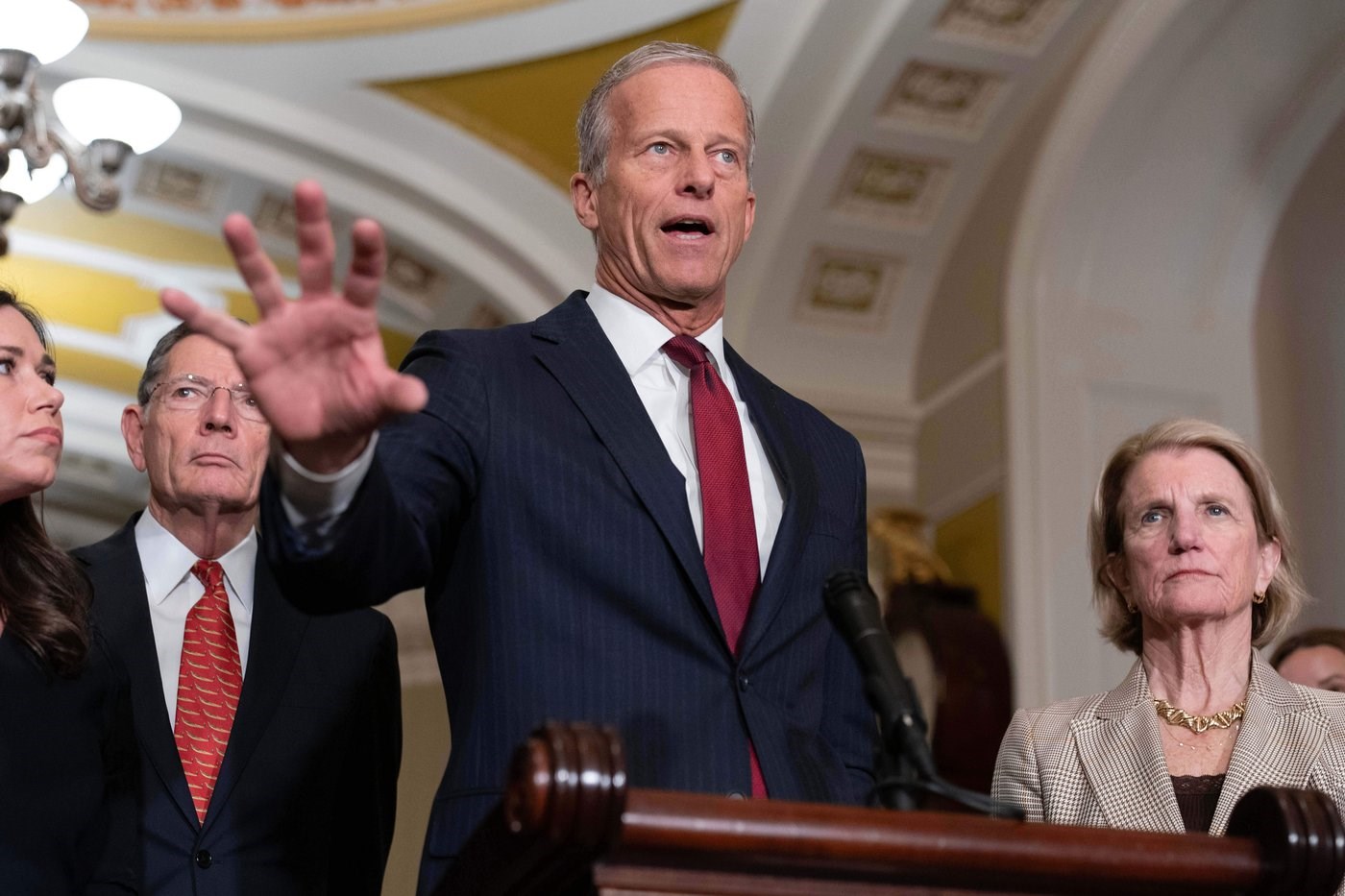
Senate Majority Leader John Thune, R-S.D., speaks to reporters after a weekly Republican policy luncheon, at the Capitol in Washington, Tuesday, March 10, 2026. (AP Photo/Jose Luis Magana)
March 16, 2026 - 9:06 PM
WASHINGTON (AP) — Legislation that would require proof of U.S. citizenship for new voters has become a rallying cry for President Donald Trump, who claims that passage of the bill will “guarantee the midterms” for his Republican Party in November.
The bill, which the Senate will take up as early as Tuesday, would require voters to provide proof of citizenship when they register and to present approved identification when they go to the polls, among other new rules that Trump and his most loyal supporters are pushing as part of an effort to assert more federal control over elections.
Federal law already requires that voters in national elections be U.S. citizens. But the legislation would lay out strict new requirements for voters to prove their status.
Democrats are uniformly opposed to the legislation and expected to block its passage through the Senate. They say the legislation would disenfranchise millions of American voters who don’t have birth certificates or other documents readily available — both Republicans and Democrats who would be newly registering to vote.
Despite the long odds of success, Trump has been pushing Senate Majority Leader John Thune to move ahead with the bill and suggested Republicans eliminate the filibuster or find another workaround to pass it. Thune has repeatedly said there isn’t enough support in the Senate to do that.
Instead, Republicans plan to hold an extended debate on the bill for a week or more, an effort to try and appease Trump and make Democrats defend their position.
The bill would “require Americans to demonstrate that they’re eligible to vote,” Thune said last week. “And that they are who they say they are.”
Proof of citizenship would be needed for new voters
The Safeguard American Voter Eligibility, or SAVE America Act, would force Americans to prove they are citizens when they register to vote, mostly through a valid U.S. passport or birth certificate.
Driver's licenses in many states would not be enough. The legislation says that the identification must be compliant with new REAL ID rules and also indicate that the applicant is a citizen of the United States — which few state licenses do.
A person registering to vote could also present a passport or a birth certificate. U.S. military members could present a military ID along with a record of service that shows where they were born.
Most people registering to vote would have to present the documents in person at an elections office, including people who vote by mail. Advocacy groups that oppose the legislation say that the bill would crush voter registration efforts ahead of this year's elections.
The bill would create new penalties for election officials who register applicants who have not presented documentary proof of citizenship. Opponents say that provision could potentially scare workers into turning away valid applicants while also discouraging people from working or volunteering at polling locations. It would also allow private individuals to sue election officials in some circumstances.
Voter identification expansion would include mail-in ballots
While federal law requires that voters are U.S. citizens, there is not currently a nationwide requirement that voters must show identification when they go to vote. Currently, 36 states have voter identification laws in place, some stricter than others, according to the National Conference of State Legislatures.
The bill would require voters in all states to present valid identification, and those voting by mail would have to send a photocopy. Overseas military and some qualified disabled individuals would be exempt from those rules.
Republican supporters most frequently highlight this section of the bill when pushing for its passage. Thune said last week that if you have to show an ID to get a library card, “it’s not too much to ask voters to show ID to vote in federal elections.”
States would be required to share their voter rolls
The legislation would require states to share voters' information with the Department of Homeland Security as a way to verify the citizenship of the names on the voter rolls — giving the federal government unprecedented access to state voter data. Many states are already embroiled in legal fights with the Trump administration over demands that they provide voter information.
Supporters of the state-federal sharing say that it would enable DHS to compare the state information with their own databases that are used to verify immigration status.
But Senate Democratic leader Chuck Schumer predicted that handing over names to the federal government would allow DHS to ”purge tens of millions of people from the voter rolls.”
Trump pushes for Republicans to add his other priorities
Senate Republicans are expected to offer amendments on the floor as part of their talkathon in support of the bill. Trump has said he wants more provisions added, including a ban on mail-in ballots, which are used by many states.
Trump has long criticized mail-in ballots and used it as a central argument in his false claims of fraud in the 2020 election he lost to Democrat Joe Biden. But voting groups — and many lawmakers in both parties — have long championed the practice as helping to make it easier for Americans to vote.
The president also wants to add two unrelated provisions around transgender rights issues — one that would ban those born as men from playing in women’s sports and another to block sex reassignment surgeries on some minors.
Many requirements would begin right away
If the SAVE America Act were enacted, the new rules for voter registration and voter identification at the polls would take effect immediately. Trump says it’s necessary for Republicans to win in the midterm elections — even though they won both chambers of Congress and the White House without the law in 2024.
With primary elections getting underway next month, critics say it would be difficult and costly for state election officials to implement, and could confuse voters.
Marc Elias, a Democratic elections attorney, said he isn’t ”aware of any state that currently requires what this would require.”
“If it’s passed tomorrow, the day after states would need to implement this,” Elias said.
___
Associated Press writer Lisa Mascaro contributed to this report.
News from © The Associated Press, 2026