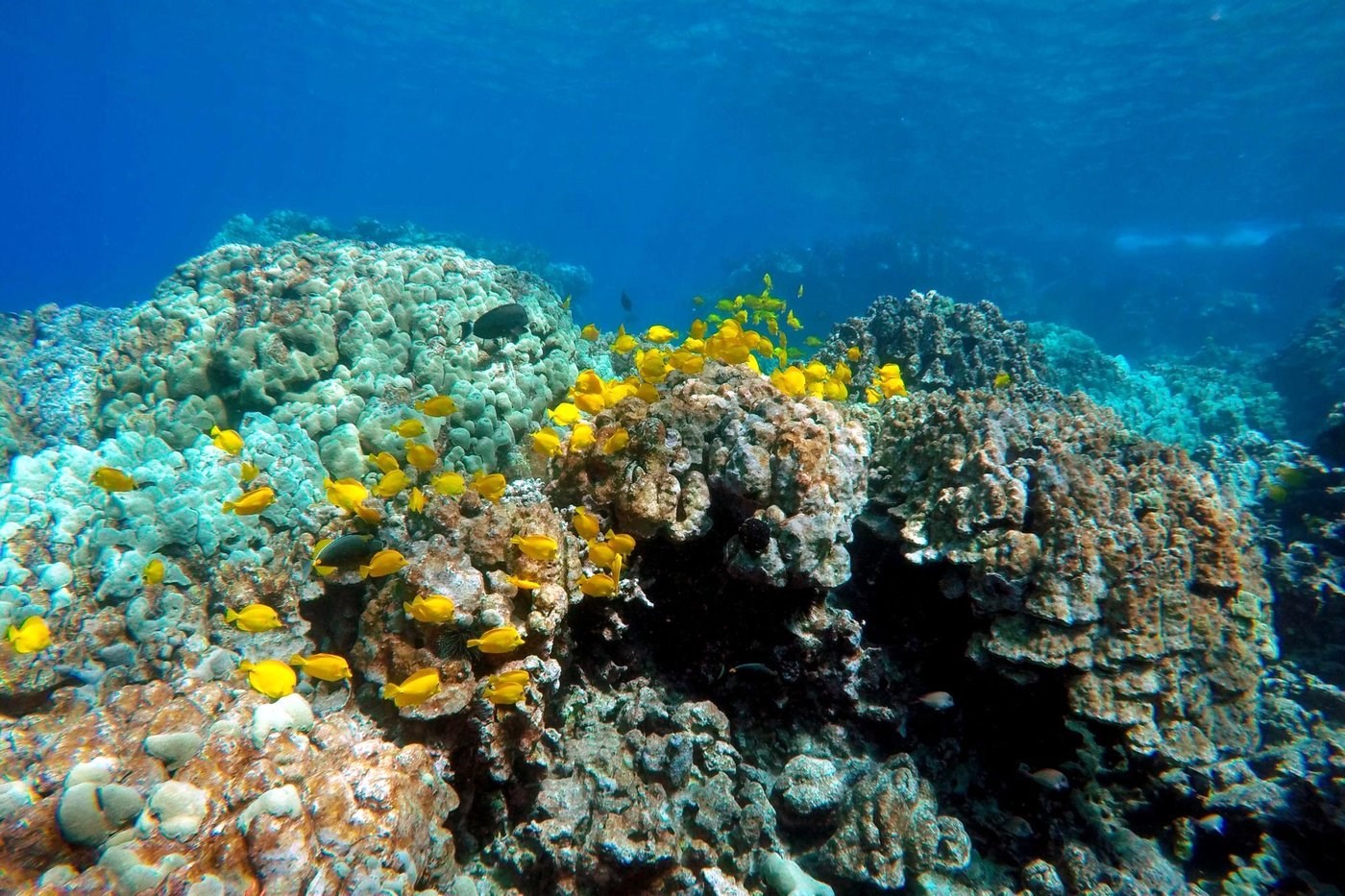
A school of yellow tang fish swim along a reef on the Kona Coast of the the island of Hawaii in July 2017. (Nathan Eagle/Civil Beat via AP)
Republished March 18, 2026 - 2:25 PM
Original Publication Date March 18, 2026 - 1:11 PM
Hawai?i island resident Kekoa Alip knows there are recent state reports showing at least some aquarium-trade fishing could resume off the Kona Coast without shrinking the region’s current numbers of prized reef fish.
But the 46-year-old, like others who grew up on the Kona Coast, also recalls that the lau?ipala, or yellow tang, and other fish species sought by the pet trade used to be far more abundant along those shores than they are now — more than even during the nearly decade-long pause on aquarium-trade fishing there.
“You could see the waves roll with lau’ipala,” said Alip, who used to live on a beach by the Hawai?i Ocean Sciences and Technology Park. “From childhood to my early adulthood, there were totally visual effects of the yellow tang in the reef.”
Aquarium-fish harvesting has long been one of Hawai?i’s most contested environmental issues. It currently isn’t happening legally anywhere in the state following years of legal battles and court rulings. But now it is approaching a new crossroads.
Many state lawmakers hope to finally pass an outright ban in this year’s legislative session, after several prior attempts, that would stop the fish collections on the Big Island altogether. The proposal has gained some early traction and sparked a lengthy debate on the House floor last week. The House passed HB 2101 with a vote of 43-8, sending it over to the Senate for consideration.
In the Senate, the bill has been referred to four committees — a sign that it could face more resistance there.
At the same time, state aquatic resource managers are moving ahead with their own rules to revive Big Island collections of fish for the first time since 2017. Specifically, they propose issuing a limited number of permits — seven — to Big Island collectors who could take more than 200,000 yellow tang and other species from the reefs there each year.
Their quotas largely resemble those recommended in an environmental review prepared by the pet trade industry five years ago, and those similarities have irked some local conservationists.
Hawai?i’s reef fish are highly coveted in the aquarium trade and represent a multibillion-dollar industry abroad, according to Ron Tubbs, who collected and sold reef fish off O?ahu for decades before a court ruling halted the practice there in 2021.
The same day as the House floor debate on Tuesday, the nation’s most prominent pet trade group — the Pet Advocacy Network — enlisted one of Hawai?i’s most powerful lobbyists, Blake Oshiro, to work on its behalf, state ethics records show. Oshiro’s firm, Capitol Consultants Hawai?i, has also lobbied for the group in previous years when it was known as the Pet Industry Joint Advisory Council.
The proposed ban moving through the Legislature this year has drawn hundreds of pages of written testimony, largely in support — but so far none from the Pet Advocacy Network. The Hawai?i County Council has thrown its support behind the ban, voting 9-0 in January to urge state lawmakers to prohibit commercial aquarium harvests.
Some in the industry see a new business opportunity. The Biota Group, headed by CEO Carsten Buschkühle and a local manager, James Gorke, has been working in recent years to raise Hawai?i’s reef fish species in captivity as an alternative to the harvests in the wild. The group currently uses large tanks at Hawai?i Pacific University’s Waimanalo campus.
An aquarium harvest ban, the company recently testified, would encourage it to invest more money into that effort.
“Aquaculture allows Hawaiian reefs to stay stocked with marine life,” the group added, “while still allowing the iconic animals as ambassadors to educate the world about Hawaii’s reefs.”
Biota Group testified that Hawai?i’s aquaculture sector faces “significant risk and financial loss” amid the push to revive harvests in the wild. Its leaders did not respond to Civil Beat’s requests to discuss those challenges.
An Export Trade
Tubbs said he dove and collected reef fish for about four decades before a state court blocked the practice on O?ahu, requiring extensive environmental review before it could resume.
He could typically turn a big profit selling kole — a dark bristletooth tang with a gold ring around its eyes — to wholesalers in Los Angeles or other parts of the U.S. mainland, he said, for around $20 a fish. The wholesaler, he said, would then sell the fish to a pet store for around $40, and the store would sell the store for around $60.
After aquarium fishing halted on O?ahu, Tubbs said, he used nearly $100,000 of his retirement savings on his own unsuccessful attempt to breed small crustaceans and marine invertebrates in captivity. Now, he works as an event photographer and mechanic to help make ends meet.
The aquarium-fishing halt “greatly impacted a lot of people here,” Tubbs said.
Between 1975 and 2017, the number of commercial collectors ranged from a low of eight in 1982, according to the Aquatic Resources Division, to a high of 54 in 1996.
There were 41 active collectors in 2020, the division reported, before an environmental court ruling halted the practice statewide.
Alip, who now opposes aquarium-fish harvests, used to harvest yellow tang and kole off Kona when he was a teenager with his cousin, he said, who’s about 10 years older. His cousin would then sell the fish to wholesalers.
His cousin would pay Alip around $100 per dive, he said, noting that he used the profits to buy a new Toyota truck. They eventually stopped after a year or so, he said, concerned by the dwindling number of fish they saw each time they went in the water.
“We chose kuleana over cash,” Alip said. “It’s an export trade. Never heard of anyone wanting locally, the fish. And that was concerning to me even back then.”
Alip, who works in conservation on the Big Island, said he now feels a bit embarrassed by taking part in the practice back in the 1990s. Still, he added, sharing his personal story is necessary as communities around Hawai?i discuss what to do about the aquarium-fish harvests.
More Than Just Fish Counts
Now, much of the debate over aquarium-fish harvesting in Hawai?i centers not just on whether the practice is sustainable but what sustainability even means or looks like.
Collectors such as Tubbs and their supporters point to studies that show yellow tang, kole and other reef fish can quickly respawn in mass numbers. Most of the juvenile fish they take, collectors and state aquatic managers say, never would have reached adulthood in the wild anyway because they haven’t yet developed their natural defenses against predators.
The state Aquatic Resources Division told the Hawai?i Board of Land and Natural Resources in 2024 that, based on fish counts from recent years, limited collections could resume without harming existing population levels.
The division’s input on recent fish counts could be informative, Hawai?i island native and marine research scientist Alohi Nakachi said, but it needs to be considered along with the negative changes that small shore-lying communities say they’ve witnessed over time, plus the Indigenous approaches once used to manage those resources.
“It’s just different knowledge sources, different ways of knowing, and we need to look at them together,” Nakachi said. “What we’re missing today is those konohiki — those people of place that were on the water all the time, that saw the changes.”
“It’s holistic. It’s not just the fish,” she added. “It’s how the limu will affect the fish that affect the coral reefs. They’re all in this integrated, connected system.” The juvenile fish that never make it to adulthood, she said, still matter. “It’s still serving an ecosystem function.”
The goal, Nakachi said, should be to help the species thrive for generations in a healthy environmental state — something Hawaiians refer to as ?aina momona — as they face growing threats from climate change plus runoff and habitat degradation.
Bryan Ishida, an aquatic biologist with the division, told the land board in 2024 that his analysis on whether to reopen the aquarium-fishing collections did not include cultural and ethical concerns, and those needed to be considered, too.
The fate of Hawai?i aquarium fishing also continues to play out in court. A group dubbed the Hawai?i Island Aquarium Fishers Association sued in 2024 to get the land board and the aquatic division to start issuing commercial licenses for collections.
Those fishers are entitled to resume aquarium harvesting, according to their Los Angeles-based attorney Geoff Davis, because in 2021 they fulfilled the environmental review requirements laid out in an earlier court decision.
Further, Davis has said the aquarium fishers are being unfairly singled out among other fishers in having to complete those expensive reviews.
An online public hearing on the state division’s proposal to advance rules to reopen the aquarium fishing is slated for March 31, followed by an April 1 in-person hearing at Kealakehe High School in Kailua-Kona.
The proposed West Hawai?i aquarium fishing ban bill now awaits a hearing before state Senate committees.
___
Civil Beat’s coverage of environmental issues on Hawai?i island is supported in part by a grant from the Dorrance Family Foundation; coverage of climate change and the environment is supported by The Healy Foundation, the Marisla Fund of the Hawai‘i Community Foundation and the Frost Family Foundation.
___
This story was originally published by Honolulu Civil Beat and distributed through a partnership with The Associated Press.
News from © The Associated Press, 2026