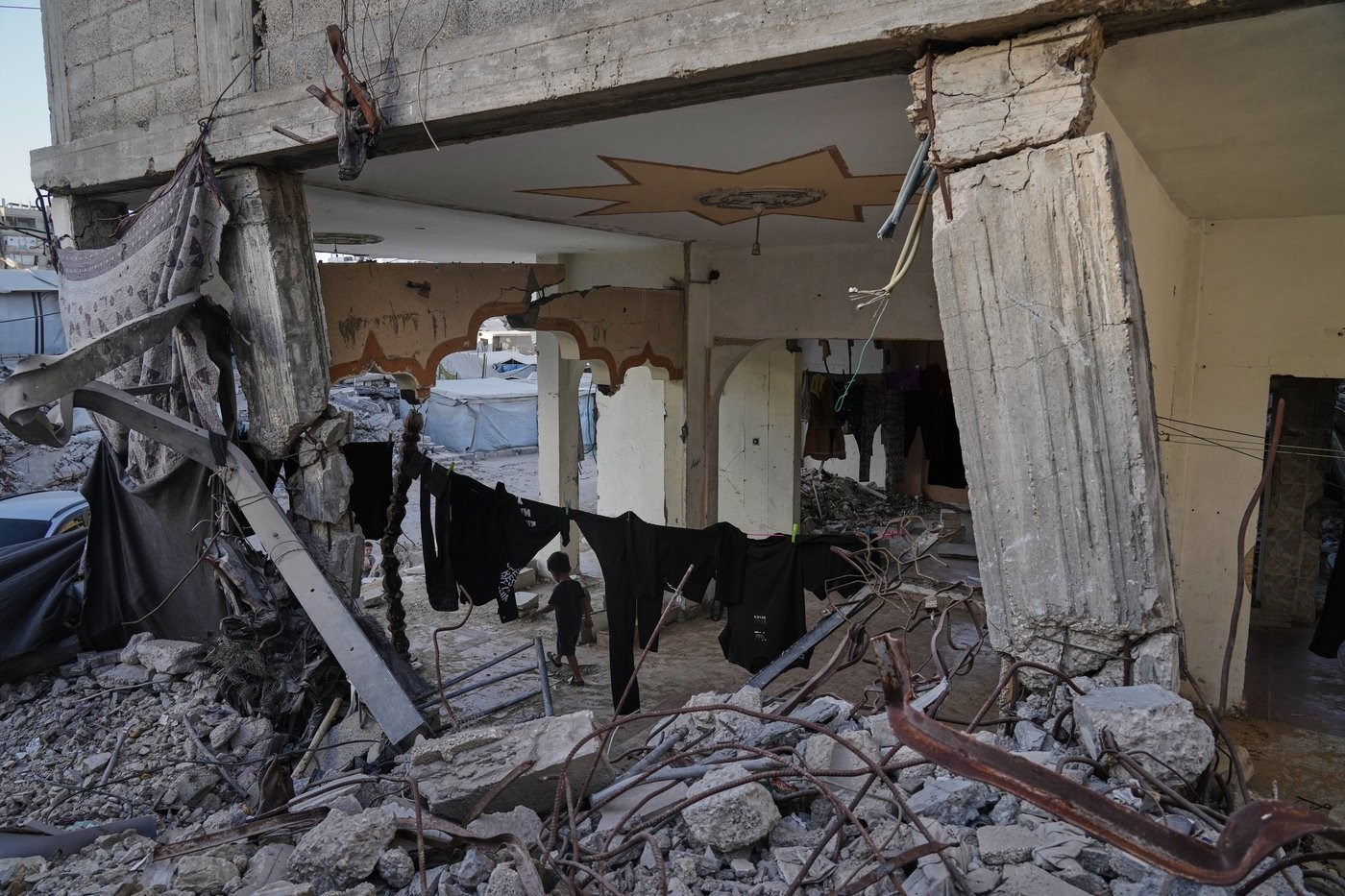
Displaced Palestinians shelter inside a building heavily damaged during the Israel-Hamas war in Gaza City, Thursday, Sept. 17, 2026. (AP Photo/Jehad Alshrafi)
September 17, 2026 - 11:04 PM
DEIR AL-BALAH, Gaza Strip (AP) — The deadly collapse of a multistory building in Gaza has drawn new attention to the hardships facing Palestinians there nearly a year after a ceasefire between Israel and Hamas promised to kickstart reconstruction.
But as talks faltered, plans for rebuilding stalled. Many residents have since moved back into some of the hundreds of thousands of homes damaged by the war despite the risk of weakened foundations and unstable walls suddenly giving way.
The Gaza Health Ministry said 21 people were killed in the collapse in Gaza City on Wednesday. Um Mohammad Adas, whose relatives were among the dead, said the fallen building had become a shelter of last resort.
“Now, they are lying in the street homeless and with absolutely nothing,” she said of her family members who survived the collapse. “Even the clothes they are wearing were borrowed.”
Families living in similar structures said they couldn’t afford any other shelter.
“We don’t have money to go somewhere else,” Ahmad Arafat said on a street full of rubble near his home. “And we can’t afford to buy tents like other people.”
Other people who have moved back into debris-filled buildings with sloping floors and cracked ceilings in Gaza City said they don't have options.
“What forces people to live in these places is that there is no shelter other than this shelter. I mean, there are no tents, no basic necessities,” Alam Zakout said outside the damaged building where he and his family live. “Come on, you tell me, where am I supposed to go? I have nothing other than this house.”
The collapse this week wasn't the first involving unsafe dwellings in Gaza, but the high death toll underscored the dangers in a territory where the vast majority of the population lacks adequate shelter.
The U.N. Office for the Coordination of Humanitarian Affairs said that during the first week of September there were collapses at five shelters, a category that can include standalone homes or units in larger buildings.
More than 2,000 additional buildings were at risk of collapse, the Palestinian Ministry of Public Works said in a statement Wednesday.
Dangers in Gaza persist without reconstruction
Israel has said it will not permit any rebuilding in Gaza until Hamas disarms, leaving more than 1 million people to live in unsafe displacement sites, according to a joint damage assessment released in April by the World Bank and United Nations. Many are crowded into sprawling tent camps lacking basic sanitation.
The assessment said 76% of residential units had been damaged or destroyed, calling the loss of the enclave's housing stock “catastrophic.”
“People are choosing to stay in dangerous buildings because the idea of living in a tent is worse, and there are very few tent supplies available if they want to leave those buildings,” said Shaina Low, a Norwegian Refugee Council spokesperson. “No tent supplies are getting into Gaza. People are willing to risk it because there isn’t a suitable alternative.”
The council is among the aid groups that have long warned about Gaza's shelter crisis. Nearly three years of war have damaged more than 320,000 homes, affecting 1.7 million of the territory’s 2.1 million people, according to a report published last month.
The council's surveys found 72% are staying in buildings that have sustained some damage. In one Gaza City neighborhood sampled, 22% of buildings were at risk of imminent collapse.
The buildings can be dangerous at any time, but engineers and humanitarian groups warn they are especially at risk of collapse during bouts of bad weather, when rain can flood through cracked concrete and exposed rebar, further weakening already damaged structures. The report found 71% of those surveyed had experienced flooding since the start of the previous winter, both in tents and buildings.
Aid groups say more shelter materials needed
Norwegian Refugee Council and other aid groups recently reiterated calls for Israel to allow more shelter and reconstruction materials into Gaza, noting Israel had twice rejected the entry of timber and emergency shelter kits in late August and early September for security reasons.
They have called for timber, emergency shelter kits, excavators and other equipment needed to clear dangerous debris. Israel has long restricted the entry of materials it considers “dual use,” saying they could be commandeered and used by militants.
COGAT, the Israeli military body that oversees aid distribution in Gaza, did not respond to questions about denying the entry of timber or shelter kits over the past month.
The war was sparked after the Hamas-led attack on Oct. 7, 2023, in which militants killed about 1,200 people and took 251 people hostage. An October 2025 ceasefire reduced the intensity of the fighting, but Israel has continued to carry out strikes, killing at least 1,375 people since the agreement went into effect, according to local health officials.
The nearly three-year Israel-Hamas war has killed more than 73,821 Palestinians, according to Gaza’s Health Ministry. The ministry, part of the Hamas-run government, maintains detailed records viewed as generally reliable by U.N. agencies and international organizations. It does not distinguish between civilians and militants, but says women and children make up around half the toll.
___
Metz reported from Jerusalem.
News from © The Associated Press, 2026