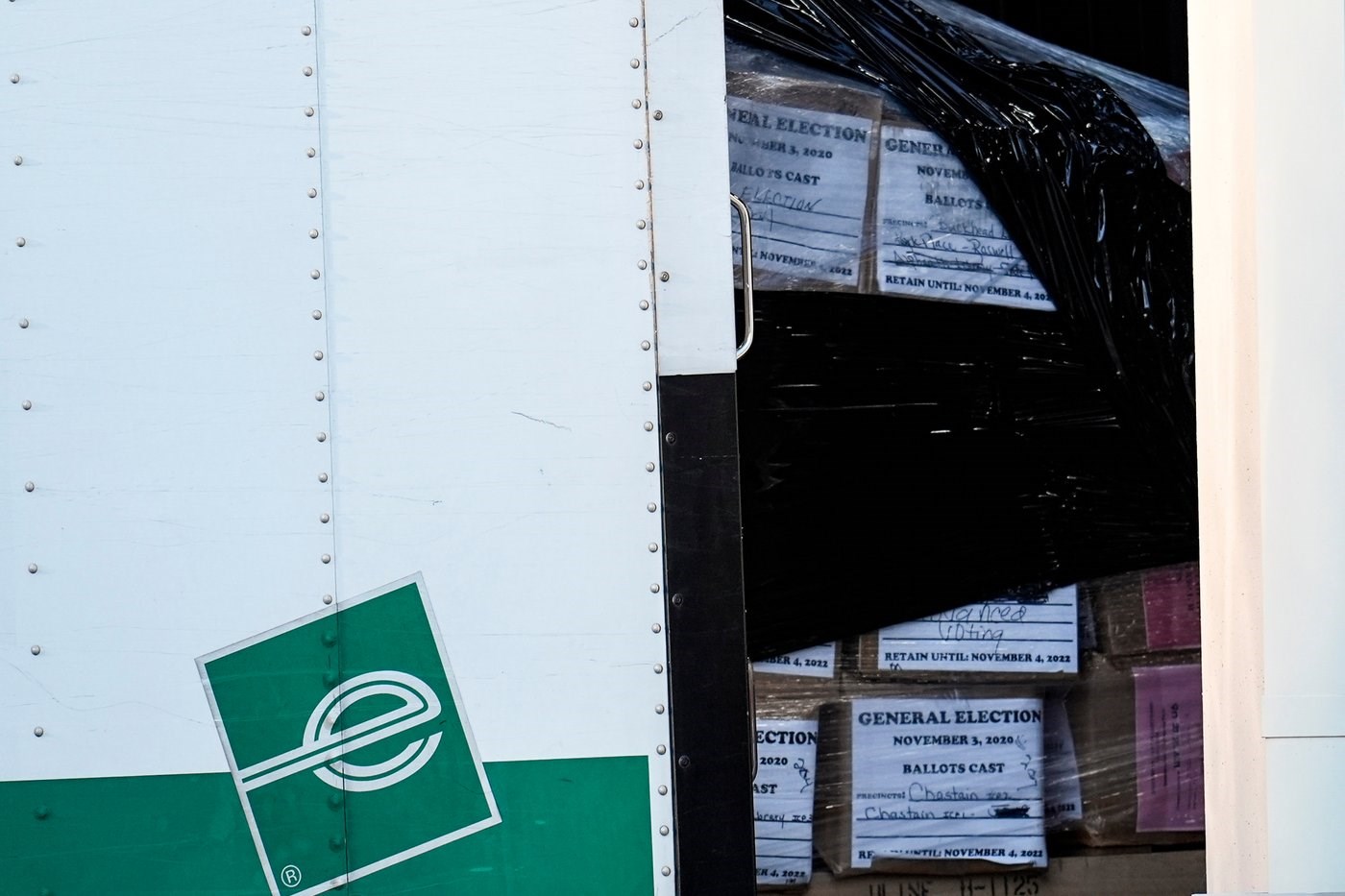
Georgia General Election 2020 ballots are loaded by the FBI onto trucks at the Fulton County Election HUB, Wednesday, Jan. 28, 2026, in Union City, Ga., near Atlanta. (AP Photo/Mike Stewart)
February 04, 2026 - 5:20 AM
ATLANTA (AP) — Officials in Georgia's Fulton County said Wednesday they have asked a federal court to order the FBI to return ballots and other documents from the 2020 election that it seized last week, escalating a voting battle as President Donald Trump says he wants to “take over” elections from Democratic-run areas with the November midterms on the horizon.
The FBI had searched a warehouse near Atlanta where those records were stored, a move taken after Trump's persistent demands for retribution over claims, without evidence, that fraud cost him victory in Georgia. Trump's election comment came in an interview Monday with a conservative podcaster and the Republican president reaffirmed his position in Oval Office remarks the next day, citing fraud allegations that numerous audits, investigations and courts have debunked.
Officials in heavily Democratic Fulton County referenced those statements in announcing their legal action at a time of increasing anxiety over Trump's plans for the fall elections that will determine control of Congress.
“This case is not only about Fulton County," said the county chairman, Robb Pitts. “This is about elections across Georgia and across the nation.”
In a sign of that broader concern, U.S. Sen. Mark Warner, D-Va., said this week that he once doubted Trump would intervene in the midterms but now "the notional idea that he will ask his loyalists to do something inappropriate, beyond the Constitution, scares the heck out of me.”
The White House has scoffed at such fears, noting that Trump did not intervene in the 2025 off-year elections despite some Democratic predictions he would. But the president's party usually loses ground in midterm elections and Trump has already tried to tilt the fall races in his direction.
Democratic state election officials have reacted to Trump’s statements, the seizure of the Georgia election materials and his aggressive deployment of federal officers into Democratic-leaning cities by planning for a wide range of possible scenarios this fall. That includes how they would respond if Immigration and Customs Enforcement officers were stationed outside polling places.
They also have raised concerns about U.S. Department of Justice lawsuits, mostly targeting Democratic states, seeking detailed voter data that includes dates of birth and partial Social Security numbers. Secretaries of state have raised concerns that the administration is building a database it can use to potentially disenfranchise voters in future elections.
Trump and his allies have long fixated on Fulton County, Georgia’s most populous, since he narrowly lost the state to Democrat Joe Biden in 2020. In the weeks after that election, Trump called Georgia's secretary of state, Republican Brad Raffensperger, urged him to help “find” the 11,780 ballots that would enable Trump to be declared the Georgia winner of the state and raised the prospect of a “criminal offense” if the official failed to comply.
Raffensperger did not change the vote tally, and Biden won Georgia's 16 electoral votes. Days later, rioters swarmed the U.S. Capitol on Jan. 6, 2021, and tried to prevent the official certification of Biden's victory. When Trump returned to the presidency in January 2025, he pardoned more than 1,000 charged in that siege.
“The president himself and his allies, they refuse to accept the fact that they lost,” Pitts said. “And even if he had won Georgia, he would still have lost the presidency.”
Pitts defended the county’s election practices and said Fulton has conducted 17 elections since 2020 without any issues.
A warrant cover sheet provided to the county includes a list of items that the agents were seeking related to the 2020 general election: all ballots, tabulator tapes from the scanners that tally the votes, electronic ballot images created when the ballots were counted and then recounted, and all voter rolls.
The FBI drove away with hundreds of boxes of ballots and other documents. County officials say they were not told why the federal government wanted the documents.
The county is also asking the court to unseal the sworn statement from a law enforcement agent that was presented to the judge who approved the search warrant.
The Justice Department declined to comment on the county's motion.
“What they’re doing with the ballots that they have now, we don’t know, but if they’re counted fairly and honestly, the results will be the same,” Pitts said.
Tulsi Gabbard, Trump's director of national intelligence, was at the Fulton search last week, and Democrats in Congress have questioned the propriety of her presence because the search was a law enforcement, not intelligence, action.
In a letter to top Democrats on the House and Senate Intelligence committees Monday, Gabbard said Trump asked her to be there “under my broad statutory authority to coordinate, integrate, and analyze intelligence related to election security.”
White House spokeswoman Karoline Leavitt said Tuesday that the president's “take over” remarks, which included a vague reference to “15 places” that should be targeted, were a reference to the SAVE Act, legislation that would tighten proof of citizenship requirements. Republicans want to bring it up for a vote in Congress.
But in his remarks that day, Trump did not cite the proposal. Instead, he claimed that Democratic-controlled places such as Atlanta, which falls mainly in Fulton County, have “horrible corruption on elections. And the federal government should not allow that.”
The Constitution vests states with the ability to administer elections. Congress can add rules for federal races. One of Trump's earliest second-term actions was an executive order that tried to rewrite voting rules nationwide. Judges have largely blocked it because it violates the Constitution.
Trump contended that states were “agents of the federal government to count the votes. If they can't count the votes legally and honestly, then somebody else should take over.”
Sen. Thom Tillis, R-N.C., said Wednesday said he supported the SAVE Act but not Trump's desire for a federal takeover. "Nationalizing elections and picking 15 states seems a little off strategy,” Tillis told reporters.
___
Associated Press video journalist Nathan Ellgren in Washington contributed to this report.
___
Riccardi reported from Denver.
News from © The Associated Press, 2026