David A. Lieb
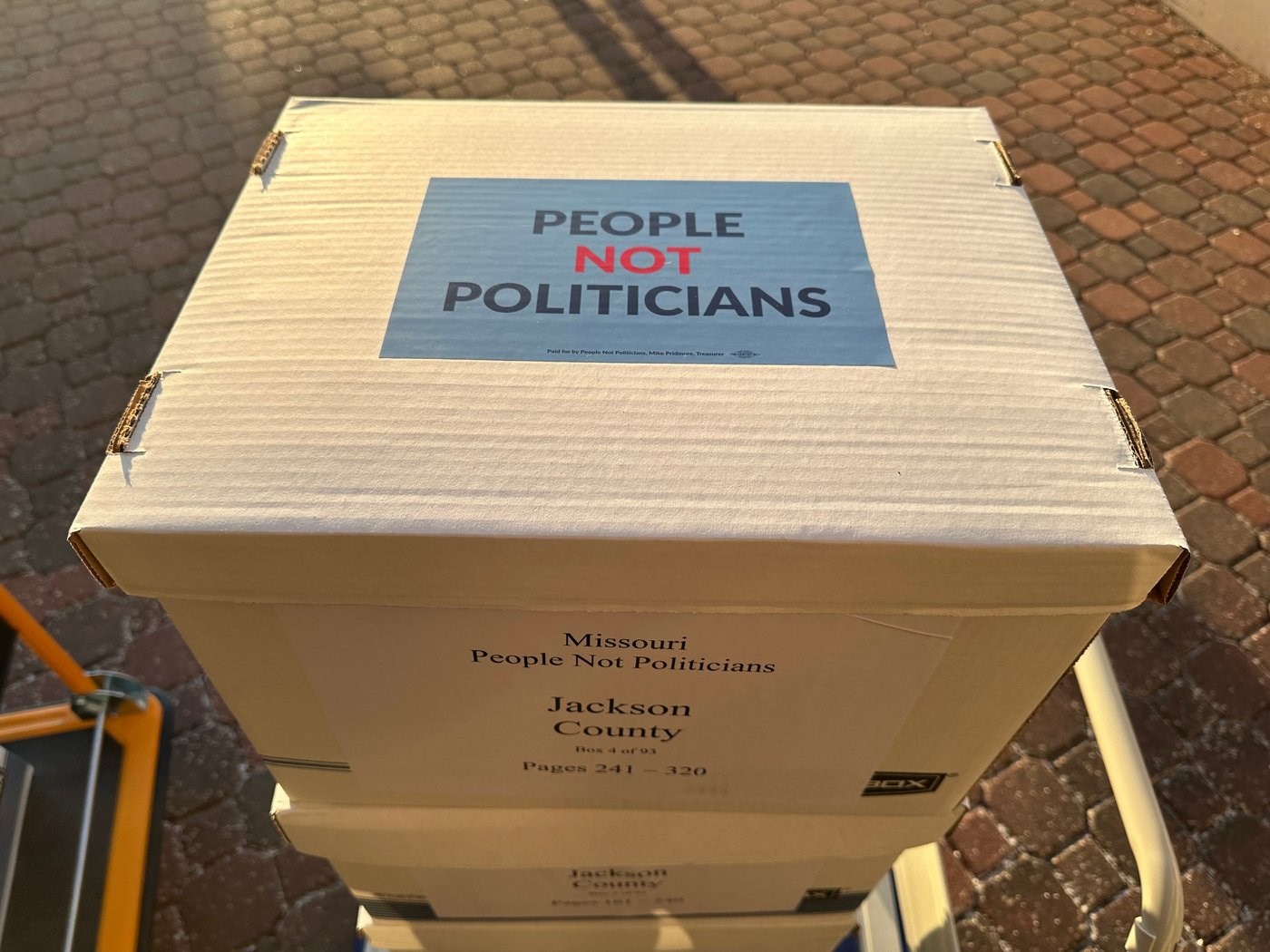
Boxes of petition signatures are stacked up to be delivered Tuesday, Dec. 9, 2025, to the secretary of state's office in Jefferson City, Mo., calling for a referendum election on new U.S. House districts approved by the Missouri legislature. (AP Photo/David A. Lieb)
December 23, 2025 - 5:33 AM
JEFFERSON CITY, Mo. (AP) — The question of whether Missouri's new congressional districts are in effect for the 2026 elections will be up to a court to decide.
A lawsuit filed Tuesday on behalf of voters contends the redrawn map backed by President Donald Trump should have been automatically suspended earlier this month when opponents submitted more than 300,000 petition signatures seeking to force a statewide vote.
But Republican Attorney General Catherine Hanaway says the new districts took effect — and will remain in place as candidates run for office — unless Republican Secretary of State Denny Hoskins verifies the signatures are sufficient and certifies that the petition meets constitutional muster.
The court battle carries consequences for Trump's plan to reshape congressional districts in Republican-led states, which could give the GOP a shot at winning additional seats in the midterm elections and retaining control of the closely divided U.S. House. Missouri's new map is intended to help Republicans pick up a Democrat-held district in Kansas City by splitting off portions and stretching the rest into rural areas that are predominantly Republican.
Nationwide, the unusual mid-decade redistricting battle has so far resulted in a total of nine more seats that Republicans believe they can win in Texas, Missouri, North Carolina and Ohio — and a total of six more seats that Democrats expect to win in California and Utah, putting Republicans up by three. But the redrawn districts are being litigated in some states, and if the maps hold for 2026, there is no guarantee that the parties will win the seats.
Missouri's constitution allows voters who are opposed to a new law to gather petition signatures to put the measure to a statewide vote. If they submit about 110,000 valid signatures — meeting minimum thresholds in at least two-thirds of the state's congressional districts — the law is placed on hold until a referendum can be held at the next November election.
Historically, the state has treated laws as suspended when referendum petitions get submitted. But Hanaway contends a law can be suspended only after the secretary of state determines there is a sufficient number of valid signatures — a process that could conclude long after Missouri's candidate filing period, which runs from Feb. 24 through March 31.
Local election officials have until July 28 to finish verifying signatures, and Hoskins could make a final decision after that. Missouri's primary elections are Aug. 4.
“This is a transparent ploy to force the use of HB1’s new congressional map by delaying certification of the referendum’s signatures … until it is too late to change the congressional map for the 2026 midterms,” says the lawsuit, which was filed by the American Civil Liberties Union on behalf of two Kansas City-area voters who signed the referendum petition.
The lawsuit comes just one day after the Missouri attorney general released a statement reasserting that the new congressional map “remains in effect” while the petition signatures are reviewed.
To suspend laws immediately upon submitting a petition would "allow anyone to freeze duly-enacted state laws by dropping off boxes of unverified signatures,” Hanaway's office said in a statement.
The latest lawsuit is at least the ninth related to Missouri's new congressional map. Some of the lawsuits contend that mid-decade redistricting violates the state's constitution and that Republican Gov. Mike Kehoe had no legal grounds to call lawmakers into a special session to pass the new map.
News from © The Associated Press, 2025