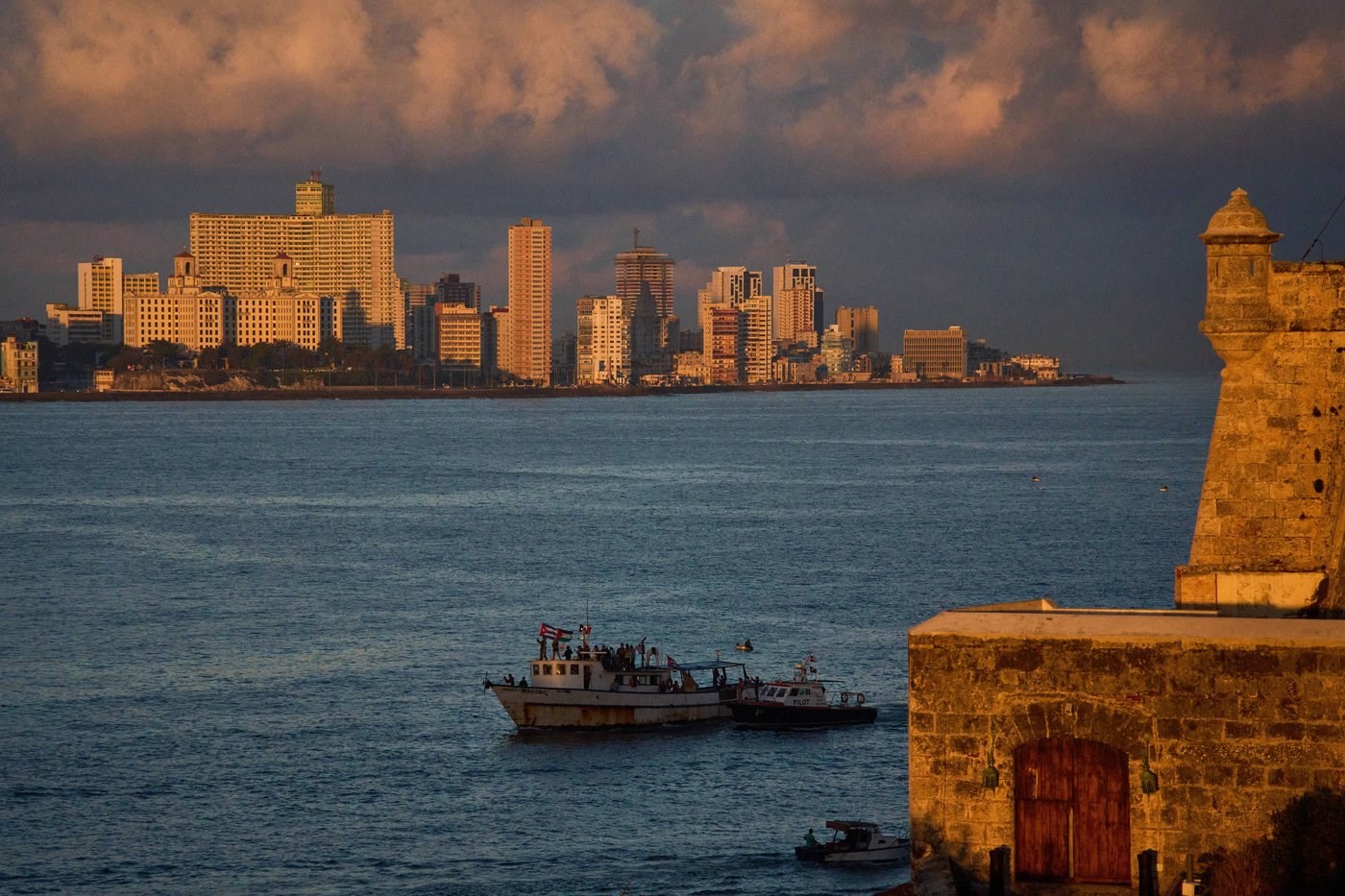
Activists wave Cuban and Palestinian flags from the vessel Maguro, arriving from Mexico with humanitarian aid as part of the "Nuestra America," or Our America Convoy, in Havana Bay, Cuba, Tuesday, March 24, 2026. (AP Photo/Ramon Espinosa)
March 24, 2026 - 8:57 AM
HAVANA (AP) — A ship bringing humanitarian aid to Cuba arrived in Havana on Tuesday loaded with solar panels, bicycles, food and medicine as the island’s economic and energy crises deepen.
Some 30 people were aboard the first of three ships expected to arrive in Cuba as it grapples with severe blackouts, a crumbling power grid and a U.S. energy blockade.
“This type of economic warfare shouldn’t exist, this attitude of a pirate state that doesn’t respect international law,” activist Thiago Ávila told reporters as he disembarked from the ship, christened “Granma 2.0” in homage to the ship that ferried revolutionary leader Fidel Castro to the island in 1956.
“These ships are a drop in an ocean of need…at the same time, it’s a gesture of solidarity,” Ávila said.
The ship departed Puerto Progreso, in Mérida, Mexico, last week and two others are heading to Cuba.
“The help is important for us, so that it can be seen that the revolution is not alone,” Antonia Santamaría, a 72-year-old retiree, said as she watched the boat slowly approach the dock.
The flotilla is part of a caravan called “Our America Convoy to Cuba,” with more than 650 participants from 33 countries who arrived on the island last weekend with tons of aid and were received by President Miguel Díaz-Canel.
Visitors included British parliamentarian Jeremy Corbyn, Colombian Sen. Clara López, Spanish politician Pablo Iglesias, and U.S. labor leader Chris Smalls. The popular Irish hip-hop trio Kneecap also participated.
The energy embargo imposed by U.S. President Donald Trump in late January to bring pressure for a change in the island’s political model has compounded five years of profound economic crisis stemming from the paralysis caused by the COVID-19 pandemic and previous U.S. sanctions against the Caribbean nation.
Cuba is suffering from transportation shortages, reduced working hours, flight cancellations, and, above all, blackouts, including two island-wide blackouts in recent days.
Trump and U.S. Secretary of State Marco Rubio — whose parents emigrated from Cuba in the 1950s — have said they were prepared to “take” the island. Authorities from both countries acknowledged that they are holding talks, although they have not disclosed details.
Cuba’s Deputy Minister of Energy and Mines Argelio Abad Vigo last week said the country has gone three months without receiving supplies of diesel, fuel oil, gasoline, jet fuel, and liquefied petroleum gas, all of which are vital for the economy and electricity generation. Cuba produces barely 40% of the fuel it needs.
Meanwhile, a Hong Kong-flagged vessel that was reportedly carrying 200,000 barrels of diesel from Russia to Cuba has instead docked in Venezuela, according to MarineTraffic, a project that tracks the movement of vessels around the globe using publicly available data.
Leaders from several countries and social organizations have warned that Cuba could be on the verge of a humanitarian crisis.
Countries including Mexico, China, Brazil and Italy and non-governmental groups from the United States are among those that have sent aid.
Caricom, a Caribbean trade bloc, said Tuesday that it would send aid including powdered milk, medical supplies and water tanks to Cuba via Mexico, which has agreed to transport the items for free by ship.
The international aid is usually distributed free of charge by the state through the network of stores that Cubans use to buy food, except in cases where a donor specifies that a shipment should have a specific destination, such as medicine for hospitals.
News from © The Associated Press, 2026