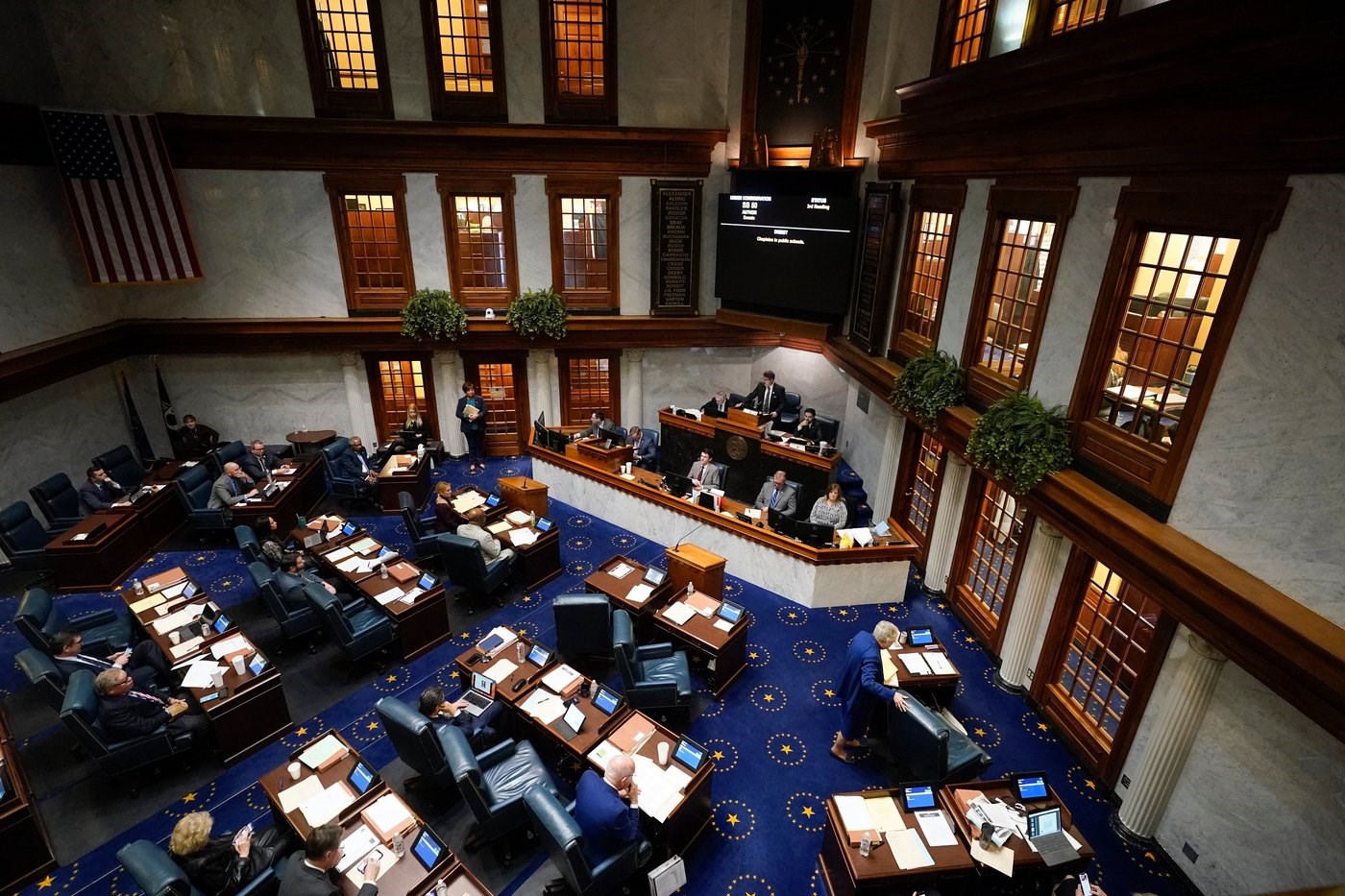
FILE - Senators meet in the senate chamber at the Statehouse, Feb. 1, 2024, in Indianapolis. (AP Photo/Darron Cummings, file)
Republished December 08, 2025 - 7:04 AM
Original Publication Date December 07, 2025 - 9:06 PM
A proposal to redraw Indiana's congressional boundaries faces its first public test in the state Senate on Monday, with no clear indication it can win a final vote later in the week despite months of pressure from President Donald Trump.
Senators will take action on a bill designed to favor GOP candidates in the next year's midterm elections. Republicans control the state Senate, but many have been hesitant or openly opposed to the idea of mid-decade redistricting. Several have been threatened over their stance or refusal to immediately declare support.
Their votes could test Trump's typically iron grip on the Republican Party. Monday's committee hearing may indicate how many senators plan to go on record against the bid to consolidate power in the staunchly conservative state.
The map, introduced just last Monday and passed by the Republican supermajority in the state House on Friday, would split the city of Indianapolis into four districts distributed across other Republican-leaning areas. It also groups the cities of East Chicago and Gary with a broad rural region.
The contours would eliminate the districts of Indiana's two Democratic congressional representatives: longtime Rep. André Carson of Indianapolis, the state’s only Black member of Congress, and Rep. Frank Mrvan, who represents northwest Indiana near Chicago.
Republicans currently hold seven of the state's nine districts.
Why redistricting?
Democrats are hoping to flip control of the U.S. House in the 2026 elections and they like their odds, since midterms tend to favor the party out of power.
Redistricting usually happens once a decade after the census, but Trump has pushed Republican-led states to create more GOP-leaning districts. Texas, Missouri, Ohio and North Carolina have followed suit, while Democrats in California and Virginia have moved to draw their own favorable maps.
Not many states, outside of those with smaller or single-member congressional delegations, are represented solely by one party.
Republicans in favor of making Indian's map 9-0 through gerrymandering often point to Massachusetts, where Democrats hold all nine seats, or Connecticut, where they hold all five. Republicans hold all five Oklahoma seats and eight of Tennessee’s nine seats, while Democrats hold seven of Maryland’s eight seats.
But the idea of redrawing a congressional map last approved in 2021 has made many Republicans in Indiana uneasy, particularly in the Senate. The chamber’s leader previously said there were not enough votes to support redistricting, and the current vote count is unclear.
The Senate elections committee heard testimony Monday afternoon on the legislation, with 127 people signing up to voice their opinion.
The White House has upped the pressure on Indiana. Vice President JD Vance visited Indianapolis twice since August, and legislative leaders met with Trump in the Oval Office earlier this year.
After Senate leader Rodric Bray said the chamber would reject the governor’s call for a special session on redistricting, Trump attacked Bray and other senators on social media and vowed to endorse primary challengers against any lawmaker who opposes redrawing the map.
In the following weeks, about a dozen state lawmakers were targeted by threats and swatting incidents, in which a hoax call attempts to prompt a police response to a private home.
Redistricting proponents need at least 25 votes in the 50-member Senate to give final passage to the map. That would trigger a tiebreaking vote from Republican Lt. Gov. Micah Beckwith, who supports redistricting.
If the Senate rejects the new districts, it would be extremely difficult for proponents to revive the issue. Indiana’s filing deadline for congressional candidates is in early February, and primary elections are held in early May.
National redistricting battle
In Utah, lawmakers on Tuesday will try to reassert authority over congressional redistricting by convening a special legislative session.
A judge ruled in November that a map advanced by state lawmakers earlier this year “unduly favors Republicans and disfavors Democrats.” The judge imposed an alternative map that would keep Democratic-leaning Salt Lake County almost entirely within one district rather than split between the four Republican-leaning districts.
The legislative session's agenda includes pushing back next year’s filing deadlines from January to March, buying time until after a potential ruling on redistricting by the state Supreme Court.
“I support the state’s appeal and have confidence the Utah Supreme Court will consider it in a timely way,” Republican Gov. Spencer Cox said Sunday, "so we have clarity for the 2026 election.”
___
Volmert reported from Lansing, Michigan. Mead Gruver in Fort Collins, Colorado, and David A. Lieb in Jefferson City, Missouri, contributed to this report.
News from © The Associated Press, 2025