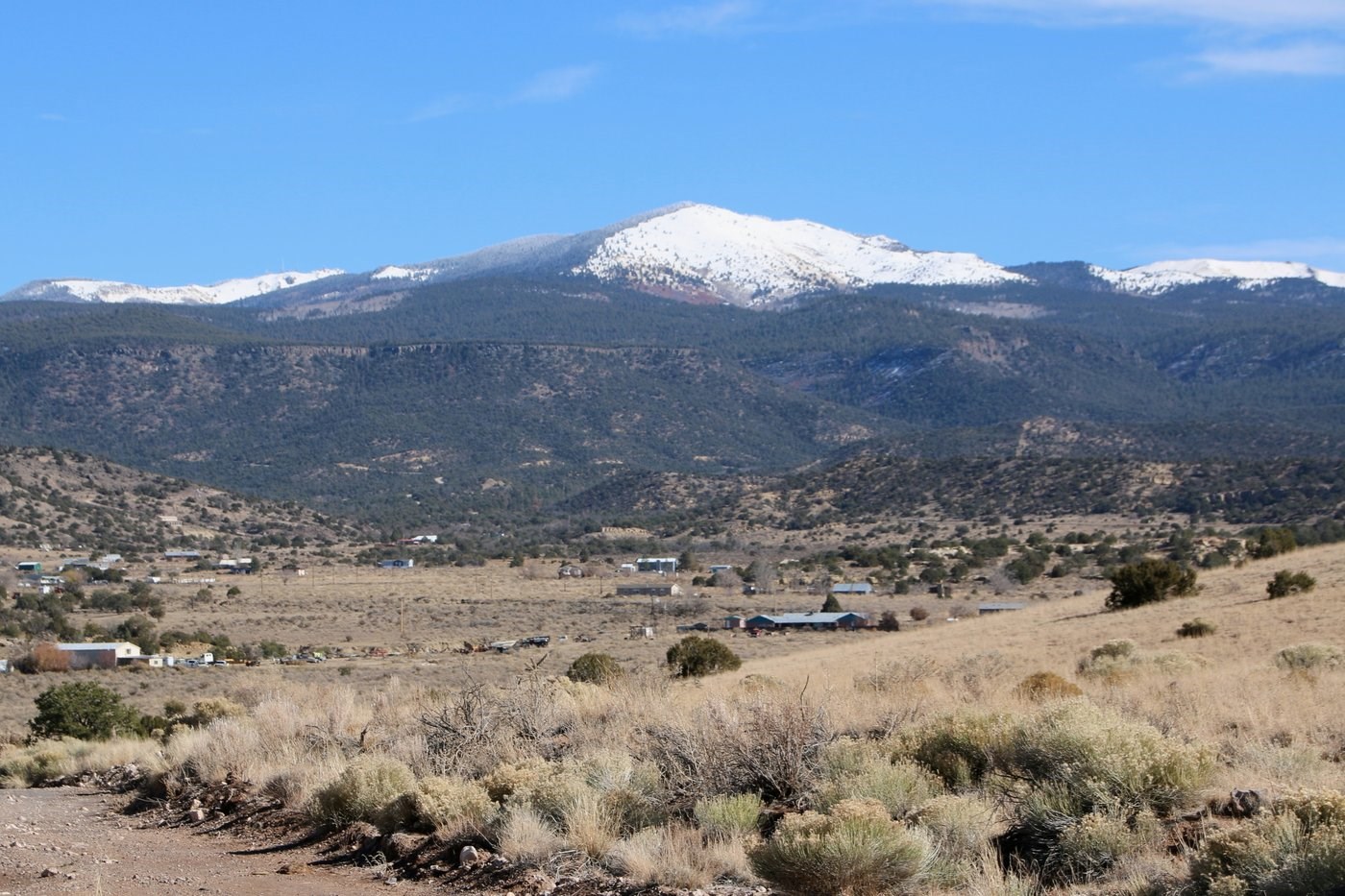
The western slope of Mount Taylor is capped with snow on Nov. 25, 2025, in Cibola County, N.M. (Bella Davis/New Mexico In Depth via AP)
September 15, 2026 - 11:32 AM
For Native communities in northwest New Mexico’s Grants mineral belt, one of the central concerns with the idea of resumed uranium mining is the potential harm to Mount Taylor. That concern led the state to designate Mount Taylor as a traditional cultural property nearly two decades ago. But as uranium mining companies hoping to operate within the area move through the state permitting process, state regulators still can’t say what role the designation will play in their decisions.
Mount Taylor is sacred to the Navajo Nation, the Hopi Tribe, and the pueblos of Laguna, Acoma and Zuni.
“We have, and other peoples have, a really millennia-long relationship with the mountain,” June Lorenzo (Laguna/Diné) told the Radioactive and Hazardous Materials Committee during a meeting in the Laguna Pueblo village of Paguate on Friday. “It’s part of our vocabulary. It features largely in our creation stories.”
It’s not only the mountain that’s important, but also the surrounding landscape, said Lorenzo, a former tribal court judge who’s done academic research and advocacy work on legacy uranium issues.
The five tribes undertook a legal fight in the late 2000s in an effort to protect Mount Taylor from extraction, resulting in the state designation of 400,000 acres as a traditional cultural property. At the time, Lorenzo said, the tribes were accused of using the process to try to acquire the land, but that’s a misunderstanding of their relationships with Mount Taylor. Besides, the designation didn’t actually transfer ownership to them.
“None of us want to own—we will never own the mountain,” she said. “It’s like a relative.”
The designation is meant to give tribes a stronger voice in decisions about mining and other development, but because New Mexico hasn’t permitted a uranium mine since the designation took effect, it’s never been tested.
Two proposed underground uranium mines — Roca Honda and La Jara Mesa — would fall within the state-designated acreage.
Sen. Jeff Steinborn, D-Las Cruces, asked state regulators whether they can deny a permit based on concerns about cultural sites.
“I don’t have an answer to that question. We have yet to get to that stage of how impacts to the (traditional cultural property) will be mitigated,” said David “D.J.” Ennis, program manager of the Energy, Minerals and Natural Resources Department’s Mining Act Reclamation Program.
Ennis said the department is partnering with the U.S. Forest Service to evaluate the issue.
Energy Fuels, the top producer of uranium in the U.S., proposes having dewatering well pads used to remove groundwater from the mine and ventilation shafts on about 30 acres of the designated land.
In response to tribal input, the company revised previous iterations of its plan to remove “significant disturbance” from the area, including a mine shaft, said Nick Martin, environmental manager at Energy Fuels.
Steinborn seemed to be unconvinced.
“We have tremendous concern for cultural sites, not to mention the environmental issues and the worker safety issues,” he told Martin and two other Energy Fuels representatives.
How do they plan to mitigate impacts to the area, the state senator asked.
Martin mentioned independent engagement with tribes and a review under Section 106 of the National Historic Preservation Act, which requires federal agencies to consider how projects they carry out or permit will affect historic properties.
Sen. Angel Charley (Laguna/Zuni/Diné), a Democrat who grew up in Laguna Pueblo and lives in nearby Acoma Pueblo, pushed back on that, noting the Trump administration is trying to weaken Section 106.
That includes a proposal to make tribal consultation no longer required.
As Friday’s meeting wrapped up, New Mexico In Depth asked Misael Cabrera, senior vice president of regulatory affairs at Energy Fuels, to respond to the concern Charley — who has called for a moratorium on uranium mining — raised about Section 106.
“Sometimes politicians deregulate, other times politicians re-regulate,” Cabrera said. “Irrespective of what those folks do, we want to make sure that we’re being good neighbors for the communities that we’re in. Why? Because it makes business sense. If the people around you are always fighting you, it makes things harder.”
He pointed to an agreement Energy Fuels and the Navajo Nation signed in January 2025 that allows the company to transport uranium ore through Navajo lands. In exchange, the company agreed to more protections than what’s legally required and to haul away up to 10,000 tons of waste from abandoned uranium mines spread across the Navajo Nation, according to a press release.
The agreement came after the Navajo Nation and the Havasupai Tribe condemned Energy Fuels in 2024 for moving ore across their lands without their permission.
“One of the things that folks don’t understand when I say middle ground, some might ask, ‘Well, why can’t you just leave? Why can’t you just leave that place alone?’ It’s because these projects, they actually don’t start making money until like year five, after you’ve started producing,” Cabrera said. “And until then, we actually work on borrowed money. We borrow money from shareholders. … So we’ve got to analyze all of that in our decisions.”
___
This story was originally published by New Mexico In Depth and distributed through a partnership with The Associated Press.
News from © The Associated Press, 2026