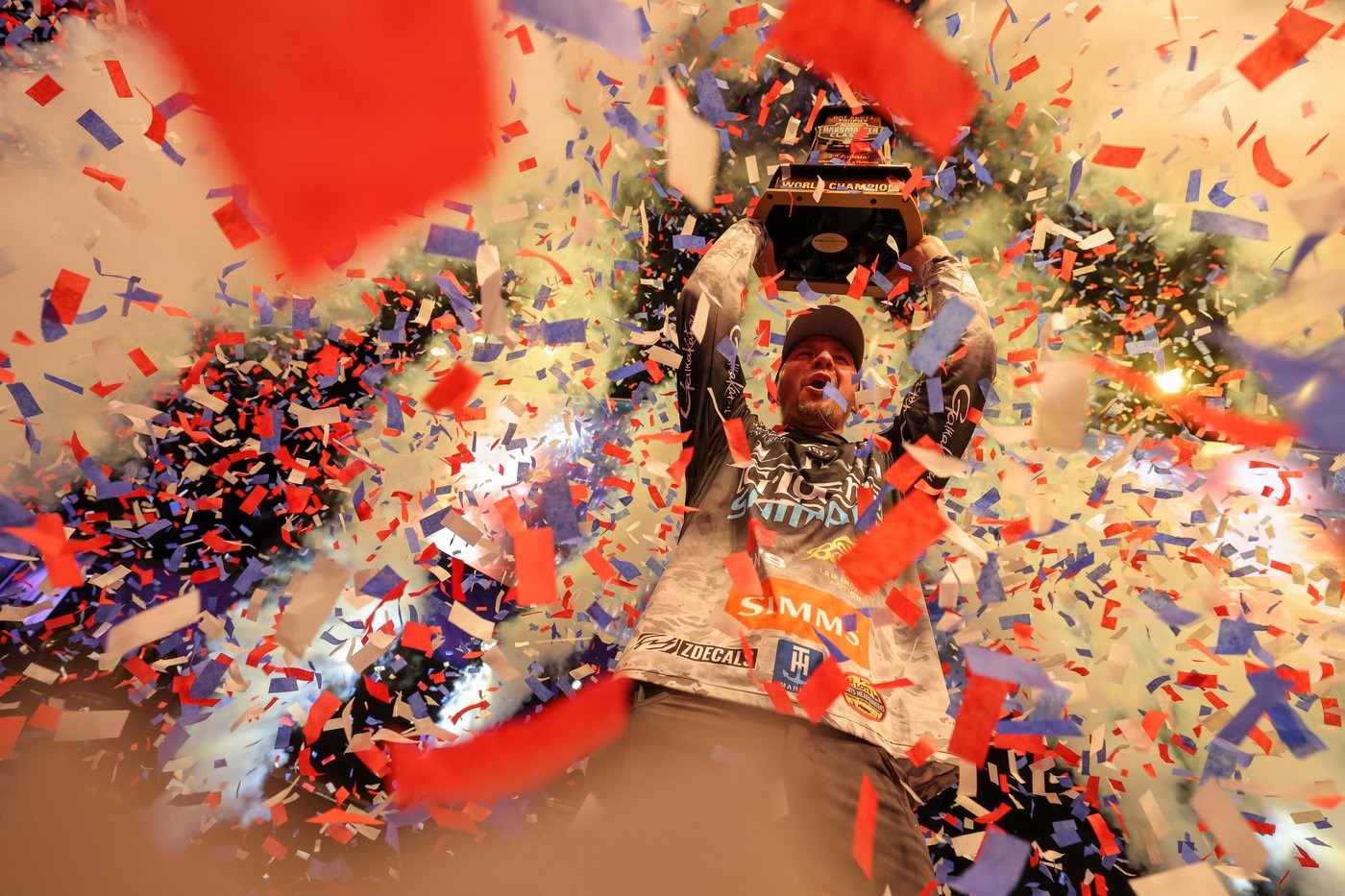
Canadian bass fisherman Jeff Gustafson is shown in this 2023 handout photo after winning the US$1-million Bassmaster Classic in Knoxville, Tenn. THE CANADIAN PRESS/Handout — Bass Anglers Sportsman Society (Mandatory Credit)
Republished March 16, 2026 - 1:36 PM
Original Publication Date March 16, 2026 - 12:41 PM
Jeff Gustafson returned to his office Monday.
The Kenora, Ont., angler was back in his Lund 2075 Pro-V bass boat on Alabama's Lake Guntersville for some fun fishing in not-so-fun conditions -- 3 C temperatures with wind and rain. However, it was welcomed after Gustafson spent last week talking to fans at the US$1-million Bassmaster Classic, which ended Sunday on the Tennessee River.
Three years ago, Gustafson became the first Canadian to win the event, also on the Tennessee River. A six-time Classic competitor, Gustafson spent last week in Knoxville, Tenn., at the outdoor expo after not qualifying for the 2026 tournament.
Gustafson also won his first Elite Series title on the Tennessee River in February 2021. He earned wire-to-wire victories in both events.
"Yeah, it was hard because I've had a lot of success at that place, so you wish you were fishing," Gustafson said. "That (being at expo) felt good because many people wanted to come to talk about fishing and ask about it, but the Classic is a big event, and as anglers, it's the one week of the year where we get treated like rock stars a little bit.
"Probably the hardest part was at the start of the week when everyone was getting into town and pre-fishing, and you saw how much fun everyone was having on their social media. More than anything, for me, it's motivating. I don't want to be at that expo again next year, I want to be on the water."
Both of Gustafson's Tennessee River wins came via the same moping technique. It's basically a four-inch smelt-coloured Z-Man Jerk Shadz plastic bait on a 3/8-ounce Smeltinator jig presented just above bottom-hugging smallmouth bass vertically (completely motionless or with a slight shake/jiggle) or retrieved slowly.
Gustafson also went against conventional wisdom in both events. He chased smallmouths exclusively, while others felt a mixture of smallmouth and largemouth bass would be the winning ticket.
Gustafson experienced a first Monday, coming across a largemouth bass floating at the surface with a smaller one stuck in its mouth. In a video posted online, Gustafson was able to separate the two and to his surprise, the smaller one squirmed out of his hand back into the water.
The '26 Elite season resumes March 26-29 on the Tennessee-Tombigbee Waterway in Columbus, Miss., then shifts to the Arkansas River in Muskogee, Okla., from April 16-19. Gustafson hasn't been to either fishery.
"But I like that, too," he said. "I think both tournaments will be around some stage of the spawn … so that tells you that you want to be fishing protected areas and areas they're likely to spawn in.
"I can probably throw five or six rods on the deck and be able to go do what I need to do. That's sort of my mindset anyway, hopefully it will work out."
Gustafson is off to a much better start to 2026 than over the same stretch last year.
After finishing 18th at the season opener on Guntersville, he was 49th at Lake Marti, another Alabama-based waterway. The '25 campaign opened in Florida, with Gustafson finishing 82nd on the St. Johns River, then 81st on Lake Okeechobee.
That put Gustafson into a huge hole in the overall standings, one he really couldn't dig himself out of. Fortunately, there are no Florida dates on the '26 calendar.
"A solid start, which makes a big difference," Gustafson said. "It definitely makes it much more fun, but I also think your mindset is better; everything is better.
"The next two are kinds of shallow river situations that probably in my earlier years I would've dreaded, but if you find the right little areas where some fish are, it can be good. If I can survive these next two, the rest of the year are places I'm pretty comfortable with, and I think I'll be in good shape."
This year, the Elite Series has limited the use of forward-facing sonar (FFS) to five of its nine tournaments. FFS is a live-imaging technology that uses a transducer to locate fish and structure, and even lures up to 100 feet in front of the boat. Competitors can see fish movement and reactions to lures in real time and react accordingly.
The Tennessee-Tombigbee Waterway tournament will feature no FFS, while the technology will be allowed for the Arkansas River event.
"I like it," Gustafson said. "I think it's a good compromise, and it's good for everybody.
"It's fun using the machine, but I think (non-FFS tournaments) help the guys who've been at it for a long time. Like I said, I'm fine with it either way."
This report by The Canadian Press was first published March 16, 2026.
News from © The Canadian Press, 2026