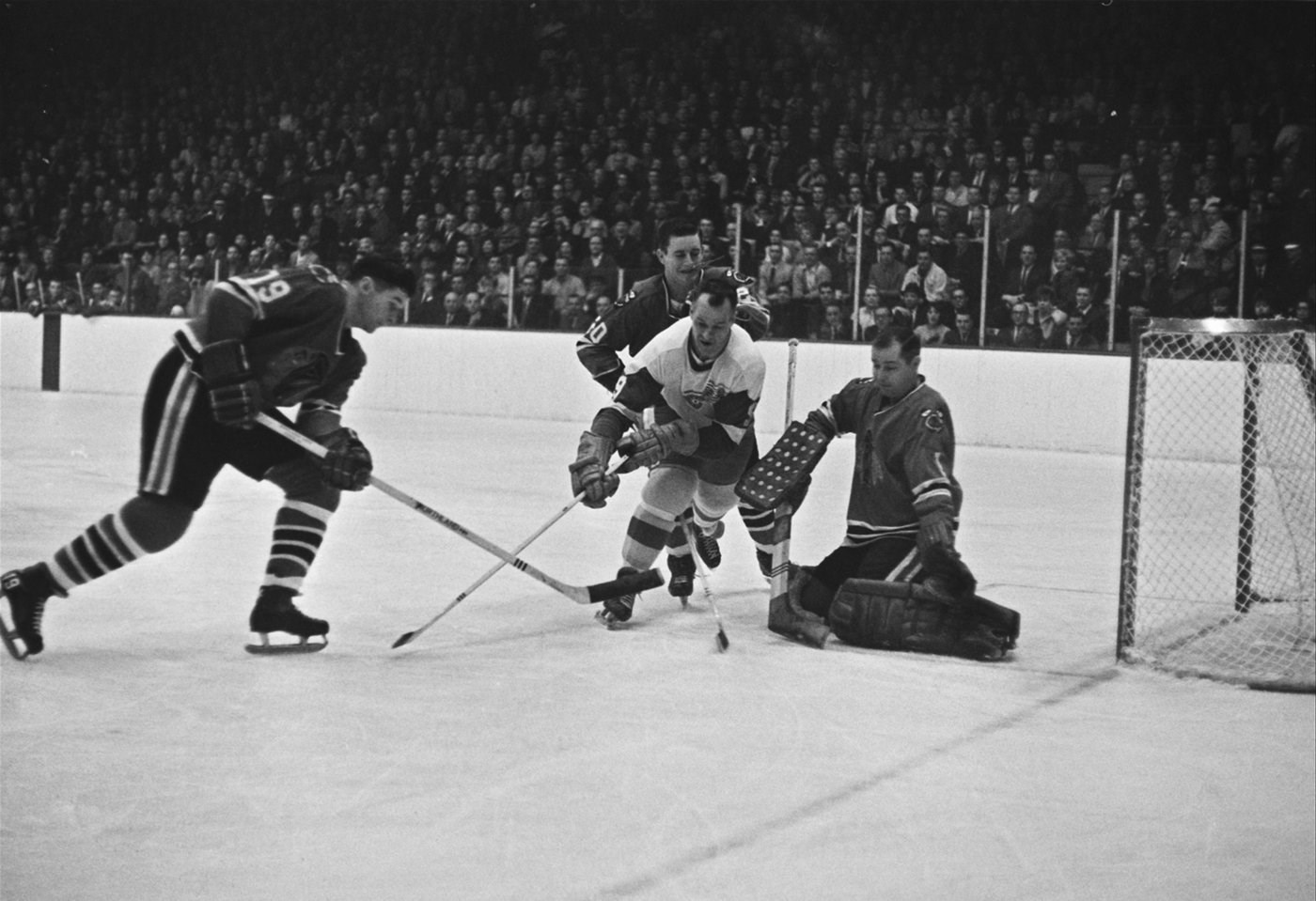
Detroit Red Wings' star Gordie Howe (9) charges in but is ganged up on the three Chicago players, Al MacNeil (19), Doug Jarrett (20), and goalie Glenn Hall, who defend against the shot in first period of their NHL game in Chicago, March 16, 1966. (AP Photo/Paul Cannon)
January 07, 2026 - 12:50 PM
Hall of Famer Glenn Hall, an iron man who changed the way goaltenders play during a stellar NHL career with Detroit, Chicago and St. Louis, has died at 94.
Nicknamed Mr. Goalie, Hall won two Stanley Cups, the Calder Memorial Trophy, three Vezina trophies and the Conn Smythe Trophy from 1952 to 1971. He was named a first-team all-star seven times and played in 13 all-star games.
Amazingly, he started and finished 502 consecutive regular-season games from the beginning of the 1955-56 season with Detroit through 12 games of the 1962-63 campaign with Chicago.
During that regular-season streak, also he played 50 straight playoff games. And he did it without a mask, only opting for facial protection late in his career.
"Glenn Hall was the very definition of what all hockey goaltenders aspire to be. Aptly nicknamed 'Mr. Goalie,' Glenn was sturdy, dependable, and a spectacular talent in net," NHL commissioner Gary Bettman said in a statement.
"He set the bar for consistency with a goaltending ironman record of 502 consecutive regular-season games played for the Detroit Red Wings and Chicago Blackhawks. That record, set from 1955-56 to 1962-63, still stands, probably always will, and is almost unfathomable – especially when you consider he did it all without a mask."
Hall is credited with innovating the butterfly style of goaltending. While goalies traditionally had played in the upright position, Hall would go to ground, splaying his pads on the ice to defend his goal.
Hall played in 906 career regular-season games in the NHL with 84 shutouts and a stingy 2.50 goals-against average. He also had six shutouts and a 2.79 goals-against average in 115 playoff outings.
That earned him induction into the Hockey Hall of Fame in 1975 and, in 2017, inclusion in the NHL's list of 100 Greatest Players.
"Glenn Hall was a legend, and I was a big fan of his. He set the standard for every goaltender who followed. His toughness and consistency defined what it meant to play. ... Rest easy, Glenn. My condolences go out to the Hall family," Hall of Fame netminder Martin Brodeur said on X.
While Hall was a rock in goal, his success came at a cost.
"My first priority was staying alive," he famously said. "The second was stopping the puck."
In a 1957 playoff game between the Red Wings and Boston, Hall was knocked out by a screened shot from the Bruins' Vic Stasiuk. Hall required 23 stitches to close a gash on his lip.
He returned to the game after urging the doctor to speed up the repair job.
There were countless other stitches. Hall also regularly threw up before games, with his Hall of Fame bio noting "One teammate even suggested his bucket should have been placed in the Hall of Fame."
"I was not good when I didn't (throw up)" Hall said in a Q-and-A at the at the St. Louis Sports Hall of Fame 2012 enshrinement dinner. "I put pressure on myself. I think pressure is the greatest thing there is for an athlete. You put pressure on yourself and you push yourself to another level.
"Playing well is not an accident. You have to prepare. And this was one of my ways of preparing."
Born in Humboldt, Sask., Hall played junior hockey for the OHA's Windsor Spitfires before signing with the Detroit Red Wings in 1951.
He was called up from the minors during the 1951-52 playoffs. While he did not see action, his name was engraved on the cup after the Red Wings defeated the Montreal Canadiens in the final. Sadly his name was misspelled "Glin Hall."
Hall made his NHL debut in December 1952 in a 2-2 tie at the Montreal Forum, wearing borrowed equipment when his own went missing in transit from Saskatoon. It was the first of six games in relief of an injured Terry Sawchuk with Hall going 4-1-1 with a shutout and 1.67 goals-against average.
With a healthy Sawchuk manning the Detroit crease, Hall didn't play in the big league again until 1955 when he had two outings.
But after the Wings won the Stanley Cup in 1955, their fourth title in six seasons, GM Jack Adams sent Sawchuk to Boston in a nine-player trade. That opened the door to the five-foot-11 180-pound Hall, who took over as Detroit's No. 1 at the beginning of the 1955-56 season.
Hall played all 70 regular-season games, posting 12 shutouts and a 2.10 goals-against average en route to winning the Calder Trophy as the league's top rookie. Hall played the full 70 games again the next season before Adams shipped him and Ted Lindsay to Chicago in July 1957 for Johnny Wilson, Forbes Kennedy, Bill Preston and Hank Bassen.
In ridding himself of Lindsay, deemed persona non grata for attempts to form a players union, Adams gave the Hawks a perennial stopper in goal.
Hall did not miss a beat or a game until November 1962 when he injured his back bending over to adjust a strap while getting dressed for a game. That subsequently forced him to leave in the first period against Boston. He had to sit out the next three games, ending the streak.
Hall spent 10 seasons in Chicago and in 1961 helped the Hawks to their first Stanley Cup championship since 1938.
After sharing the Vezina with Denis Dejordy in 1967, the 36-year-old Hall was left unprotected in the expansion draft. The St. Louis Blues grabbed him and lured him back with a salary offer of US$47,500.
The expansion team went all the way to the Stanley Cup final in their first year in the league.
While the Blues lost to to the Montreal Canadiens in four games, Hall earned the Conn Smythe Trophy as the top playoff performer after stopping 140 of the 151 shots he faced in the final.
"That's how good he was. He was the backbone of our franchise," said Scott Bowman, who coached the Blues.
Hall shared the net with fellow veteran Jacques Plante In 1968-69 with Hall finally donning a mask during games. The duo combined to win the Vezina that year, when the Blues conceded just 157 goals in 76 games.
As a Blue, Hall was involved in one of the league's iconic goals, albeit at the wrong end of the play, in 1970 when Boston defenceman Bobby Orr scored 40 seconds into overtime to complete a four-game sweep and give the Bruins their first Stanley Cup in 29 years.
After taking Derek Sanderson's pass from behind the net, Orr beat Hall just before being tripped by St. Louis defenceman Noel Picard. The image of Orr flying through the air as he celebrates the Cup-winning goal is among the most famous in NHL history and was immortalized in a statue that stands outside the TD Garden.
Hall retired several times, coming back before finally hanging up the skates for good in 1971.
He looked after his farm — located on 155 acres in Stony Plain, Alta. — but stayed connected to the game, with the Blues and the Calgary Flames as a consultant and goaltending coach.
Hall savoured the Blues' first Stanley Cup win in 2019, 52 years after he was the first player taken by the club in the 1967 expansion draft.
Hall was inducted into the Saskatchewan Hall of Fame in 1991.
Hall's wife of 55 years, Pauline, died in 2009 from cancer.
---
This report by The Canadian Press was first published Jan. 7, 2026.
News from © The Canadian Press, 2026