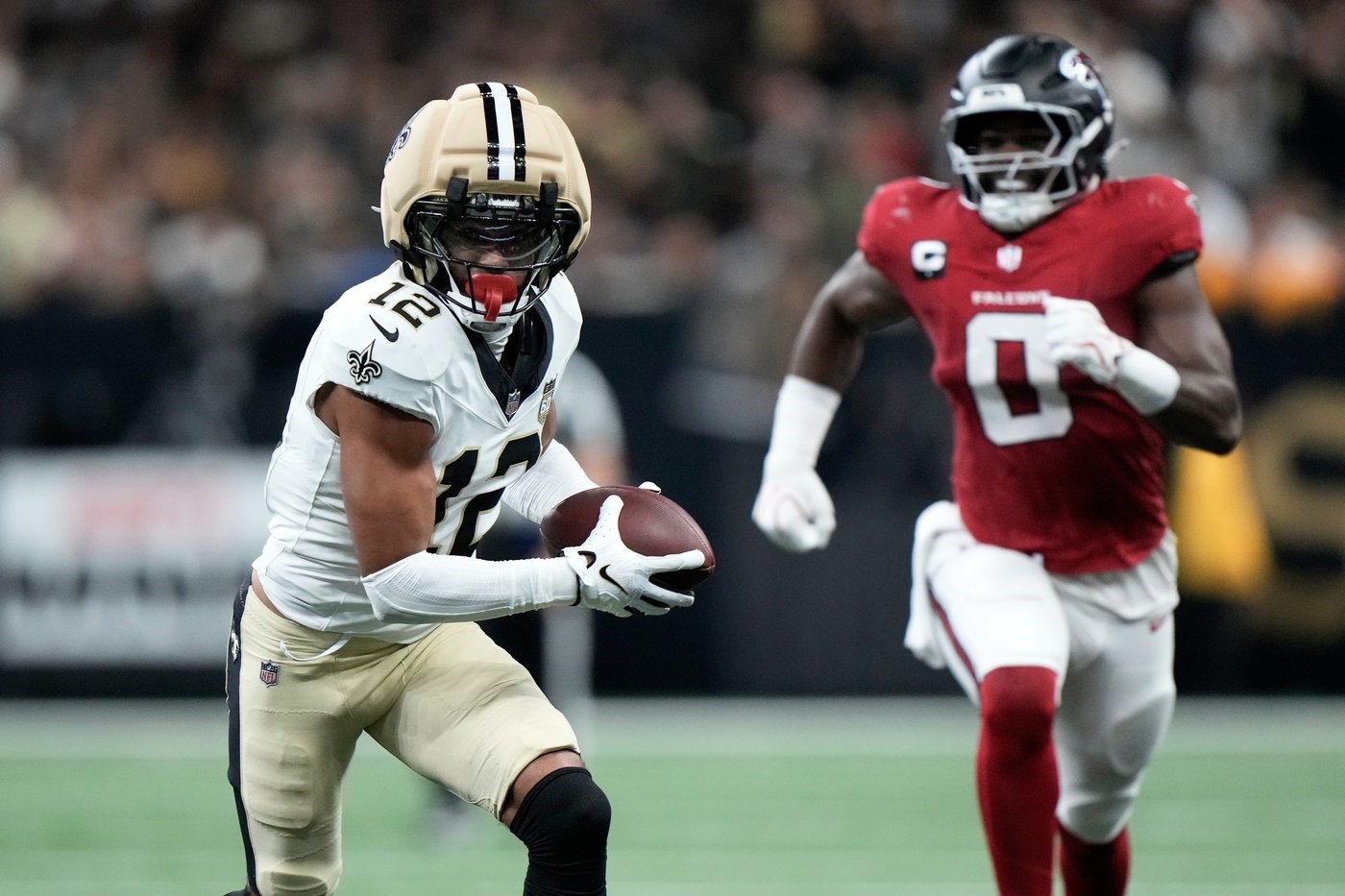
New Orleans Saints wide receiver Chris Olave (12) runs against Atlanta Falcons linebacker Divine Deablo (0) during the first half of an NFL football game in New Orleans, Monday, Oct. 5, 2026. (AP Photo/Gerald Herbert)
November 02, 2026 - 9:01 PM
TEMPE, Ariz. (AP) — Arizona Cardinals left tackle Jayden Williams is among a slowly growing number of NFL players who have tried wearing a Guardian Cap — a soft, protective helmet cover that the league believes could help mitigate head injuries — during games.
His reasoning is simple: What’s the harm?
“You go out there and bang your head on every play,” Williams said. “If I can get a little extra protection, why not have it?”
It’s a common sentiment shared by some of the roughly 20 to 25 players who have opted to add the extra protection during games during the 2026 season. The hope is that wearing equipment like the Guardian Cap can make a violent game safer.
But that’s part of the problem, according to Chris Nowinski, who is the CEO of the Concussion & CTE Foundation in Boston. He believes the NFL is overselling the benefits of the cap to give a false sense of comfort about a dangerous sport that can’t be completely sanitized.
“It works a little bit in a lab, but the benefits have been dramatically overstated,” Nowinski said. “The one thing that needs to be clear to players is that it’s never been shown to reduce concussions, the company itself refuses to market it as reducing concussions and there’s zero reason to believe it would make a significant difference in reducing CTE rates.”
The NFL’s push for the Guardian Cap comes against the backdrop of stories about former players being diagnosed with chronic traumatic encephalopathy (CTE) after death.
A degenerative brain disease that has been linked to concussions and other head trauma common in military combat and contact sports, CTE has been diagnosed in more than 100 former NFL players, casting a pall over the United States’ most popular sports league.
Some high-profile football players diagnosed with CTE after their deaths include Hall of Famers like linebacker Junior Seau and quarterback Ken Stabler, along with former Patriots tight end Aaron Hernandez.
Does the Guardian Cap work?
The NFL says that laboratory testing has shown that if one player wears a Guardian Cap, there is about a 10% to 15% reduction in forces transmitted through the helmet, and a 20% to 30% reduction if both players are wearing the cap.
Once the league had those numbers, it mandated the caps at contact practices for most players since 2022. Quarterbacks, kickers and punters are the only position groups not required to wear the caps during practices that involve contact.
Dr. Allen Sills, the NFL’s chief medical officer, disputed the league is making unfounded promises about the effectiveness of the caps. He called it “a tool in our toolbox” to combat head injuries — not a panacea.
“We actually did not introduce the Guardian Cap to reduce concussions, that was not our intention, which shocks a lot of people,” Sills said. “We simply said, you know what, if this can reduce force by even 10-15%, that could be useful for players who are suffering from repetitive head impacts.”
After more data became available, the NFL was more bullish about the cap’s ability to reduce concussions. In research published in August 2025 in the American Journal of Sports Medicine, required use of the Guardian Cap (the NXT model) was found to be associated with a 54% to 62% reduction in the overall incidence of NFL practice concussions even if “reduction in concussions could not be attributed solely to the energy-absorbing effects of the Guardian Cap NXT.”
“That’s pretty hard to ignore,” Sills said. “If you tell me that any injury, we can reduce it by 50%, we’re certainly going to lean into that, whether we’re talking about concussions, ACLs, Achilles or whatever it is.”
No players are mandated to wear the caps in games, but more are choosing to do so.
“Just talking with family, talk to my girlfriend, too, and it was like, ‘Why not?’ It can only help you,” said Pittsburgh Steelers rookie wide receiver Germie Bernard. “It won’t harm you, you know what I mean. That helped me make my decision. The people around me want me to be safe. They want me to play long term and when the game is over I want to be healthy mentally and so that’s what went into it and that’s how I made my decision.”
It’s not surprising most of the players wearing the cap in games are in the early stage of their careers. Many of them spent part of college or high school using such a cap and have adjusted to its look, which is much more prominent than a regular helmet. Back in 2022, star defensive lineman JJ Watt compared the helmet to a “beehive.”
Younger players have gotten over that stigma.
“I don’t really care,” Bernard said. “I’m out there playing football. I’m not out there for looks and what not. That doesn’t really matter to me.”
Some of the players wearing the Guardian Cap are fairly high profile, including Saints receiver Chris Olave and Patriots receiver Romeo Doubs.
Doubs is essentially a Guardian Cap brand ambassador and said he hopes it becomes a standard part of equipment for youth football players.
“Just early on in my career, just too many head injuries, and I was always wearing them in practice,” Doubs said. “So, it just made sense. I had multiple reasons for it. No. 1, just protecting myself on the football field. No. 2, just conditioning myself to just wear it all the time.”
Mitigating factors
The Guardian Cap isn’t just used at the NFL level. College programs and even high school and youth programs are using it as a way to protect against head injuries.
Nowinski — the CTE researcher — said it’s important to note the NFL version of the cap (the NXT model) is different from the XT model that’s marketed toward younger players. A University of Wisconsin study in 2025 said that the model “did not reduce player concussions in high school football practices.”
Guardian Sports is the company that sells the cap and their website acknowledges their products cannot eliminate the risk for concussions.
“No helmet, headgear, or chinstrap can prevent or eliminate the risk of concussions or other serious head injuries while playing sports or otherwise,” the statement says. “Researchers have not reached an agreement on how the results of impact attenuation tests relate to concussions or other injuries.”
Still, Nowinski is worried the Guardian Cap is giving parents and athletes a false sense of security that the game has been made considerably safer.
“My perception is that the NFL wants us to believe that CTE is behind us,” Nowinski said. “Nothing could be further from the truth.”
___
AP Pro Football Writer Rob Maaddi in Tampa, Florida, along with AP Sports Writers Will Graves in Pittsburgh and Kyle Hightower in Boston contributed to this report.
___
See AP’s full NFL coverage here
News from © The Associated Press, 2026