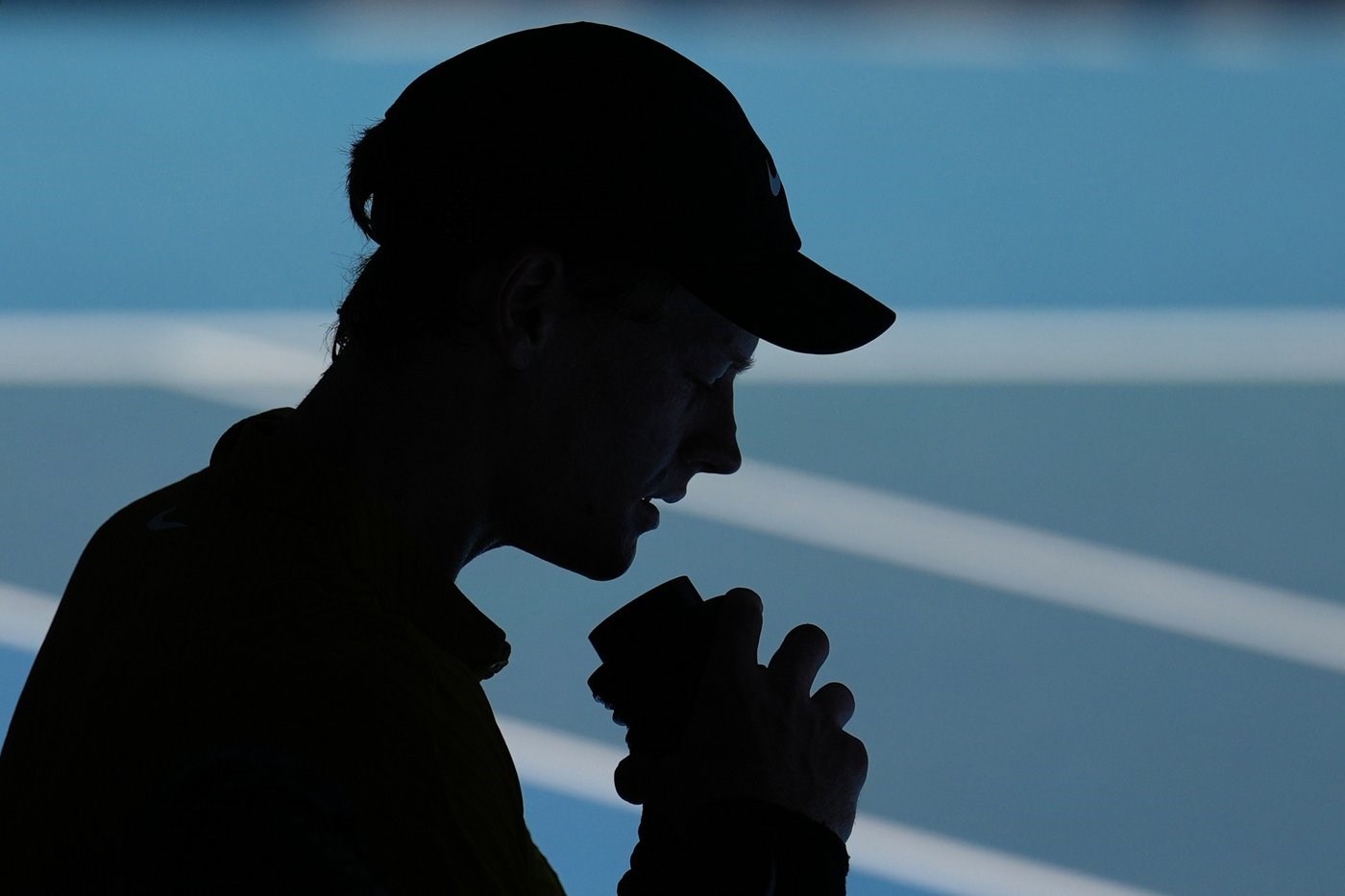
Jannik Sinner of Italy takes a drink during his third round match against Eliot Spizzirri of the U.S. at the Australian Open tennis championship in Melbourne, Australia, Saturday, Jan. 24, 2026. (AP Photo/Dita Alangkara)
January 26, 2026 - 3:38 PM
MELBOURNE, Australia (AP) — The Australian Open put its Extreme Heat Protocol into play for the second time this tournament because of searing heat on Tuesday.
The policy uses a ‘Heat Stress Scale’ ranging from 1 to 5 and taking into account the air temperature, radiant heat, humidity and wind speed.
When the index hits 5, play is suspended on outside courts and the roof is closed on the three arenas at Melbourne Park which have retractable covers.
That happened on Saturday during Jannik Sinner’s match on the center court.
The roof was open to start Day 10 but the measures were imposed again after Aryna Sabalenka beat Iva Jovic 6-3, 6-0. The roof was closed for the next match, a men’s quarterfinal between No. 3 Alexander Zverev and American Learner Tien.
“At the end of the match, it was really hot out there,” Sabalenka said. “I’m glad they kind of closed the roof kind of, like, almost halfway so we had a lot of shade in the back so we could go back and stay in the shade.
“I guess, yeah, as a woman,” she added, laughing, “we are stronger than the guys, so they had to close the roof for the guys so they don’t suffer!”
The protocol aims to ensure player safety and consistency during extreme conditions. With temperatures forecast to reach 45 degrees Celsius (113 Fahrenheit) late Tuesday, organizers were prepared.
Here’s what to know about the Australian Open’s Extreme Heat Protocol:
The Australian Open introduced the Heat Stress Scale in 2019, a measure from 1 to 5 that takes into account four climate factors: air temperature, radiant heat, humidity and wind speed.
It was developed to provide consistency for all players and minimize the risk of heat-related illness.
It sets thresholds for cooling interventions. In the event of extreme heat, the tournament referee has the authority to suspend play or order extra cooling breaks.
Play is automatically suspended when the index hits 5 in women’s and men’s singles.
The referee may suspend the calling of any upcoming matches on outdoor courts. And if matches on the outdoor courts have been suspended, the referee may make the decision to close the roof — or to keep the roof closed — for any upcoming matches on the arena courts.
The referee will make the decision as to when to call for the resumption of play, and each player must be given at least a half-hour of notice prior to the resumption of play.
When the index reaches 4, organizers can impose an extra 10-minute break between the second and third sets in women’s singles matches and between the third and fourth sets in men’s singles.
In an arena stadium, if the roof is closed before the end of the first set in a women’s singles match or before the end of the second set in a men’s singles match, there will be no extra cooling breaks.
Sabalenka said she knew going into the match that some precautions would be taken when the scale hit 4 and then the full policy implemented when it hit 5.
“I knew . . . that they won’t let us play on crazy heat. If it would reach the 5, they would definitely close the roof, so I knew that they were protecting us, our health,” she said. “Yeah, anyway, when we’re finished .. it was 4.4, so it was quite hot.”
___
More AP tennis: https://apnews.com/hub/tennis
News from © The Associated Press, 2026