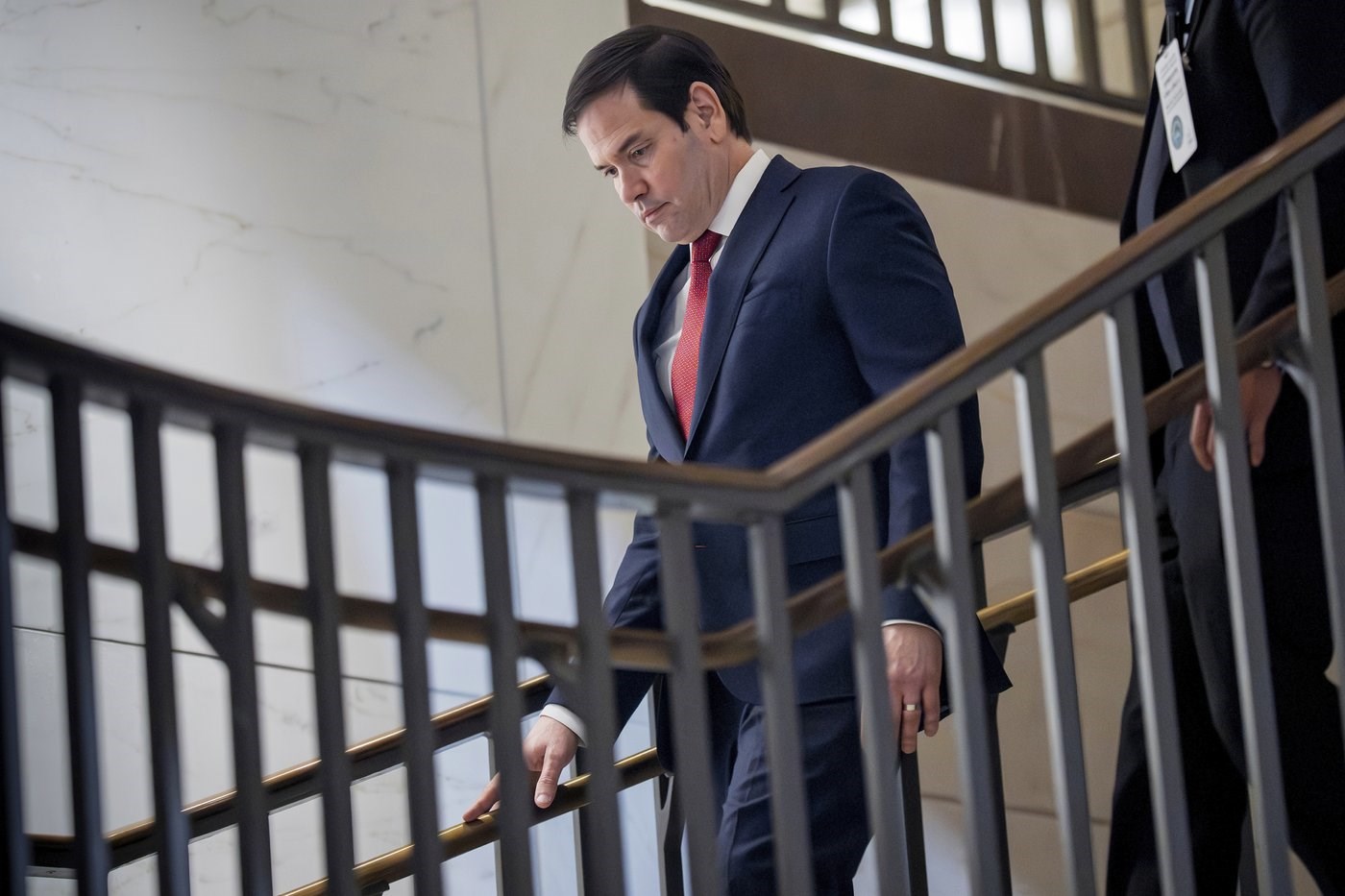
Secretary of State Marco Rubio arrives at the U.S. Capitol on Monday, Jan. 5, 2026, for a closed-door briefing with top lawmakers. (AP Photo/J. Scott Applewhite)
January 07, 2026 - 8:18 AM
OTTAWA — Canada's former ambassador to Venezuela says Ottawa is "parroting" Washington's anti-democratic line by giving air to the idea of fresh elections in the South American nation.
"It's intellectually insulting to take at face value what an anti-democratic actor is saying about democracy," said Ben Rowswell, who served as Canada's envoy to Caracas from 2014 to 2017.
He said Canada should instead be working toward helping Venezuelans put into office the leaders they chose in the stolen 2024 election.
Rowswell was reacting to a statement issued Tuesday by Foreign Affairs Minister Anita Anand. In it, Anand said U.S. Secretary of State Marco Rubio believes Venezuelans should have a chance to elect their own leader "in the future" following the capture of President Nicolas Maduro by U.S. forces.
Anand said Rubio spoke with his G7 counterparts Tuesday about "the importance of freeing political prisoners, putting in place conditions for a functioning democracy, and planning for elections with a legitimate president chosen by the Venezuelan people in the future."
The State Department's Wednesday summary of Rubio's Tuesday call was much less detailed. It said he discussed "the need to ensure a proper, judicious transition of power in Venezuela," with no mention of democracy or elections.
The views Anand attributed to Rubio differ from those expressed by U.S. President Donald Trump, who has said the U.S. captured Maduro for economic gain and to stop drug trafficking.
Rowswell, now a consultant with the group Catalyze4, said it's not helpful for Anand to echo Rubio when he raises the idea of fresh elections.
"It's a report from a discussion with a government that has declared its opposition to democracy in Venezuela, which is the United States," he said.
"To reproduce what Secretary Rubio said about democracy begs the question of whether Canada is also adapting an anti-democratic position as well, by just parroting what an anti-democratic actor is saying."
Venezuela's opposition produced printouts from polling stations proving that their presidential candidate Edmundo Gonzalez, backed by opposition leader Maria Corina Machado, won the 2024 election.
Canada and other countries backed this view and deemed Maduro to be an illegitimate leader — a stance that echoed western reaction to a 2018 election in Venezuela that was also widely seen as stolen.
Rowswell noted that Trump has so far sidelined the Venezuelan opposition and has focused instead on working with Maduro's cabinet to boost oil exports. He noted that Maduro's regime was responsible for egregious human rights abuses.
"I do think that Marco Rubio himself has some aspirations to a greater, democratic outcome. But his government has just decided to oppose a democratic transition in Venezuela," he said.
"For Canada to parrot (those) words suggests either Canada is thinking about adopting an anti-democratic position relative to Venezuela, or that it has not yet internalized the reality that the United States is an anti-democratic actor."
Rubio said Wednesday the U.S. has a three-phase plan for Venezuela: stabilization, recovery and transition. He has talked of ensuring American and other companies have fair access to Venezuelan markets and creating a process of reconciliation so opposition politicians and groups can safely return.
Rubio also said the U.S. has leverage over what Venezuela's interim authorities can do, pointing to Trump's claims about the U.S. seizing Venezuelan oil.
"In the end it will be up to the Venezuelan people to transform their country," he told reporters.
Rowswell said Prime Minister Mark Carney and Anand should more clearly outline how Canada intends to promote democracy in Venezuela and how that would advance Canada's interests by curbing migration and cutting down on corruption.
"They're missing significant opportunities to advance Canada's interests," he said. "It's important that the government speak clearly in order to advance Canada's interests and they haven't yet done that."
The federal government has urged "all parties" to respect international law in public statements that have avoided suggesting the U.S. has violated global rules — unlike statements issued by France, Spain, Brazil and Mexico.
Anand has said Ottawa's focus is on supporting the democratic will of Venezuelans and on regional stability. She hasn't explained how Canada might contribute, or how it expects things to proceed.
Rowswell said Canada must be particularly cautious about echoing the U.S. following the release last month of the new U.S. national security strategy. In it, Washington says it will "restore American preeminence in the Western Hemisphere" through a "potent restoration of American power and priorities."
"The United States is a hostile force to democracy in our hemisphere," Rowswell said. "They're intrinsically hostile to the principle of sovereignty."
He said Canada should build on the work it did for years to support Venezuela's democratic opposition through a multi-country coalition called the Lima Group, which ceased operations roughly five years ago.
Rowswell said stability in Venezuela is likely to come through a "pacted transition" — a process that has taken place in other Latin American countries which sees an authoritarian regime and moderate opposition figures negotiate terms for sharing power or transitioning to democracy.
The process often includes gradual reforms and arrangements like exile abroad for former regime officials to prevent a cycle of retribution.
In Venezuela, a pacted transition could see acting President Delcy Rodriguez sit down with foes Gonzalez and Machado to hash out "inherently awkward decisions" on the country's future, Rowswell said.
"The opinions of the United States or of Canada about each actor don't matter so much as what would Delcy Rodriguez actually agree to," he said.
Rowswell added that any efforts to restore democracy in Venezuela would need the support of South American leaders on both sides of the left-right divide that often polarizes the continent's politics. That would mean having left-leaning governments in Brazil and Colombia join with right-leaning countries such as Chile and Ecuador.
Rowswell added that Carney sent a good signal by speaking with Machado on Sunday — his first publicized discussion with anyone related to the situation in Venezuela.
He said that "signals who Canada thinks is the most important actor. It's not the repressive regime, and it's not foreign military power that has just violated Venezuelan sovereignty. It's the person who best encapsulates the will of the people of Venezuela."
This report by The Canadian Press was first published Jan. 7, 2026.
— With files from Kelly Geraldine Malone in Washington
News from © The Canadian Press, 2026