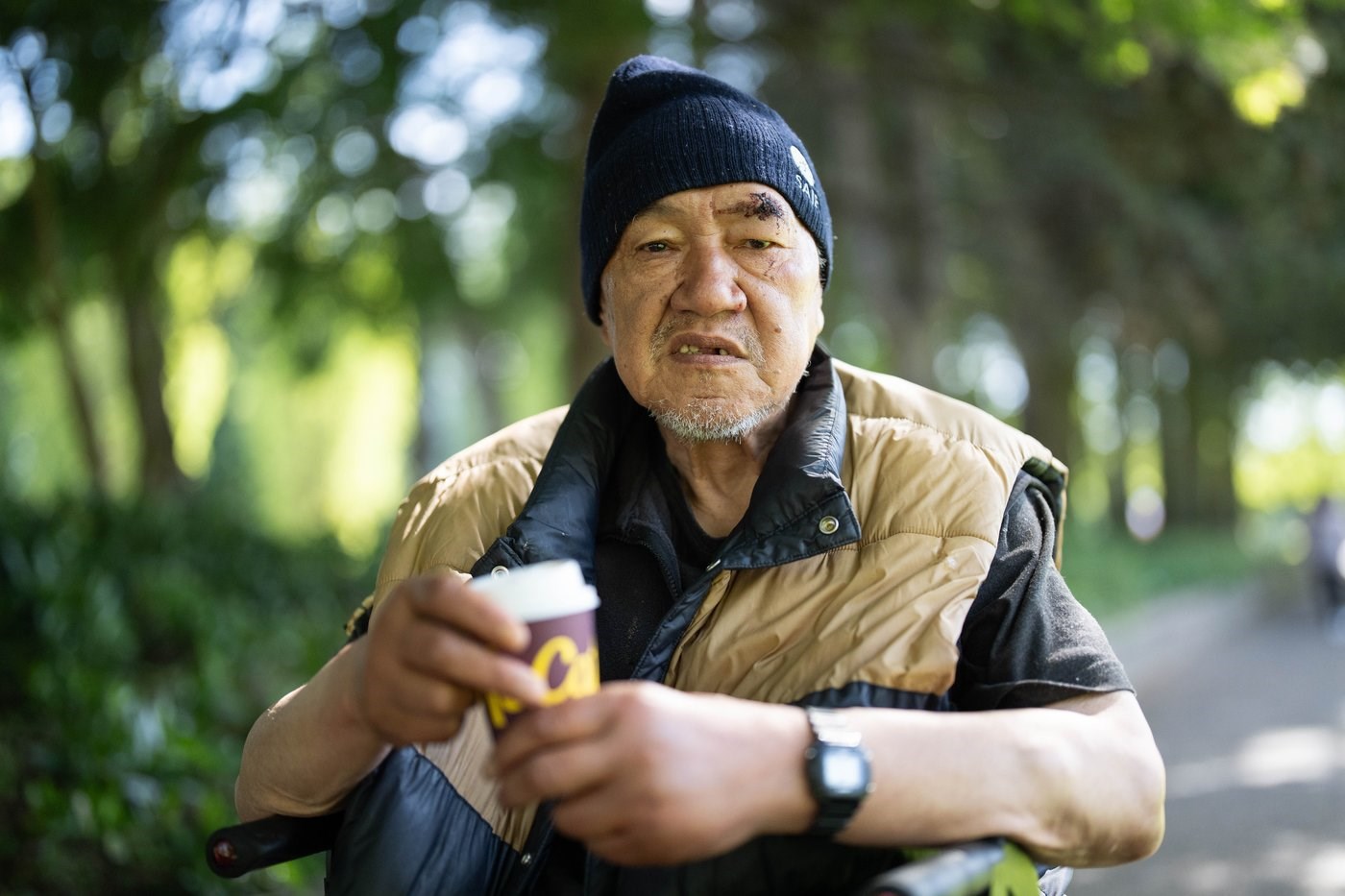
Tom Tang, 76, an unhoused senior, poses for a picture in Richmond, B.C., on Monday, June 1, 2026. THE CANADIAN PRESS/Ethan Cairns
Republished June 08, 2026 - 4:52 PM
Original Publication Date June 08, 2026 - 1:01 AM
RICHMOND — Tom Tang, went from being an art teacher and street portraitist in China, to living in a park in Richmond, B.C.
He didn't quite understand how he ended up there.
"Time all blurs together when you spend a long time wandering on the streets. I don't know what date it is," said Tang in his native Shanghainese on a recent Sunday afternoon.
His path took him from teaching at a school in Shanghai, to Canada in the wake of the 1989 Tiananmen Square killings. Marriage, a son and an apartment followed.
When The Canadian Press met him, he was living in a tent in Brighouse Neighbourhood Park, befriending drug dealers and addicts around him.
He said he shared his cigarettes with them, and checked them in their sleep to make sure they were breathing.
A man in a red jacket wearing a gold necklace walked by, and Tang greeted him with a wave. "Hey Tom," the man responded.
Tang identified him as one of the dealers who roam the park, with whom he has "great relations."
"Sometimes the drug dealers ask me if I want to try. I say No because I don't have any money," laughed Tang. "When people are using (drugs) next to me, I would say, 'Sorry, I didn't see anything' and move away."
Tang's tone was light, but outreach worker Hugh Freiberg with Richmond's Refuge Church knows Tang and said there was a survival mechanism at play. "He tries to get along with everybody so that nobody will rob him or steal his stuff."
Freiberg said he had compassion for all homeless people, but seniors like Tang — with no substance use or mental health issues — stood out.
"These are people who worked all their lives,“ said Freiberg. "They did nothing wrong, and they ended up on the street, and they're getting minimal support from the provincial government."
Tang long dreamt of a permanent place to live, where he could rest easily. The first thing he would do "is sleep for three days and three nights straight," he said, laughing.
Now, after a year and a half on the streets, Tang finally has more than a flimsy tent in the park to call home.
He moved into a long-term care home last week, a social worker said.
'I AM NOT WELCOMED BY ANYONE'
A couple of weekends ago, Tang, who has diabetes, was sitting on his walker in the shade, sipping coffee from McDonald's across from the park.
After almost 40 years in Canada, his belongings occupied two small plastic bags.
"I couldn't believe I've been able to survive so many days being homeless. It's been so long I can barely remember what it feels like sleeping on a mattress," said Tang, who's missing numerous teeth and has a wounded brow.
B.C. seniors advocate Dan Levitt said seniors like Tang, unfamiliar with English or Canadian systems, faced "double jeopardy or triple jeopardy."
"My heart goes out to Tom and others struggling to access the care and support they need," said Levitt.
Levitt said Tang's case highlighted an urgent need to expand long-term care, and seniors' affordable housing options.
Levitt's office reported last July that between 2016 and 2025, B.C.'s long-term care wait-list tripled, from 2,381 to 7,212.
Freiberg said Richmond's main shelter houses 60 people, a third of them seniors, and three-quarters refugees or immigrants. They can only stay 30 days. Then they're back on the streets.
"We try to keep these people alive and try to minimize their suffering, but the longer that they're out there, the more stress is caused to their mental and psychological health," said Freiberg.
He first met Tang outside a convenience store.
"He would come to the 7-Eleven, I would meet up with him and give him a meal every day, and whatever supplies he needed. He was sleeping on a chair in the lobby, and they let him stay there for a while, but eventually asked him to move on," said Freiberg.
Tang used to teach in Shanghai's post-secondary public school system. But he dreamt of life abroad, and a long-held desire to immigrate to Canada became reality in 1989 after the Tiananmen Square massacre.
"But the immigration journey has been rough," said Tang.
He married and had a son and began working as a portraitist in Vancouver's Stanley Park and Queen Elizabeth Park, charging $20. Occasionally he travelled to Calgary and Toronto to "try his luck."
"Being a portrait artist doesn't require much English skill," chuckles Tang. "I remembered that I once set up my art stand outside of Eaton Centre (in Toronto), and the income was decent. I had great eyesight, and I could still drive many years ago."
But things went downhill after his 2008 divorce. Tang's ex-wife sold their two-bedroom Richmond apartment and returned to China.
He lived with his son on Richmond's Granville Avenue, but when his son moved to the United States, Tang had nowhere to go.
"I am not welcomed by anyone,” says Tang, whose monthly pension is a little more than $1,000.
He tried couch surfing, but eventually his friends' doors closed. "When you are rich, everyone wants to be your friend, but when you are poor and walking around with a bag of clothes, people all run away," says Tang.
Tang said he had had no success securing a long-term care bed, being told the wait was more than two years.
An elderly man with a scarred nose interrupted, looking for his friend "Amber."
He asked if we wanted to share a bowl of marijuana, but Tang turned him down with a smile and he shook our hands before moving on.
Tang gave a tour of his small black tent, next to a Progressive Housing Society facility at the park. It was quite new, a handout from the city, after his last tent was stolen.
"Life is all about experience. Being homeless is also part of the experience," he said.
Tang said his son lived in New York, pursuing an arts career. Tang was happy to talk but begged this reporter not to contact his son about his "miserable situation."
"I only want to call him after I get a place to live," said Tang.
But that reunion may now be a step closer.
A social worker who has helped Tang said on Monday that he had finally moved into a Richmond long-term care home, although the home would not confirm his admission, citing privacy.
Outreach worker Stephanie Scramstad with Refuge Church said media attention had helped get Tang off the streets.
He moved in on June 4 — the anniversary of the Tiananmen Square crackdown that brought him to Canada in the first place.
At last, he can sleep easier.
This report by The Canadian Press was first published June 8, 2026.
News from © The Canadian Press, 2026