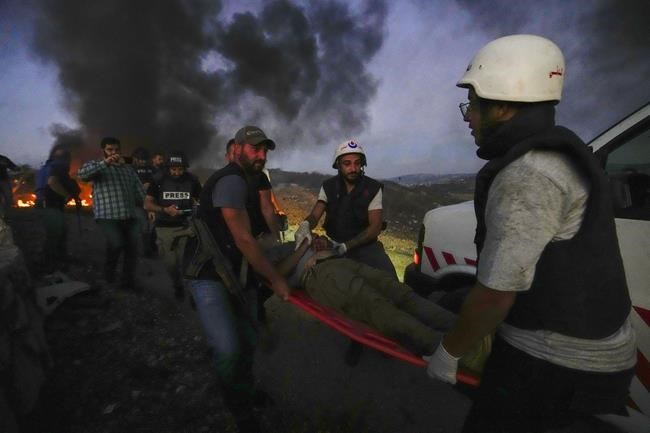
FILE - Civil Defence workers carry Qatar's Al-Jazeera TV cameraman Elie Brakhya who was injured by Israeli shelling, at Alma al-Shaab border village with Israel, south Lebanon, Friday, Oct. 13, 2023. Two Israeli strikes that killed a Reuters videographer and wounded six other journalists in south Lebanon nearly two months ago were an apparent deliberate and direct attack on civilians "that must be investigated as a war crime," two international human rights groups said Thursday. (AP Photo/Hassan Ammar, File)
December 07, 2023 - 5:29 AM
BEIRUT (AP) — Two Israeli strikes that killed a Reuters videographer and wounded six other journalists in south Lebanon nearly two months ago were apparently deliberate and a direct attack on civilians, two international human rights groups said Thursday.
Amnesty International and Human Rights Watch said that the strikes should be investigated as a war crime. Their findings were released simultaneously with similar investigations by Reuters and Agence France-Presse.
Israeli officials have said that they don't deliberately target journalists.
The investigations by the rights groups found that two strikes 37 seconds apart targeted the group of journalists near the village of Alma al-Shaab on Oct. 13.
The strikes killed Issam Abdallah and wounded Reuters journalists Thaer Al-Sudani and Maher Nazeh, Qatar’s Al-Jazeera television cameraman Elie Brakhya and reporter Carmen Joukhadar, and AFP’s photographer Christina Assi, and video journalist Dylan Collins.
The seven journalists, all wearing flak jackets and helmets, were among many who deployed in southern Lebanon to cover the daily exchange of fire between members of Lebanon’s militant Hezbollah group and Israeli troops. The violence began a day after the Oct. 7 attack by Hamas on southern Israel that triggered the latest Israel-Hamas war.
Amnesty International said that it had verified more than 100 videos and photographs, analyzed weapons fragments from the site, and interviewed nine witnesses. It found that the group “was visibly identifiable as journalists and that the Israeli military knew or should have known that they were civilians yet attacked them.”
London-based Amnesty said that it determined that the first strike, which killed Abdallah and severely wounded Assi, “was a 120mm tank round fired from the hills between al-Nawaqir and Jordeikh in Israel," while the second strike appeared to be a different weapon, likely a small guided missile, causing a vehicle used by the Al Jazeera crew to go up in flames.
Amnesty said that the tank round, most likely an M339 projectile, was manufactured by the Israeli IMI Systems and had been identified in other Amnesty International investigations of attacks by the Israeli military.
HRW said that it had interviewed seven witnesses, including three of the wounded journalists and a representative of the U.N. peacekeeping force in south Lebanon. The New York-based rights group also said it analyzed 49 videos and dozens of photos, in addition to satellite images, and consulted military, video, and audio experts. HRW said it sent letters with findings and questions to the Lebanese and Israeli armed forces, respectively, but didn't receive a response from them.
Ramzi Kaiss, a Lebanon researcher at Human Rights Watch, said that the group has documented other cases involving Israeli forces.
“Those responsible need to be held to account, and it needs to be made clear that journalists and other civilians are not lawful targets," he said.
Aya Majzoub, Amnesty International’s deputy regional director, condemned the "attack on a group of international journalists who were carrying out their work by reporting on hostilities.”
“Direct attacks on civilians and indiscriminate attacks are absolutely prohibited by international humanitarian law and can amount to war crimes,” she said.
Collins, the American AFP video journalist from Boston, said that the journalists had been at the scene for more than an hour before the strikes and felt “secure.”
He said they were “on an exposed hill, visible to multiple Israeli positions, and they had drones in the air the entire time,” adding that there were "no military activities near us.”
“Our job is to tell the story, not to become the story,” Collins said.
Abdallah’s mother, Fatima, told The Associated Press that the family was sure from the first day that Israel was behind the attack. Now that there is evidence, she said, she hopes “they (Israel) will be held accountable.”
“This move is not only for Issam but for journalists to be protected in the future,” Abdallah said.
News from © The Associated Press, 2023