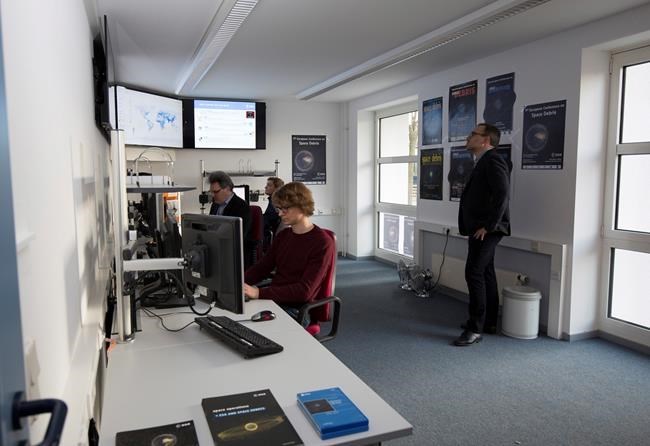
In this undated photo provided by the European Space Agency, ESA, analysts at work in the space debris facility located at ESA's ESOC mission control centre, Darmstadt, Germany. Decades' worth of man-made junk is cluttering up Earth's orbit, posing a threat to spaceflight and the satellites we rely on for weather reports, air travel and global communications. More than 750,000 fragments larger than a centimeter are already thought to orbit Earth, and each one could badly damage or even destroy a satellite. (Roberto Palmari/ESA via AP)
April 21, 2017 - 3:19 AM
BERLIN - Decades' worth of man-made junk is cluttering up Earth's orbit, posing a threat to spaceflight and the satellites we rely on for weather reports, air travel and global communications.
More than 750,000 fragments larger than a centimetre are already thought to orbit Earth, and each one could badly damage or even destroy a satellite.
Experts meeting in Germany this week say the problem could get worse as private companies send a flurry of new satellites into space over the coming years, unless steps are taken to reduce space debris.
Luisa Innocenti of the European Space Agency said Friday a first mission to capture space junk is being planned, but noted that it is highly complex because failure could worsen the problem by creating more debris.
___
ESA video explaining problem: https://www.youtube.com/watch?v=zT7typHkpVg
News from © The Associated Press, 2017