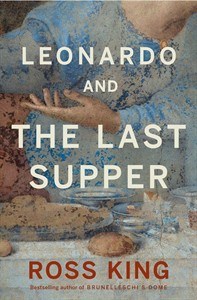
The book cover for Ross King's book "Leonardo and the Last Supper," which is shortlisted for a Governor General's Literary Award, is shown in a handout photo. THE CANADIAN PRESS/HO
October 16, 2012 - 12:38 PM
TORONTO - With his new book, "Leonardo and the Last Supper," Saskatchewan-born author and art historian Ross King says he "wanted to part the curtains of myth" surrounding the painter and his influential mural.
One of those myths is that the same model served as both Christ and Judas for Leonardo da Vinci's late 15th century work, which is in the refectory of the Santa Maria della Grazie convent in Milan.
"That story is patently false, it was an invention of the late 19th century," King, whose book is shortlisted for a Governor General's Literary Award, said in a recent phone interview.
"I wanted to look at the story that Leonardo didn't show Christ's face in focus, or he didn't finish painting the face because he didn't believe that he had the capability to capture the divine. That story is also not true."
Ross also writes that the beardless, long-haired figure to Christ's right is the apostle John, not Mary Magdalene, as is often purported.
"It's just such an appealing story. People want it to be true, because in some ways it's a nice story," said Ross, noting he gets asked about the Mary Magdalene speculation "all the time" when he gives lectures on the painting.
"Mary Magdalene does appear in other versions of the Last Supper by people like Fra Angelico, and so it wouldn't necessarily be heretical or anything like that had Leonardo included her there. But sadly, that's not her, that is St. John.
"And the position of the hands, the way he is leaning over to listen to what Peter is asking, all of that is coming straight out of the Bible and straight out of the way everyone else portrayed St. John as well."
King also aimed to uncover stories that were true and equally interesting, such as who served as the models for the apostles in the painting.
One of his theories is that da Vinci created his self-portrait once or possibly even twice in the work.
"Self-portraiture in fresos was a very venerable, tried and trusted method," explained Ross, who grew up in North Portal, Sask., and now lives in Woodstock, England.
"Many painters looking for a model would look in a mirror to find one."
"Leonardo and the Last Supper" (Bond Street Books) also runs down the life and times of the Renaissance man, focusing on his early 40s when the Tuscan moved to Milan to reinvent himself.
Feeling he was in his twilight years (life expectancy for a man in Italy back then was 40) and that he might not ever achieve a masterpiece in the art world, da Vinci wanted to pursue his love of mechanics and engineering.
"He wanted to create a masterpiece, he just didn't want it to be in painting," said Ross, noting da Vinci had many skills and "didn't think of himself first and foremost as a painter."
"In fact, one of his friends observing him said that whenever Leonardo should have been painting he was working on geometry, architecture and anatomy, and it was in fields like that — and I think especially architecture, and maybe also military engineering — that he wanted to make his mark on the world."
He also became a court jester of sorts, entertaining audiences with magic tricks and jokes, and created sets in the theatre.
But that changed when, after a commission to build a bronze horse sculpture for the ruler of Milan didn't pan out, da Vinci was asked to create what became "The Last Supper."
Ross's book details the process behind the creation of the mural, from the sketching, to the building of scaffolding, to the plastering and the type of paint and tools he used.
It also speculates on why da Vinci positioned the figures the way he did, why he made them gesture the way they do, and how his vegetarian diet influenced the food featured in the painting.
Ross won a 2006 Governor General's Award for the French Impressionism book "The Judgment of Paris" and was shortlisted for last year's Charles Taylor Prize for Literary Non-Fiction for "Defiant Spirits: The Modernist Revolution of the Group of Seven."
He wrote about da Vinci because he's been interested in him since childhood, when he wanted to be an artist and realized the famed painter was left-handed, like he is.
Ross also had something else in common with da Vinci: writing backwards.
Some have speculated da Vinci wrote backwards as a form of code, but Ross doesn't believe that's the case.
"All this backwards handwriting wasn't to keep his ideas secret, it was simply because that's what came naturally to him."
Ross did much of his research in England and consulted with Martin Kemp, one of the world's top da Vinci experts who is also his neighbour.
He also read da Vinci's personal notes, including lists showing his day-to-day domestic life.
"We tend to think of him as an almost super-human genius who floated above the mundane, everyday life," said Ross.
"But what you dive into when you look at his writings is his everyday life where he's writing out his lists of what he needs to buy and so forth.... It kind of makes you see the genius in a light that we can appreciate."
The winners of the Governor General's Literary Awards will be announced Nov. 13 in Montreal.
News from © The Canadian Press, 2012