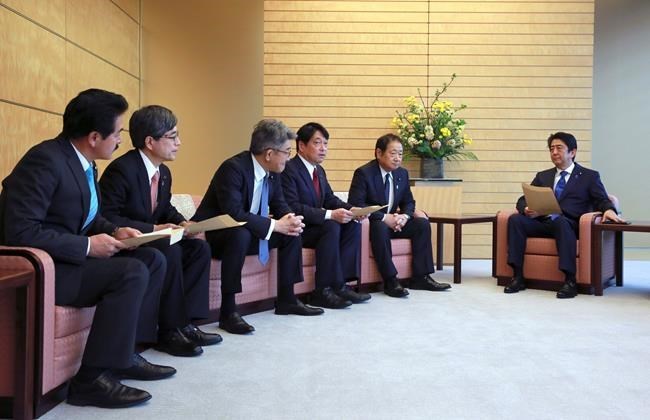
Japanese Prime Minister Shinzo Abe, right, speaks to Hiroshi Imazu, second right, Chairman of Research Commission on Security of Japan's ruling Liberal Democratic Party (LDP), and other LDP representatives after a proposal on missile defense was submitted to Abe at the prime minister's office in Tokyo, Thursday, March 30, 2017. Japan's ruling party has urged the government to consider arming itself with more advanced and offensive capability, such as striking enemy targets with cruise missiles, loosening Japan's self-defense-only military posture since the end of World War II. (AP Photo/Eugene Hoshiko, Pool)
Republished March 30, 2017 - 5:28 AM
Original Publication Date March 29, 2017 - 10:55 PM
TOKYO - Japan's ruling party urged the government Thursday to consider arming the country with more advanced and offensive military capabilities, such as striking enemy targets with cruise missiles, further loosening the self-defence-only posture Japan has maintained since the end of World War II.
The Liberal Democratic Party's council on defence policy urged the government to immediately start studying ways to bolster Japan's capability to intercept missiles with a system such as the Terminal High-Altitude Area Defence, or THAAD, that the U.S. and Seoul have agreed to install in South Korea.
The panel cited a "new level of threat" from North Korea, which fired four missiles this month, three of them landing inside Japan-claimed exclusive economic waters.
"North Korea's provocative acts have reached a level that Japan absolutely cannot overlook," the party's security panel said in the proposal given to Prime Minister Shinzo Abe. "We should not waste any time to strengthen our ballistic missile defence."
The panel noted that North Korea's recent missile launches have shown advancing technology, including the capability to launch from mobile facilities or submarines, the use of solid fuel, and high-altitude trajectories, which make them harder to trace and respond.
With higher levels of threat coming from North Korea, Japan should consider possessing "our own capability of striking back at an enemy base, with cruise missiles for instance, to further improve deterrence and response as part of the Japan-U.S. alliance," the proposal said.
The panel said the government should consider introducing THAAD and a shore-based Aegis missile defence system, among other equipment, while pursuing upgrades to two existing missile defence systems — ship-to-air SM-3 interceptors and the ground-based PAC-3.
China, which was occupied by Japanese troops during World War II, quickly criticized the proposal. Beijing views any Japanese plan to boost its military capabilities with suspicion.
"China is opposed to any actions by other countries to take the (North Korean) nuclear issue as an excuse to compromise the security of other countries," defence ministry spokesman Wu Qian told a monthly briefing Thursday.
Beijing has strongly protested the THAAD deployment in South Korea, saying its powerful radar would allow the U.S. to monitor flights and rockets deep inside northeastern China.
Japan has maintained that its right to strike a foreign base in case of an imminent attack is not banned under its pacifist constitution.
Former defence minister Itsunori Onodera, who headed the defence policy council, told Abe that Japan needs to be prepared for being targeted by multiple missiles.
"Our proposal is about how we can fight back and stop the other party from firing a second missile, instead of making a pre-emptive strike," he said.
Abe said he takes the report seriously and will co-operate with the party to improve Japan's ballistic missile response.
The proposal does not call for a first-strike capability. Japan since its World War II defeat has limited its military to self-defence, while relying on the U.S. "nuclear umbrella" and the 50,000 American troops stationed in Japan under a bilateral security alliance as deterrence.
Abe has stretched those restrictions by easing a self-imposed ban on weapon exports and reinterpreting the war-renouncing constitution to allow Japan's military to defend allies under attack. Japan and the U.S. have also revised their defence guidelines, giving Japanese Self Defence Force a greater role.
Concerns in Japan about the level of U.S. commitment to the region under President Donald Trump have also prompted calls for Japan to take greater responsibility for its own security.
Critics say changing policies to allow Japan to fight back against a foreign base would only escalate tension and signal a weakening of the U.S. regional commitment, and that the consequences should be carefully studied.
Japan's defence budget has steadily risen over the past five years under Abe, who ended a decade of defence budget cuts. The annual increase is currently just over 2 per cent, and Abe says he is ignoring a customary cap of 1 per cent of GDP.
___
Associated Press writer Christopher Bodeen in Beijing contributed to this report.
___
Follow Mari Yamaguchi on Twitter at twitter.com/mariyamaguchi
Her work can be found at https://www.apnews.com/search/mari%20yamaguchi
News from © The Associated Press, 2017